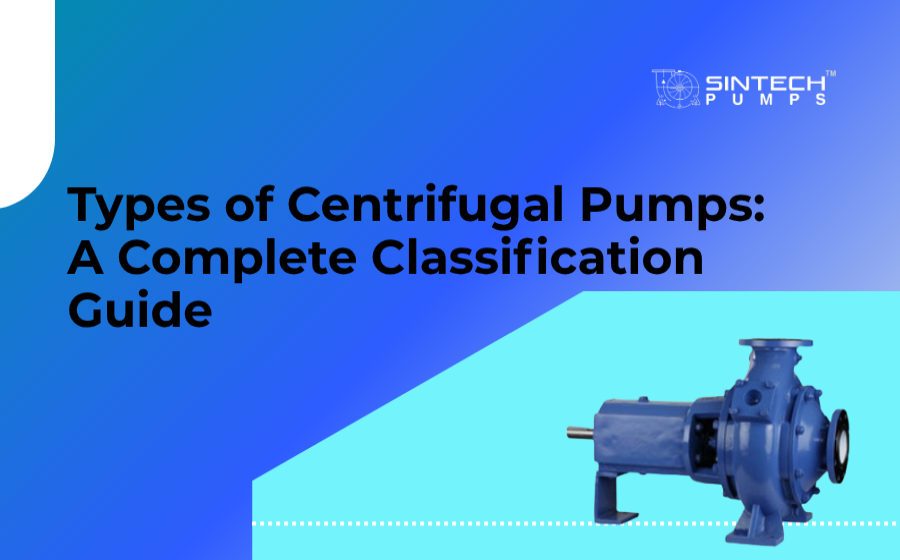
What are the main types of centrifugal pumps?
Centrifugal pumps are classified by flow direction (radial, axial, mixed), number of stages (single-stage, multistage), orientation (horizontal, vertical), impeller design (open, semi-open, closed), suction design (single-suction, double-suction), and construction (end-suction, split-case, self-priming, submersible, inline).
What is the difference between single-stage and multistage centrifugal pumps?
A single-stage pump uses one impeller and suits head requirements under roughly 100 metres. A multistage pump stacks impellers in series, with each stage adding head, making it the right choice for boiler feed water and high-pressure process lines.
Which type of centrifugal pump is used for high pressure?
Multistage centrifugal pumps are used for high-pressure duty because each additional impeller stage adds head, allowing the pump to reach pressures a single-stage machine can’t achieve at the same speed.
Horizontal vs vertical centrifugal pump, which is better?
Neither is universally better. Horizontal pumps are easier to align and service and suit most plant floor installations. Vertical pumps save floor space and, in models like Sintech’s SVT, can draw water from depths beyond 300 metres, making them the standard for deep well and sump applications.
What is a double-suction centrifugal pump used for?
A double-suction (split-case) pump is used where high flow rates and balanced shaft thrust matter, such as power plant cooling water systems and large water treatment plant intakes.
Why does impeller type matter in centrifugal pump selection?
Impeller type determines how well a pump handles solids and abrasive particles. Open and semi-open impellers tolerate some solids content, while closed impellers deliver higher efficiency but need cleaner liquid to avoid clogging.
Can a centrifugal pump handle liquids with solids or fibre?
A standard closed-impeller centrifugal pump struggles with solids-laden or fibrous liquids. Torque flow pumps, which use a recessed impeller set back from the flow path, are built specifically for this duty and are common in sugar mill juice lines and wastewater plants.
What standards govern centrifugal pump manufacturing in India?
Indian and international centrifugal pump manufacturing commonly references ISO 2858 and DIN 24255 for standard process pumps, ISO 5199 for chemical duty, and IS 9137 for acceptance testing at the manufacturer’s works.
How deep can a vertical turbine pump draw water from?
Sintech’s vertical turbine pumps (SVT) can operate at depths of up to 300 metres, making them suitable for deep tube well irrigation and canal-based water supply schemes.
Do all centrifugal pumps use the same impeller?
No. Impeller choice depends on the liquid being handled. Clean water applications typically use closed impellers for efficiency, while liquids with solids or fibre need open, semi-open, or recessed impeller designs instead.