Follow us

Follow us

Home » Blog » Multistage Pumps: Applications, Advantages & How to Select the Right Configuration

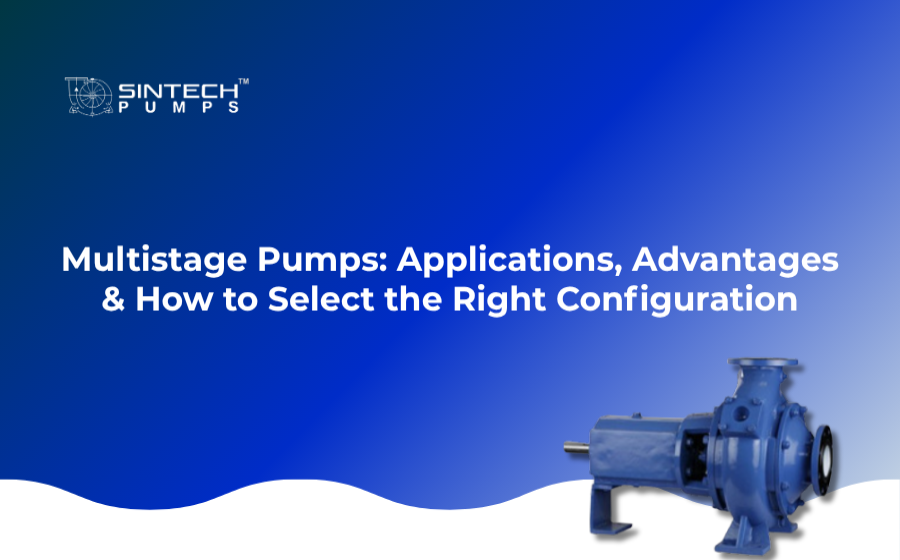
Multistage Pumps: Applications, Advantages & How to Select the Right Configuration

Posted: 26/08/2026
Category: Blog

Table of Contents

  1. What Is a Multi Stage Pump and How Does It Work?
  2. Multistage Centrifugal Pump vs Single-Stage: Why Stages Matter
  3. Where Multistage Pumps Are Used Across Indian Industry
  4. Horizontal Multistage Pump vs Vertical: Choosing the Right Orientation
  5. High Pressure Multistage Pump Applications: Boiler Feed and Beyond
  6. How to Select the Right Pump Configuration
  7. Common Selection Mistakes to Avoid
  8. Sintech’s Approach to Multistage High Pressure Pumps
  9. Frequently Asked Questions

Multi stage centrifugal pumps use two or more impellers arranged in series inside a single casing. Each stage adds to the total head the pump can generate. This design lets a single unit reach heights or pressures a single-stage pump cannot manage on its own. This guide looks at where multistage pumps earn their keep. It covers the advantages over single-stage designs, and how to pick the right configuration for boiler feed, high-rise water supply, or high-pressure process duty.

What Is a Multi Stage Pump and How Does It Work?

A multistage pump is a centrifugal pump built with several impellers mounted on a common shaft. The impellers connect in series, so the discharge of one stage becomes the suction of the next. Each impeller, or stage, adds a fixed increment of head. Two stages roughly double the head of a single stage at the same flow. Four stages roughly quadruple it. This is why a multi stage pump can reach heads of 500 metres or more. A single-stage centrifugal design would need an impractically large diameter to do the same job.

The concept is old. The basic layout has not changed much since the early twentieth century. What has advanced considerably is the engineering behind hydraulic balance, thrust management, and stage-to-stage sealing. In a multi stage centrifugal pump, axial thrust builds up because each impeller pushes back against the flow direction. Manufacturers manage this using balancing drums, balancing discs, or back-to-back impeller arrangements. Getting this wrong is one of the more common causes of premature bearing failure in the field.

Net Positive Suction Head (NPSH) is the minimum suction-side pressure margin needed to stop the fluid from vaporising inside the pump. It becomes especially critical in multi stage centrifugal pumps. The first stage carries the entire burden of avoiding cavitation for every stage downstream. If the first impeller cavitates, the pressure boost from every subsequent stage is compromised too.

Multistage Centrifugal Pump vs Single-Stage: Why Stages Matter

Choosing between a single-stage centrifugal pump and a multistage centrifugal pump comes down to one number: total dynamic head (TDH). A rough benchmark used across Indian process plants applies once TDH requirements cross 80 to 100 metres. Beyond that point, a single-stage pump needs an oversized impeller diameter. Its specific speed also drops low enough to hurt hydraulic efficiency.

A multistage pump sidesteps this problem by spreading the head requirement across several smaller, more efficient impellers. The result is usually a smaller overall casing. Efficiency at the Best Efficiency Point (BEP) also tends to be higher, with a narrower, more stable performance curve. There is a trade-off, though. More stages mean more wear rings, more inter-stage seals, and a longer rotor. All of this raises the importance of precise shaft alignment and vibration monitoring during operation.

Plants in the North India industrial belt running boiler feed duty, condensate extraction, or reverse osmosis feed at 20 to 150 bar almost always favour pumps built with additional stages. The efficiency gain and footprint reduction outweigh the added maintenance discipline that a longer rotor assembly demands.

Where Multistage Pumps Are Used Across Indian Industry

Multistage pumps show up wherever a plant needs high head at moderate to low flow, and Indian process industries lean on them constantly.

Thermal and captive power plants use multistage pumps for boiler feed water duty. Pressures here routinely exceed 100 bar, and any drop in suction pressure risks flashing the feedwater into steam inside the casing. Water treatment plants supplying high-rise buildings or hillside townships use multi stage pump configurations to overcome long vertical lifts, without stacking multiple booster stations. Reverse osmosis and desalination plants along the western coast rely on high pressure multistage pump skids. These push seawater or brackish water through membranes rated for 60 to 80 bar. Paper mills use them for high-pressure washing and stock preparation lines. Process industries handling chemical dosing or clean-in-place systems specify multistage centrifugal pump units for their stable, repeatable pressure output.

Irrigation departments running canal-fed lift schemes across the Gangetic plain also use multi stage centrifugal pumps. These come into play wherever static lift exceeds what a single-stage unit can deliver efficiently, particularly on multi-hop lift schemes common across Uttar Pradesh and parts of Madhya Pradesh.

Horizontal Multistage Pump vs Vertical: Choosing the Right Orientation

Orientation is one of the first decisions an engineer makes once head and flow requirements are locked in. A horizontal multistage pump is generally easier to inspect and maintain. Its casing can be split for access without disturbing suction and discharge piping. That matters on plants where downtime is measured in lost production, not just labour hours.

Vertical multistage configurations, by contrast, save floor space. They suit sites where headroom exists but plan area does not, a frequent constraint in retrofitted pump houses or older sugar mill boiler houses being upgraded for higher steam pressure. In Sintech’s experience, the horizontal multistage pump remains the default choice for boiler feed and process applications. Axial split or ring-section casing designs make overhaul faster, and they reduce the risk of misalignment after reassembly.

Ring-section multistage pumps take this further. Each stage sits in its own separately cast section, bolted together. A damaged stage can sometimes be replaced without discarding the entire rotor assembly. That lowers the long-term cost of ownership for a multi stage centrifugal pumps fleet running continuous duty.

High Pressure Multistage Pump Applications: Boiler Feed and Beyond

Boiler feed duty remains the most demanding application for a high pressure multistage pump. Under the Central Boiler Board’s guidelines within the Indian Boilers Act, feedwater pumps must maintain adequate margin above saturation pressure at the suction. This is why NPSH calculations for these units are rarely left to rule-of-thumb estimates.

Beyond boilers, high pressure pumps of the multistage type handle reverse osmosis feed, hydro-test skids, fire-fighting ring mains, and high-pressure cleaning systems in steel re-rolling mills. A 6-stage high pressure multistage pump generating 450 metres of head at a modest flow rate is not unusual on a 67 MW captive power unit. Getting the stage count wrong in either direction has a cost. It either strands available head, or forces the pump to run permanently off its Best Efficiency Point, wasting energy every hour it operates.

Sizing conservatively without checking actual system resistance is a common trap. A pump selected for 20 percent more head than the system curve needs will operate throttled for its entire service life. The Bureau of Energy Efficiency, India has flagged oversized pump selection as one of the leading avoidable sources of wasted electricity in Indian process plants.

How to Select the Right Pump Configuration

Selecting multi stage centrifugal pumps correctly starts with an accurate system curve, not a catalogue page. Static lift, friction losses across the full pipe run, and any pressure required at the discharge point all need to be added honestly. Include future expansion margins too, if the plant expects higher throughput within the next five years.

Stage count follows directly from the ratio between required head and the head a single stage can efficiently deliver at the chosen speed. Running a multi stage pump at 2900 rpm rather than 1450 rpm halves the stage count needed for the same head. It also raises wear rates on bearings and seals, so the decision usually balances capital cost against expected maintenance intervals.

Material selection matters as much as hydraulic sizing. A multistage centrifugal pump handling condensate with dissolved oxygen needs different metallurgy than one handling clean, deaerated boiler feedwater. Specifying the wrong wear-ring material against IS 9137 acceptance testing criteria can shorten service life considerably, even when the hydraulic design is otherwise correct.

Common Selection Mistakes to Avoid

Two mistakes turn up repeatedly during plant audits across the sugar and power belt of western Uttar Pradesh. The first is ignoring NPSH available at summer ambient temperatures, when suction tank levels and water temperature both work against the pump. A design that clears NPSH margin comfortably in winter can still cavitate on the hottest days of the year. The second is selecting high pressure pumps purely on head and flow figures. Radial and axial thrust bearing life at the actual operating point matters too, not just at BEP.

A less obvious but costly error is neglecting inter-stage clearance wear monitoring. As wear rings erode, internal recirculation increases and efficiency drops quietly. Energy bills climb without any obvious symptom, until a vibration or bearing temperature alarm eventually appears. A periodic energy audit is usually the fastest way to catch this kind of silent efficiency loss before it shows up on the next electricity bill.

Sintech's Approach to Multistage High Pressure Pumps

Sintech Pumps has manufactured multistage high pressure pumps out of Ghaziabad, Uttar Pradesh to DIN 24255 and ISO 9906 performance grades for over three decades. Clients include Bajaj, Triveni, ISGEC, and Dhampur Sugar Mills, across boiler feed and process duty units. Every unit is factory-tested under IS 9137 acceptance protocols before dispatch. The performance curve a client receives on paper matches what actually runs on site.

For plants specifying a horizontal multistage pump for a new boiler feed line, or evaluating whether an ageing multi stage centrifugal pump is due for overhaul rather than replacement, Sintech’s application engineering team reviews actual system curves and operating data. Catalogue assumptions alone do not enter the picture. That review, more often than not, is what separates a pump that runs quietly for fifteen years from one that needs bearing replacement within eighteen months.

Conclusion

Multistage pumps solve a specific problem: delivering high head reliably, without the size, weight, or efficiency penalty of an oversized single-stage unit. This is why multistage pumps remain the default choice once head requirements move beyond what a single-stage unit can handle efficiently. Getting the stage count, orientation, and materials right depends on accurate system data, not guesswork. The cost of getting it wrong shows up as energy waste or early bearing failure, rather than an outright breakdown. If your plant is evaluating a new high pressure multistage pump for boiler feed, RO feed, or a high-lift water scheme, Sintech’s engineering team can review your system curve and recommend the right configuration before you finalise the order. Reach out at info@sintechpumps.com or call +91 120 4176000 to discuss your application with an engineer, not a salesperson.

Frequently Asked Questions

1. What is the difference between a single-stage and a multistage pump? 

A single-stage pump has one impeller and is suited to low-to-moderate head applications, while a multistage pump uses several impellers in series to reach much higher heads at the same flow rate, often above 100 metres.

2. How many stages does an industrial pump typically have? 

Most industrial multi stage centrifugal pumps range from 2 to 10 stages, though boiler feed applications in large power plants sometimes use configurations with more stages to reach heads exceeding 500 metres.

3. Why does NPSH matter more in multistage pumps? 

The first stage of a multi stage pump handles all the suction-side risk. If it cavitates, every downstream stage loses performance, so suction conditions need more careful checking than on a single-stage design.

4. Can a horizontal multistage pump be converted to vertical, or vice versa? 

No, orientation is fixed by the casing and baseplate design at the time of manufacture. Changing orientation requires a different pump model, not a field modification.

5. What causes bearing failure in high pressure multistage pumps? 

The most common causes are uncorrected axial thrust from wear-ring erosion, misalignment after reassembly, and operating away from the Best Efficiency Point for extended periods.

6. How often should a multistage centrifugal pump be overhauled?

This depends on duty cycle and water quality, but continuous boiler feed service typically warrants an internal inspection every 3 to 5 years, with wear-ring clearances checked against original design tolerances.

7. Is a multistage pump more energy-efficient than using two single-stage pumps in series? 

Generally yes, because a single multistage unit avoids the extra motor, extra seals, and additional piping losses that come with two separate pumps, and it usually runs closer to its Best Efficiency Point.

8. What standards apply to pump testing in India? 

IS 9137 governs acceptance testing procedures for centrifugal pumps in India, while ISO 9906 and DIN 24255 define hydraulic performance and dimensional standards that many Indian manufacturers, including Sintech, design against.

Hey, like this? Why not share it with a buddy?

Leave a Reply

Top
Thanks!

Want us to call you back?

*Please share your details so that our representative can reach out to you. Please schedule a call between 9:30 AM to 5:30 PM (IST) Mon-Sat.

    SCS Pump Your phone number will not be used for marketing purposes.