
Table of Contents
- Why Standard Sewage Pumps Fail on High-Solids Sludge
- How Sludge Is Classified by Solids Concentration
- Pump Types Available for Sludge Duty
- Where Torque Flow Pumps Outperform Centrifugal Designs
- Five Parameters for Correct Pump Specification
- Sewage Pumping Station Design Considerations
- Sludge Dewatering Pump Applications
- Frequently Asked Questions
Selecting the right sewage pump for thickened sludge requires matching pump design to actual solids concentration and viscosity, not just pipe diameter or motor size. A standard sewage pump will choke or fail within weeks on high-density sludge. This guide covers sludge classification, available pump technologies, and five specification parameters every engineer must verify before ordering.
Why Standard Sewage Pumps Fail on High-Solids Sludge
A conventional sewage pump is designed for raw municipal wastewater, screened and de-gritted, with solids typically below 2 to 3% by weight. The impeller geometry and clearances work well for that fluid. When the same sewage pump is applied to thickened sludge at 8 to 15% solids, three failure modes appear quickly.
First, the impeller eye gets bridged by fibrous material. Second, the narrow vane passages restrict flow until the pump cavitates. Third, abrasive grit accelerates wear on the impeller and casing to a fraction of the expected service life.
Plants across Ghaziabad, UP, and across industrial corridors in Maharashtra and Gujarat have learned this the hard way: specifying pump size in kilowatts without accounting for sludge character is the single most common cause of unplanned downtime in effluent treatment plants (ETPs) and sewage treatment plants (STPs).
The fix is not a bigger motor on the same impeller. It is a different pump type altogether.
How Sludge Is Classified by Solids Concentration
Before selecting any sludge pump or sludge transfer pump, the process engineer needs to characterise the fluid. Sludge in wastewater treatment is not uniform; it changes character at each process stage, and the right pump for one stage is often wrong for another.
Primary sludge (from primary clarifiers): Solids concentration typically 2 to 6% by weight. Still pumpable with a well-specified submersible sewage pump or a standard centrifugal sewage pump, provided the impeller is vortex or semi-open type to handle fibrous material.
Waste activated sludge (WAS): Biological solids from the activated sludge process. Concentration typically 0.5 to 2% after the secondary clarifier, thin enough for a standard effluent pump. After gravity thickening, WAS reaches 3 to 6% solids and requires more careful selection.
Thickened sludge: Concentration between 6 and 15% solids by weight. Viscosity rises sharply in this range. A standard sewage pump will overload, cavitate, or block. This is the zone where recessed-impeller designs and torque flow pumps become the correct specification.
High-solids sludge / dewatered cake feed: Above 15% solids. Non-Newtonian flow properties dominate; the sludge behaves more like a paste than a liquid. At this concentration, a sludge dewatering pump must handle very high viscosity at low flow rates, typically feeding a filter press, belt press, or centrifuge.
Understanding where your process stream sits on this concentration scale is the first step in any sludge pump specification.
Also Read – Non-Clog Pumps for Sludge, Sewage & Solids: Where Standard Centrifugal Pumps Fail
Sludge Pump Types: Vortex, Torque Flow & More
Several pump technologies are used in sewage pumping stations and plant sludge-handling applications. Each has a defined operating range.
Vortex centrifugal pumps: The impeller is recessed away from the flow path, creating a vortex that draws solids through without direct impeller contact. Suitable for primary sludge up to 4 to 6% solids, fibrous wastewater, and applications where solids must pass without choking. A properly sized submersible sewage pump in vortex configuration handles most raw sewage and primary sludge duties at a sewage pumping station.
Open-channel centrifugal pumps: Wide vane passages, semi-open or open impellers. Suited for low-to-medium solids at moderate viscosity. A common effluent pump configuration for STPs and cesspools.
Recessed-impeller pumps (torque flow design): The impeller is fully recessed behind the volute, and fluid passes through a wide, open flow channel. Solids, fibrous material, and viscous slurry move through without impeller contact. This design is the practical boundary between conventional centrifugal design and positive-displacement technology for sludge duty. For sludge concentrations between 6 and 15%, this is frequently the most cost-effective and reliable pump type.
Positive-displacement pumps (progressing cavity, piston): For very high solids above 15%, feeding dewatering equipment or long-distance sludge transfer under high back-pressure. Higher purchase cost, higher maintenance requirement, but the only reliable option when the sludge approaches semi-solid consistency.
For most ETP, STP, and CETP plants in India, the practical decision is between a well-specified submersible sewage pump for thin and primary sludge duty, and a recessed-impeller sludge transfer pump for thickened sludge zones.
Where Torque Flow Pumps Outperform Centrifugal Designs
Sintech's torque flow pumps, the STF series, use a fully recessed impeller design that keeps the liquid's solids completely out of impeller contact. The rotating impeller generates a toroidal vortex in the casing, which transfers energy to the fluid without the fluid touching the impeller directly.
This geometry gives torque flow pumps three advantages in high-solids sludge duty.
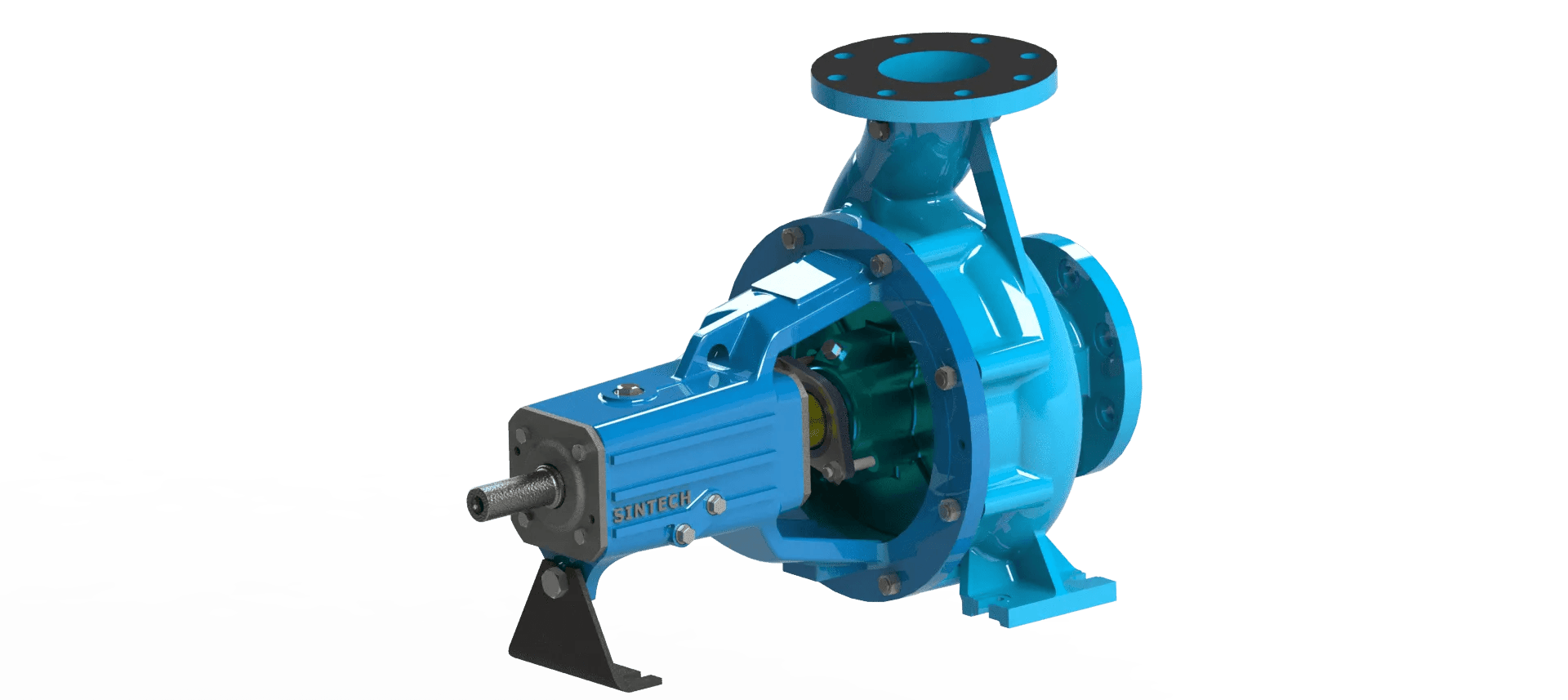
No clogging on fibrous or stringy solids. Rags, fibres, activated sludge floc, and fibrous industrial waste pass through the open casing channel without wrapping around or blocking the impeller. For a sewage pumping station receiving industrial effluent mixed with domestic sewage, a common scenario in Indian industrial towns, this is a significant operational difference.
Reduced wear on abrasive sludge. Because the impeller has no contact with the sludge, abrasive grit erodes the casing slowly rather than destroying the impeller rapidly. This extends time between overhauls compared to a conventional sewage pump on grit-laden duty.
Lower maintenance per running hour. A standard centrifugal sewage pump or sludge transfer pump on thickened sludge requires frequent impeller inspection and clearance adjustment. Torque flow pumps have no close-tolerance impeller-to-casing clearance to maintain. For plants with limited maintenance bandwidth, particularly in smaller STPs and ETPs, this is a meaningful reliability advantage.
Torque flow pumps are not the right selection for clean, low-viscosity fluids or where high efficiency at low solids is the priority. A conventional centrifugal sewage pump or effluent pump will outperform them on specific energy consumption in those conditions. The STF's operating zone is thickened sludge, solids-laden process waste, and applications where conventional centrifugal designs have a history of blocking or premature wear.
Five Parameters for Correct Pump Specification
Wrong sludge pump selection shows up quickly: choked lines, overloaded motors, seal failure, vibration, and unstable feed to downstream dewatering equipment. Getting the specification right requires verifying five parameters, not just flow rate and head.
Solids concentration (% by weight)
The single most important input. A pump rated for 3% solids will not reliably handle 10% sludge, regardless of motor size. Confirm the measured solids concentration from settled sludge, not the design assumption.
Specific gravity
Thickened sludge at 10% solids has a specific gravity of approximately 1.05 to 1.10. This directly increases the required shaft power relative to a clean-water rating. A sewage pump specified on water duty will be underpowered on dense sludge.
Particle size and abrasiveness
Grit, sand, and inorganic particles from the incoming wastewater, common at sites receiving combined sewer overflow, accelerate impeller and casing wear. For grit-laden sludge, material selection (chrome iron, hard-faced impeller) is as important as impeller geometry.
Viscosity and rheology
Above 8% solids, sludge exhibits non-Newtonian behaviour: apparent viscosity rises as flow slows. A pump sized at rated flow may behave very differently at part load. Check the head-flow curve at the actual operating viscosity, not the water curve.
Duty cycle and downstream equipment
A sludge dewatering pump feeding a filter press operates in batch mode, short, high-flow cycles separated by press filling time. A sludge transfer pump moving sludge between thickeners runs continuously. Duty cycle affects seal selection, motor sizing, and control strategy. A sewage pumping station serving an STP runs continuously; a dewatering feed pump runs on a timer.
Sintech's application engineering team in Ghaziabad routinely works through these five parameters with plant operators before recommending the STF series or a conventional sewage pump; the right answer depends entirely on what is being pumped, not on which product is available in stock.
Also Read – Torque Flow Pump Applications for Slurries & Solids
Sewage Pumping Station Design Considerations
A sewage pumping station does more than move fluid; it determines plant reliability. Several design decisions directly affect whether the pump selection holds up in service.
Wet-well geometry: For a submersible sewage pump installation, the wet-well floor geometry must match the pump inlet. A poorly designed sump allows sludge to settle and form a mat that periodically chokes the pump on startup. CPHEEO guidelines for wastewater infrastructure cover minimum velocity requirements in wet wells and collection piping.
Redundancy: A sewage pumping station on the main sludge return line at a municipal STP typically runs duty-standby at minimum. On thickened sludge circuits, having a standby pump available is non-negotiable; if the duty sludge pump blocks and there is no standby, the thickener overflows.
Pipe velocity: Sludge lines must maintain a minimum self-cleansing velocity, typically 1.2 m/s in horizontal runs, to prevent settled solids from building up in the pipe. Undersized pipework with a correctly specified pump will still block. Line sizing and pump selection work together.
Isolation and flushing: Every sludge transfer pump installation benefits from isolation valves at both suction and discharge, and a flushing connection on the suction side. If the pump blocks on start-up, flushing from clean water (or treated effluent) clears the line without manual disassembly.
India's Jal Jeevan Mission and Smart Cities programmes are expanding STP capacity across Tier 2 and Tier 3 cities. Engineers designing sewage pumping station infrastructure for these plants need pump specifications that can be maintained by operators with limited specialist training; the simpler the maintenance task, the more reliably it gets done.
Sludge Dewatering Pump Applications
A sludge dewatering pump sits at a specific and demanding point in the sludge-handling chain: between the thickener and the dewatering machine (filter press, belt press, centrifuge, or screw press). The requirements are different from a general-duty sludge pump or sludge transfer pump.
Feed consistency matters. A dewatering machine needs consistent sludge flow at the design feed concentration. Fluctuations in the sludge feed rate, caused by a pump that surges, blocks intermittently, or varies speed erratically, reduce dewatering efficiency and increase polymer consumption. For plants running a belt press or centrifuge, the sludge dewatering pump is often the most operationally sensitive pump in the system.
Backpressure tolerance. Dewatering machine feed lines can develop significant backpressure as the filter cake builds up. A centrifugal sludge dewatering pump may fall off its curve and reduce flow as backpressure rises. For high-solids sludge fed to a filter press, a positive-displacement pump maintains flow at high back pressure. For thickened-but-pumpable sludge at 8 to 12% solids fed to a belt press, a recessed-impeller effluent pump or centrifugal sludge pump at the correct duty point can work, provided the system curve is verified.
Material selection. Dewatering sludge at higher concentrations is more abrasive. An impeller in chrome iron or a wear-resistant alloy outlasts a standard cast-iron impeller significantly in this service, reducing the frequency of wet-end replacement.
Sintech manufactures torque flow pumps in the STF series that are applied to thickened sludge feed duties in Indian paper, steel, and process-industry ETPs. The recessed impeller geometry handles the fibrous and gritty character of industrial sludge without the clogging that affects standard centrifugal sewage pump designs on the same duty.
Frequently Asked Questions
What is the difference between a sewage pump and a sludge pump?
A sewage pump handles raw, unscreened, or lightly screened wastewater; solids are typically below 3% by weight. A sludge pump is designed for thicker, more concentrated material at 6 to 30% solids. The impeller design, casing clearances, and material selection differ substantially between the two. Using a standard sewage pump on thickened sludge duty causes rapid wear, clogging, and motor overload.
When should I specify a submersible sewage pump rather than a dry-installed pump?
A submersible sewage pump is appropriate for wet-well installations at a sewage pumping station where space is limited, or the installation depth makes dry-pit installation impractical. Submersible units eliminate the need for a separate pumphouse structure and are easier to retrofit in existing wet wells. For higher-solids sludge duties, a submersible format is available in vortex and recessed-impeller configurations; confirm the motor's IP rating for continuous submersion.
What solids concentration can torque flow pumps handle?
Torque flow pumps using a fully recessed impeller, such as Sintech's STF series, are routinely specified for sludge concentrations between 6% and 15% solids by weight. They can pass fibrous material, rags, and grit-laden slurry that would block a standard sewage pump or vortex centrifugal in the same service.
What causes a sludge transfer pump to block at startup?
The most common cause is sludge settlement in the suction line or wet well during pump standby. When the sludge transfer pump restarts, it encounters a settled plug rather than a flowable slurry. Prevention measures include maintaining minimum line velocity during operation, fitting a flushing connection on the suction side, and using wet-well agitation or recirculation on long standby periods.
How should a sewage pumping station be specified for combined sewer overflow?
A sewage pumping station receiving combined sewer overflow handles an unpredictable mix: domestic sewage, stormwater, and industrial discharge at variable solids content. The pump must be rated for peak solids concentration, not the average. Grit content is higher than in domestic-only systems. A vortex or recessed-impeller sewage pump is better suited than a close-tolerance centrifugal, the variable solids load that causes clogging in standard designs passes freely through a wide-channel impeller.
Can a standard centrifugal sewage pump be used for sludge dewatering pump duty?
For sludge above 8% solids, a standard centrifugal sewage pump is not appropriate as a sludge dewatering pump feed pump. The rising backpressure as the dewatering machine fills causes the pump to move up the head curve and reduce flow, leading to erratic feed and poor dewatering performance. A recessed-impeller design or positive-displacement pump maintains consistent output at variable backpressure.
Hey, like this? Why not share it with a buddy?
« Submersible Axial Flow Pump: Working Principle, Types & ApplicationsPump Selection for High-Temperature Liquids: Materials & Design Guide »