
Table of Contents
- What Is a Submersible Axial Flow Pump?
- How a Submersible Axial Flow Pump Works
- Submersible Axial Flow Pump vs Submersible Mixed Flow Pump
- Types of Axial Flow Submersible Pump Designs
- Vertical Axial Flow Pump Construction
- Axial Flow Pump Applications Across Industries
- Flood Dewatering Axial Pump
- Choosing the Right Pump for Your Site
- Conclusion
- Frequently Asked Questions
A submersible axial flow pump moves large volumes of water at low head by pushing liquid straight along the shaft axis, using a sealed motor that sits fully underwater instead of a dry-mounted one. Engineers reach for this design when a site needs fast, high-capacity flow: flood control, drainage, and irrigation are the classic cases. Sintech Pumps has built and supplied these systems out of Ghaziabad, Uttar Pradesh, for close to four decades.
What Is a Submersible Axial Flow Pump?
This design is a propeller-driven pump built to sit fully underwater, with the motor sealed inside a watertight housing directly beneath or beside the impeller. Unlike a centrifugal pump, which throws water outward through a volute, it pushes water forward in a straight line, parallel to the drive shaft. That single difference explains why an axial flow submersible pump moves so much liquid at such a low head: the propeller behaves more like a ship's screw than a paddle wheel.
Plant engineers usually bring up the term when they're dealing with open channels, storm-water sumps, or canal transfer stations where the water level fluctuates and a dry-pit installation isn't practical. Because the entire unit sits below the waterline, there's no need for a separate pump house, long suction pipe, or priming system. You lower the unit, connect the discharge, and switch it on.
At Sintech's Ghaziabad facility, these units are manufactured to DIN-24255 and ISO-9906 hydraulic performance standards, which matters more than it sounds. It means the flow and head figures on the datasheet are the figures you actually get on site, not lab-only numbers.
How a Submersible Axial Flow Pump Works
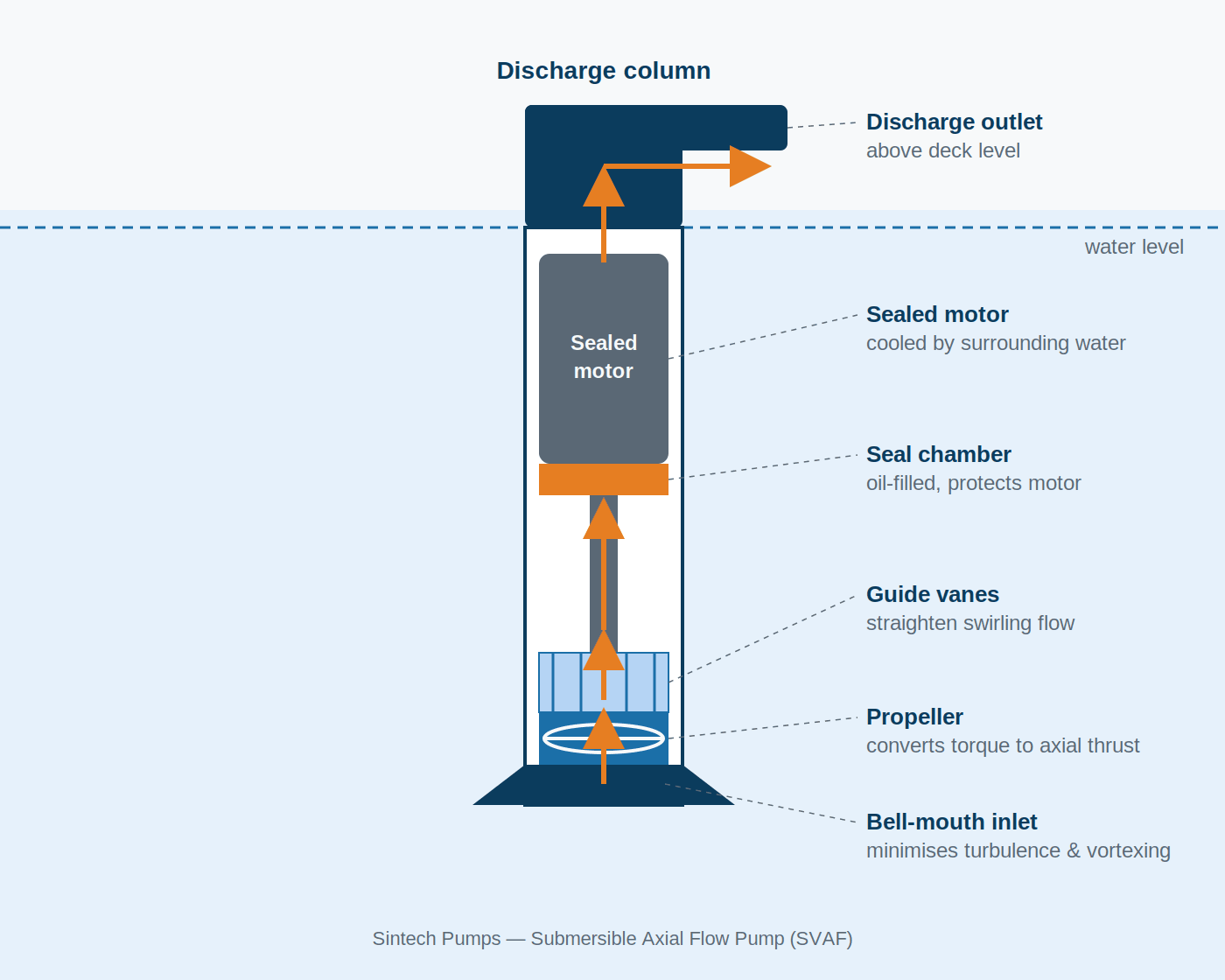
The working principle behind this pump family is closer to an aircraft propeller than a conventional water pump. A multi-blade propeller, mounted directly on the motor shaft, spins inside a cylindrical or bell-mouthed casing. As the blades rotate, they impart axial momentum to the water, accelerating it along the same direction as the shaft rather than radially outward.
Three things happen in sequence inside the casing. First, water enters the bell-mouth inlet with minimal turbulence, guided by the shape of the intake to avoid vortex formation, which would otherwise starve the propeller of a clean flow of water. Second, the rotating propeller blades convert motor torque into axial thrust, pushing the water column upward or forward through the casing. Third, fixed guide vanes downstream of the propeller straighten the swirling flow before it exits into the discharge column, recovering energy that would otherwise be lost as turbulence.
Because the motor sits in direct contact with the pumped liquid, separated only by a mechanical seal and, in most designs, an oil-filled seal chamber, cooling is handled naturally by the surrounding water. That is one reason this type of unit can often be built more compactly than an equivalent dry-mounted unit: the liquid itself acts as the heat sink for the motor windings.
Also Read – Axial Flow vs. Mixed Flow Pumps: Key Differences
Submersible Axial Flow Pump vs Submersible Mixed Flow Pump
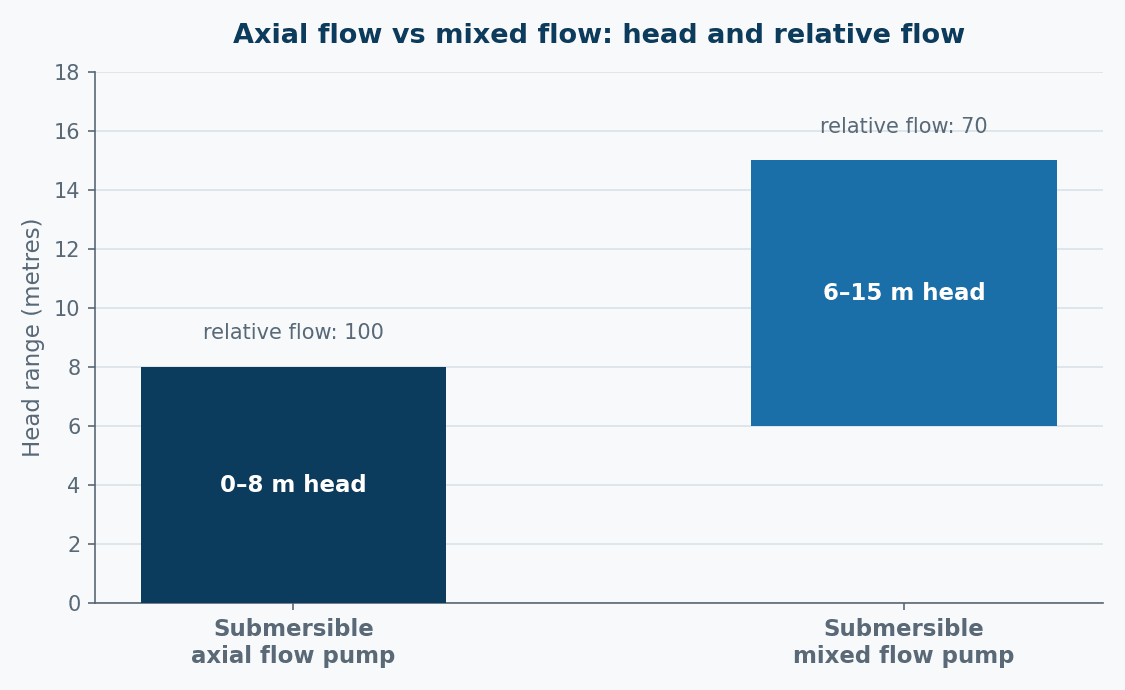
This is where a lot of procurement confusion sets in, so it's worth being precise. A submersible axial flow pump generates lift almost entirely through axial thrust, and it is built for very high flow at very low head, typically under 6-8 metres. A submersible mixed flow pump, on the other hand, blends axial and radial flow principles in one impeller, giving it a moderate head range, roughly 6-15 metres, at slightly reduced flow compared with a pure axial design.
If your site needs to move a large volume of water just a few metres vertically, think a flood relief channel or a low-lift irrigation canal, this axial design is usually the better fit. If the head requirement climbs higher, say lifting water from a deep sump into an elevated discharge channel, a submersible mixed flow pump, sometimes specified as a submersible mixed flow propeller pump because of its part-propeller impeller geometry, tends to deliver a more efficient operating point.
Sintech's engineering team routinely runs this comparison for clients before finalising a specification, because choosing the wrong family on paper can mean a pump that either can't hit the required head or wastes energy overcoming resistance it was never designed for.
Types of Axial Flow Submersible Pump Designs
Not every axial flow submersible pump is built the same way, and the differences matter once you're past the general working principle.
Fixed-blade propeller units carry blades cast or bolted at a set pitch angle. They're simple and rugged, well suited to sites where flow rate and head stay fairly constant, such as a flood dewatering axial pump station or a canal transfer pump.
Adjustable-blade propeller units allow the pitch of each blade to be changed, either manually during a shutdown or, on more advanced installations, while the pump is running. This lets the same pump body handle a range of flow and head conditions as seasonal water levels shift, common in irrigation networks and monsoon-fed drainage systems.
Portable dewatering versions, often built as a submersible mixed flow propeller pump or a lighter axial unit, come with a compact frame, quick-connect discharge coupling, and a float-switch option, so contractors can move the unit between sites without a fixed foundation.
Each configuration still relies on the same underlying physics, axial thrust moving water along the shaft line, but the mechanical execution changes depending on whether the priority is constant-duty reliability or field flexibility.
Vertical Axial Flow Pump Construction
Sintech manufactures its axial flow range under the SAF and SVAF product lines, with the vertical axial flow pump variant (SVAF) built specifically for wet-pit and submerged installation. The vertical axial flow pump places the propeller at the base of a vertical column, with the discharge running straight up through the column pipe to a header at deck level.
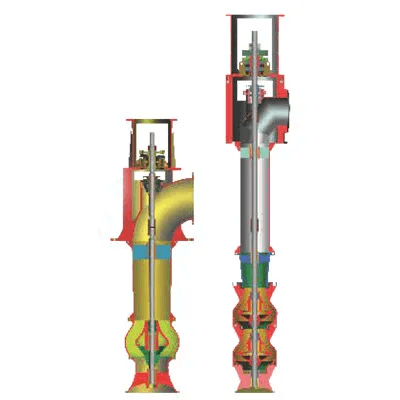
This layout has a practical advantage on congested sites: the footprint at ground level is small, since most of the hardware sits below the waterline or inside the column itself. For a sugar mill managing seasonal flood risk around its effluent ponds, or a municipal storm-water station with limited civil space, a vertical axial flow pump can be dropped into an existing sump without major structural rework.
Sintech builds these column assemblies to IS-9137 testing protocols, and every unit is hydrostatically tested before dispatch, a step that catches seal and casting issues at the factory rather than after commissioning, when a failure means draining a live sump to fix it.
Axial Flow Pump Applications Across Industries
The range of axial flow pump applications is wider than most engineers expect, mainly because the pump's core strength, moving enormous volumes at low head with minimal moving parts, fits so many industrial water-handling problems.
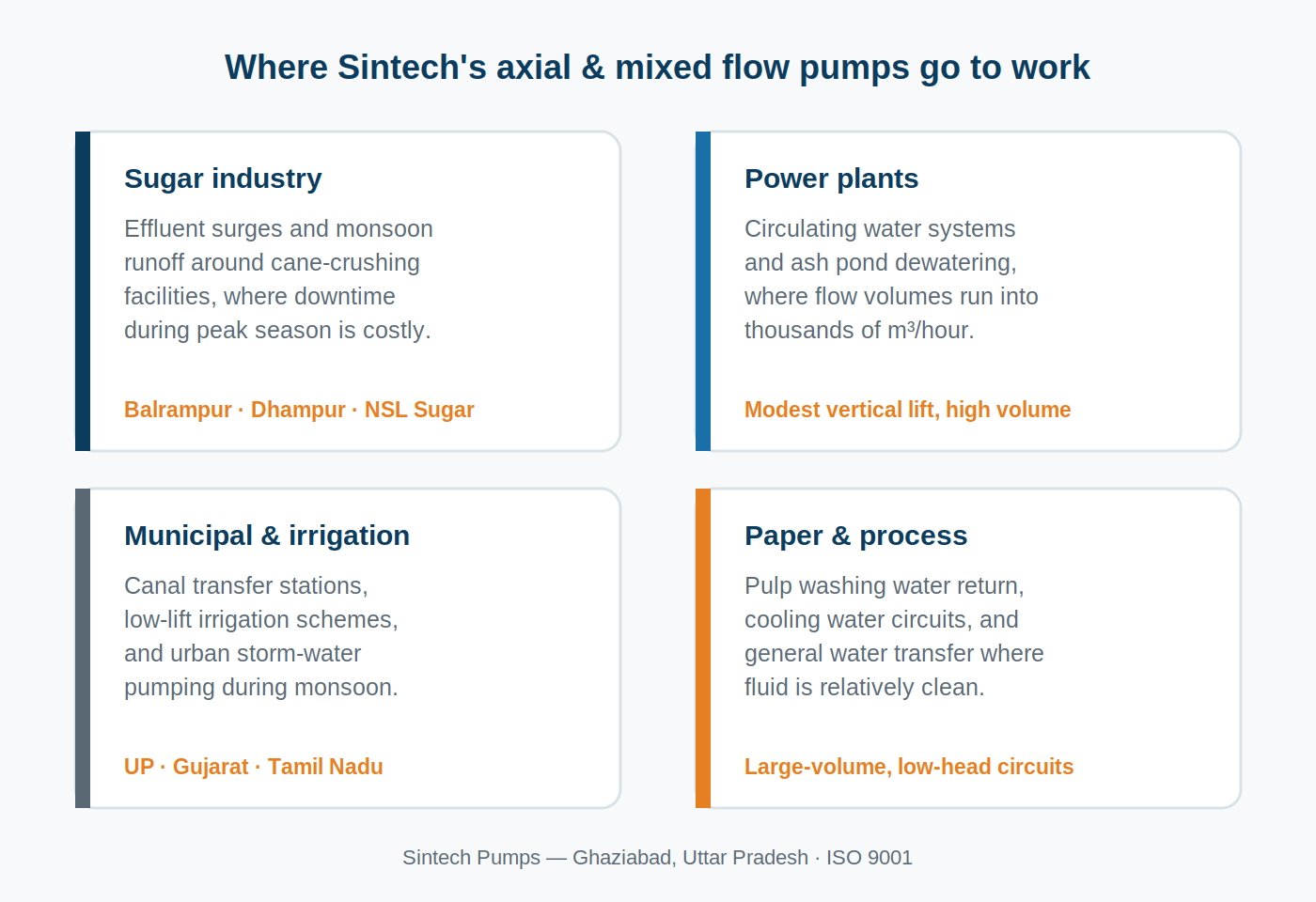
In the sugar industry, where Sintech has decades of hands-on experience with clients like Balrampur, Dhampur, and NSL Sugar, this type of unit is often deployed to manage seasonal effluent surges and monsoon runoff around cane-crushing facilities, where downtime during peak crushing season carries a real financial cost.
In power plants, axial flow pump applications typically centre on circulating water systems and ash pond dewatering, where flow volumes run into thousands of cubic metres per hour but the vertical lift required stays modest.
Municipal and irrigation departments across Uttar Pradesh, Gujarat, and Tamil Nadu use a mixed flow unit or an axial flow submersible pump for canal transfer stations, low-lift irrigation schemes, and urban storm-water pumping stations, where a fast response during a monsoon downpour matters more than fine head control.
Paper mills and process industries also lean on this family for large-volume water circuits, pulp washing water return lines, cooling water circuits, and general-purpose water transfer, where the fluid is relatively clean and the head requirement stays low. These are the axial flow pump applications Sintech's design team sees most often across its client base.
Also Read – Dewatering Pump Selection Guide: Construction, Mining & Flood Control
Flood Dewatering Axial Pump
Flood dewatering is arguably the application that puts the most pressure on a pump design, and it's where a flood dewatering axial pump earns its reputation. During a monsoon event, water levels can rise from a trickle to a torrent within hours, and a dewatering station has to respond immediately, without priming delays or warm-up time.
A flood dewatering axial pump is built around exactly this scenario. Because the unit is already submerged and ready, it starts moving water the moment power is applied: there's no suction lift to establish, no air to bleed from the casing. For a municipal corporation managing an urban drainage network, or a sugar mill protecting its effluent treatment ponds from monsoon overflow, that immediacy is often the difference between a manageable event and a shutdown.
Sintech's flood-duty installations are typically specified with a slightly oversized motor rating, since floodwater often carries silt and debris that increase running load beyond clear-water test conditions, a detail that only shows up when a manufacturer has actually serviced these units after a real monsoon season, not just tested them on a bench. In several of these projects, a mixed flow unit has been paired with axial units to handle sites where head varies through the flood cycle.
Choosing the Right Pump for Your Site
Selecting the right axial design, or deciding it isn't the right fit, comes down to three questions worth answering before you specify anything.
First, what's your actual head requirement across the full operating range, not just the average condition? A pump sized only for typical flow can struggle badly during a monsoon peak or a drought-low sump level. Second, what does the water carry: clear water, light silt, or heavier solids? That answer often decides whether a straightforward axial design suffices or a submersible mixed flow pump with a heavier-duty impeller is the safer specification. Third, is the installation permanent or does it need to move between sites, which points toward a portable dewatering configuration, sometimes built as a submersible mixed flow propeller pump, rather than a fixed vertical column.
Getting these three questions answered honestly, before committing to a model number, is what separates a pump that runs quietly for fifteen years from one that needs constant attention.
Conclusion
Picking between a submersible axial flow pump and a submersible mixed flow pump isn't really about which one sounds more powerful on a spec sheet. It's about matching the pump's hydraulic behaviour to what your site actually does during its worst hour, whether that's a monsoon peak or a drought-low sump.
Sintech's engineering team has spent close to four decades sitting across the table from plant engineers working through exactly that question, and the axial and vertical flow lines built at the Ghaziabad facility reflect what that experience has taught them about India's water-handling conditions.
If you're specifying a pump for your next flood dewatering, irrigation, or effluent management project, it's worth reaching out to Sintech's team before the civil drawings are locked in, since a short conversation at the design stage tends to save a lot of trouble later. Learn more about Sintech's axial and vertical flow pump range at sintechpumps.com.
Frequently Asked Questions
What is a submersible axial flow pump?
It is a propeller-driven pump that sits fully underwater and moves water parallel to the drive shaft, suited to very high flow at very low head.
What is the difference between a submersible axial flow pump and a centrifugal pump?
It pushes water along the shaft using a propeller. A centrifugal pump throws water outward through a volute casing, suited to lower flow and higher head.
Can a submersible axial flow pump run dry?
No. Running dry removes the cooling effect the surrounding water provides to the motor and can damage the mechanical seal within seconds. Most installations include a low-level float switch to prevent this.
What head range does a submersible mixed flow pump cover?
It typically operates in the 6 to 15 metre head range, bridging the gap between pure axial flow designs and centrifugal pumps.
Is a vertical axial flow pump suitable for irrigation canals?
Yes. A vertical axial flow pump is commonly used for low-lift irrigation and canal transfer applications where large volumes need to move a short vertical distance.
How long does this type of pump last before an overhaul is needed?
With regular seal inspection and correct sizing for the duty, a well-built unit typically runs 5 to 8 years before a full overhaul, though silt-heavy applications can shorten that interval.
Hey, like this? Why not share it with a buddy?
« Vertical Turbine Pump vs Submersible Pump: Which One Should You Use, and When?Sludge Pump Selection for Thickened Sludge and High-Solids Wastewater »