Follow us

Follow us

Home » Blog » Non-Clog Pumps for Sludge, Sewage & Solids: Where Standard Centrifugal Pumps Fail

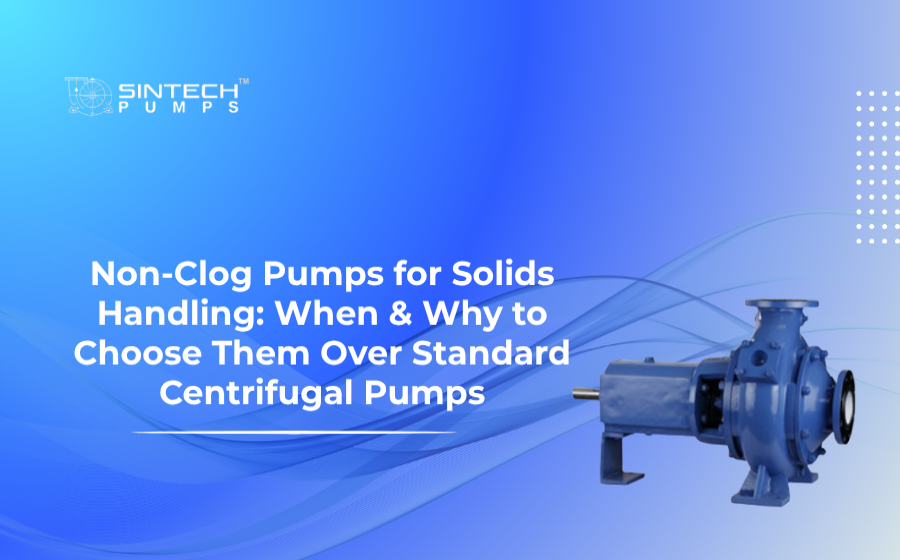
Non-Clog Pumps for Sludge, Sewage & Solids: Where Standard Centrifugal Pumps Fail

Posted: 26/08/2026
Category: Blog

Table of Contents

  1. Introduction
  2. What Makes a Pump Non-Clog: The Design Difference
  3. Where Standard Centrifugal Pumps Fail in Solids-Handling Duties
  4. Five Application Signals That Call for a Non-Clog Pump
  5. Non-Clog Pump Types: Vortex, Torque Flow, and Open Impeller
  6. Industries That Specify Non-Clog Pumps
  7. Selection Criteria Before You Specify
  8. Frequently Asked Questions

Non clog pumps are centrifugal pumps with recessed or wide-vane impellers and large-clearance passages so that solid particles, fibrous matter, and abrasive slurries pass through without clogging. They are the correct specification wherever the liquid contains solids above 6 mm, rags, sludge, or fibrous waste. These are conditions that cause a standard centrifugal pump to block and fail.

Introduction

A standard centrifugal pump looks identical from the outside. Put it on the wrong duty (raw sewage, paper pulp, sugar press mud, industrial sludge) and it will block within hours. The impeller clogs, the motor overloads, the seal fails, and your maintenance team spends a shift on an emergency callout that a correct industrial pump specification would have avoided entirely.

Non clog pumps exist precisely for that gap. They are not a premium upgrade on a standard centrifugal pump. They are a different category, built around a different hydraulic principle, for a different class of liquid. This guide explains the design logic, names the application signals that make a non clog centrifugal pump the right call, and walks through selection criteria for plant engineers specifying new installations or retrofitting aging equipment in Ghaziabad, UP, and across India’s industrial corridors.

What Makes a Pump Non-Clog: The Design Difference

The difference is in the impeller and the flow passage, not the motor or the casing shape.

A standard centrifugal pump uses a closed or semi-closed impeller with narrow vane channels, typically designed for clean water or low-viscosity liquids. The tight clearances between the impeller vanes and the casing are what give it hydraulic efficiency on clean duty. Those same tight clearances are what cause it to jam the moment a rag, a fibrous strand, or a gritty solid enters the eye.

Non clog pumps address this through one of two impeller architectures:

Recessed vortex impeller (torque flow design): The impeller sits recessed inside a large chamber and never directly contacts the liquid being pumped. Instead, it induces a rotating vortex in the fluid, and the vortex carries solids through the casing and out the discharge. The solid never touches the impeller face. This is the design used in Sintech’s STF Torque Flow Pumps: the recessed impeller creates a gentle whirlpool that moves abrasive or stringy solids through the pump without grinding or clogging the impeller. It is the most clog-tolerant architecture available for a centrifugal-class machine.

Wide-vane open impeller: The vane count is reduced and the passage width increased so that solids up to the full discharge diameter can pass through. Less clog-resistant than a full vortex design for stringy or fibrous media, but more hydraulically efficient, and acceptable for slurries with a predictable particle-size range. It works well as a pump for solids duties where particle size stays within a known band, though it is less forgiving of long fibres than a torque flow design.

Both configurations share a wide volute casing and large discharge outlet designed to accommodate solids without restricting flow.

The practical implication: a pump for solids duty is not a modified clean-water pump. It is specified from the start for solid passage, which means the hydraulic path, the impeller clearance, the shaft seal arrangement, and the casing material all differ from a standard centrifugal specification.

Where Standard Centrifugal Pumps Fail in Solids-Handling Duties

Plant engineers typically discover this the hard way. The standard centrifugal pump was already on site, already in the store, or already quoted at a lower price. It goes in on a sludge or sewage pump duty and begins failing in a predictable sequence.

Impeller clogging: Solid particles enter the eye and lodge between the vanes. Flow drops, differential pressure across the pump rises, the motor draws higher current, and the thermal protection trips. Maintenance clears the blockage, the pump runs for another shift, and the cycle repeats.

Accelerated seal wear: Abrasive particles that do pass through the impeller zone attack the mechanical seal faces. Seal life on a standard centrifugal pump in a sludge pump application is a fraction of its rated clean-water life. Seal replacements become a recurring maintenance line item.

Bearing overload: When the pump cavitates or runs against a blocked impeller, shaft vibration increases. Bearing temperatures rise. On a machine running two or three shifts a day, bearing failures follow within months.

Production stoppages: A blocked sewage pump on a treatment plant’s inlet works does not just inconvenience maintenance. It backs up the entire hydraulic sequence upstream, potentially overflowing raw sewage into containment areas.

The economic argument for correct initial specification is straightforward. Clogging-related failures account for more than 30% of pump downtime in wastewater and industrial pump installations (Koleburg Pumps field data, 2026). Choosing a non clog pump from the outset eliminates that failure category entirely.

Five Application Signals That Call for a Non-Clog Pump

These are the conditions that indicate a non clog pump is the correct specification, not a preference or a premium.

Signal 1: Solids larger than 6 mm in suspension. If the liquid contains particles, rags, wipes, or fibrous material that would not pass through a 6 mm screen, a standard centrifugal impeller will not pass them either. A solids transfer pump with a recessed or wide-vane impeller is mandatory.

Signal 2: Fibrous or stringy media. Rags, paper pulp, sugar cane bagasse fibre, textile waste, and wet wipes wrap around a standard impeller and stall it within minutes. The vortex action used in torque flow pumps prevents fibre from ever reaching the impeller face.

Signal 3: High sludge content. Sludge from digestion tanks, press mud from sugar mills, and thickened sludge from clarifiers carry solids concentrations that will foul a narrow-passage impeller. A sludge pump with a recessed impeller handles raw sludge, digested sludge, and thickened sludge without fouling. Critically, the gentle vortex pumping action does not shear flocculated sludge, which matters wherever chemical dosing upstream has promoted floc formation.

Signal 4: Abrasive slurries with unpredictable particle size. Grit, sand, and industrial process waste carry particles whose size varies with operating conditions. Non clog pumps with adequate casing clearance tolerate this variation without the clogging risk of a fixed-clearance closed impeller.

Signal 5: Continuous-duty applications where unplanned downtime is unacceptable. Municipal sewage lift stations, effluent sump transfer, and Zero Liquid Discharge feed circuits run 24 hours. A pump that requires manual clearing every shift is not a viable asset in this context. The non clog pump earns its cost premium in operational continuity.

Non-Clog Pump Types: Vortex, Torque Flow, and Open Impeller

Non clog pumps are not a single product type. There are three main architectures, each with a different hydraulic character and appropriate duty range.

Torque Flow (Recessed Vortex) Pumps

The torque flow design is the most clog-resistant configuration. The impeller is fully recessed inside the casing and does not contact the pumped liquid directly. The rotating impeller induces a vortex, and the vortex energy carries the liquid and its solids content through the pump and out the discharge. Large solids, long fibres, and abrasive particles pass through without touching the impeller. This is why torque flow remains the reference design whenever a plant needs a dependable pump for solids duty with unpredictable fibre content.

Sintech’s STF Torque Flow Pumps are built on this principle. The STF handles raw sewage, industrial sludge, fibrous pulp, and abrasive slurry, in applications where normal pumps would plug or wear out quickly. The STFV vertical sump variant extends the same hydraulic design to sump installation configurations. Both are specified across water and wastewater, paper, sugar, and process industry applications.

The trade-off: torque flow designs are somewhat less hydraulically efficient than a clean-water centrifugal pump at peak flow. For a solids transfer pump duty where continuous clog-free operation is the primary requirement, this is the correct trade-off.

Open Impeller Non-Clog Centrifugal Pumps

The open impeller design widens the vane channels and reduces the number of vanes so that solids up to the discharge diameter can pass through. It is more efficient than the full vortex design at equivalent flow and head conditions but less tolerant of fibrous or stringy media. Suited to slurry duties where particle size is relatively predictable and the risk of fibrous clogging is low.

Semi-Open Impeller Designs

The semi-open configuration retains a back shroud but leaves the front open. It handles moderate solids loading with a better efficiency profile than a full open impeller. The impeller clearance setting is critical: incorrect clearance allows solids to pack between the impeller face and the casing.

For most sewage pump and sludge pump applications in India, the torque flow or open impeller design is the appropriate starting specification. Semi-open designs are more common in process industry duties where liquid properties are well characterised.

Industries That Specify Non-Clog Pumps

Water and Wastewater Treatment

Municipal sewage treatment plants rely on non clog pumps at every stage of the treatment sequence: raw sewage lifting at the inlet works, sludge recirculation in aeration tanks, thickened sludge transfer to digesters, and treated water discharge. A sewage pump at the inlet works must handle grit, rags, and variable flow without operator intervention. Schemes under the Jal Jeevan Mission and state-level underground drainage projects increasingly specify non clog centrifugal pump models because older narrow-passage designs cannot handle the solid and fibrous content of real municipal sewage. Every stage listed here calls for a dedicated pump for solids handling, not a clean-water machine adapted after the fact.

Paper and Pulp

Paper mill process streams carry fibrous pulp, broke, and mill effluent with a high and variable solids content. Standard centrifugal pumps block on long-fibre pulp within minutes. Torque flow pumps with recessed impellers are standard specification in paper mill white water circuits, broke recovery, and effluent transfer. Sintech has supplied non clog pumps to paper mills across India including facilities associated with names like Birla and Walchand.

Sugar

Press mud, bagasse wash water, and sugar mill effluent carry fibrous and abrasive solids that are incompatible with standard centrifugal impeller geometry. Non clog centrifugal pump and torque flow pump specifications appear in sugar mill crushing sections, evaporator condensate recovery, and effluent treatment. Sintech’s supply to mills associated with Balrampur, Dhampur Sugar Mills, and Triveni reflects this application history.

Steel and Process Industries

Scale pit sumps, rolling mill coolant loops carrying fine scale, and descaling water circuits carry abrasive solids. A solids transfer pump with wide-passage design handles this duty without the rapid impeller wear seen on standard centrifugal equipment. Tamil Nadu, Maharashtra, and Gujarat account for a significant share of India’s process industry non clog pump installations. These plants represent some of the most demanding industrial pump duties in the country.

Zero Liquid Discharge Systems

ZLD feed circuits handle concentrated brine streams and process effluents with high dissolved and suspended solids. Non clog pumps appear at the sump transfer stage and in evaporator feed circuits where elevated solids concentration and temperature would accelerate clogging in a standard centrifugal design.

Selection Criteria Before You Specify

Specifying the correct non clog pump requires more than confirming that solids are present. These are the parameters a plant or project engineer should characterise before equipment selection. Getting these parameters right up front is what separates a correctly specified pump for solids duty from a machine that fails within its first year.

Maximum solid particle size and shape. Round particles and irregular grit behave differently from fibrous strands. State the maximum particle diameter, the predominant shape (round, fibrous, or irregular), and whether the size distribution is stable or variable.

Liquid viscosity and specific gravity. Sludge with 5% solids concentration by mass behaves differently from sludge at 15%. A sludge pump selection requires the density and rheological character of the actual process liquid, not clean water as a proxy.

Flow rate and head requirement. The duty point determines the impeller size and speed. For non clog pumps, the efficiency at the duty point will be lower than an equivalent clean-water centrifugal pump, so size the motor accordingly.

Abrasivity of solids. Abrasive grit and sand accelerate impeller and casing wear even in a non-clog design. Hard-iron or rubber-lined casing options are appropriate where abrasivity is high. This is a common failure mode across industrial pump installations handling mining or ash slurries.

Installation orientation. Non clog pumps are available in horizontal end-suction, vertical sump (STFV/CPSV), and submersible configurations. Sump geometry and available NPSH determine which orientation is feasible. A vertical solids transfer pump configuration is often preferred where floor space around the sump is limited.

Seal arrangement. Gland packing is acceptable for less aggressive slurries. Mechanical seals are appropriate for cleaner effluents. Some sludge pump duties benefit from a dry-running-tolerant seal where the pump may occasionally run low on liquid level.

Sintech’s application engineering team in Ghaziabad reviews process conditions and recommends pump type and size based on actual duty parameters, including cases where a standard centrifugal pump is acceptable and a non-clog specification would be over-engineering.

Frequently Asked Questions

1. What is a non-clog pump and how does it differ from a standard centrifugal pump? 

A non clog pump uses a recessed vortex impeller or wide-vane open impeller with large clearance passages so that solids, fibres, and abrasive particles pass through the casing without blocking the impeller. A standard centrifugal pump uses a narrow-vane closed or semi-closed impeller designed for clean water, with tight impeller-to-casing clearances that cause it to jam when solids are present.

2. When should I specify a non-clog pump instead of a standard centrifugal pump? 

Specify a non clog pump when the liquid contains particles larger than 6 mm, fibrous or stringy solids, sludge with measurable solids concentration, or abrasive slurry with variable particle size. Also specify a non clog centrifugal pump when the duty is continuous and unplanned downtime is unacceptable.

3. What is a torque flow pump and is it the same as a non-clog pump? 

A torque flow pump is a specific type of non clog pump that uses a fully recessed impeller to generate a vortex in the fluid rather than direct impeller contact. It is the most clog-resistant centrifugal pump architecture. The Sintech STF range is a torque flow design. Not all non clog pumps are torque flow pumps: open impeller and semi-open designs are also classified as non-clog but with different clog-resistance characteristics.

4. Can a non-clog pump handle sewage and sludge simultaneously? 

A sewage pump on a wastewater treatment plant inlet works typically handles raw sewage containing both suspended solids and settled sludge fractions. A non clog centrifugal pump with a torque flow impeller handles this combined duty. Purpose-specified sludge pumps are used where the application is dedicated to sludge transfer at higher concentrations, such as from a thickener underflow.

5. What industries use non-clog pumps in India? 

Non clog pumps are specified across water and wastewater treatment, paper and pulp, sugar, steel, food processing, and chemical process industries in India, making them one of the most widely used industrial pump categories in the country. Municipal corporation infrastructure under Jal Jeevan Mission and Smart Cities schemes increasingly specifies non clog pump types for sewage network upgrades. Karnataka, Tamil Nadu, West Bengal, Maharashtra, and Uttar Pradesh account for a significant share of solids transfer pump installations.

6. How do I select the right non-clog pump for my application? 

Define the maximum solid particle size and shape, liquid density and viscosity at operating temperature, required flow rate and total head, abrasivity of solids, and installation configuration. Submit these parameters to the pump manufacturer’s application engineering team. Sintech’s team reviews process conditions and recommends the correct non clog centrifugal pump type and size: STF torque flow for fibrous and abrasive duties, open impeller for predictable particle-size slurries.

7. What maintenance does a non-clog pump require? 

A non clog pump requires less frequent maintenance than a standard centrifugal pump on solids-handling duty, but it is not maintenance-free. Routine checks include impeller clearance (for open impeller designs), mechanical seal condition, bearing temperature, and motor current draw. Torque flow pumps require minimal impeller adjustment because the impeller does not contact the liquid directly, which extends the maintenance interval compared to open impeller non-clog designs.

8. Is a non-clog pump less efficient than a standard centrifugal pump? 

At the same duty point, this type of pump is generally less hydraulically efficient than a standard centrifugal pump sized for clean water. The recessed or wide-vane impeller geometry sacrifices some hydraulic efficiency to achieve clog resistance. However, this efficiency difference is offset by the elimination of clogging downtime, reduced seal and bearing replacement frequency, and extended pump life. The total operating cost over a five-to-ten-year period is typically lower for the correct non clog pump specification than for a cheaper standard centrifugal pump on the same solids-handling duty.

Hey, like this? Why not share it with a buddy?

Leave a Reply

Top
Thanks!

Want us to call you back?

*Please share your details so that our representative can reach out to you. Please schedule a call between 9:30 AM to 5:30 PM (IST) Mon-Sat.

    SCS Pump Your phone number will not be used for marketing purposes.