Centrifugal End-Suction Pumps (CPS)
The workhorse of closed-loop chilled water circuits. End-suction centrifugal pumps are compact, easy to maintain, and suited to moderate flow rates at heads of 10 to 60 metres. Sintech’s CPS range is manufactured to ISO-2858 and IS-9137, with installations running across process industries in Tamil Nadu and Karnataka.
A circulating pump in this category handles most chilled water distribution duties in pharmaceutical, food processing, and light manufacturing plants. Correctly sized, a CPS delivers years of stable operation with minimal maintenance intervention.
Split Casing Double Suction Pumps (SCS)
Where flow requirements are high, and the head is moderate, a split casing double suction pump handles the load a single-suction pump cannot. The double-suction impeller cancels axial thrust and reduces bearing loads, extending service intervals significantly.
The SCS is the natural choice for the condenser water loop in medium to large plants, including steel plants, paper mills, and power generation auxiliaries. It also serves as the primary water circulation pump in large HVAC and district cooling installations.
Vertical Turbine Pumps (SVT)
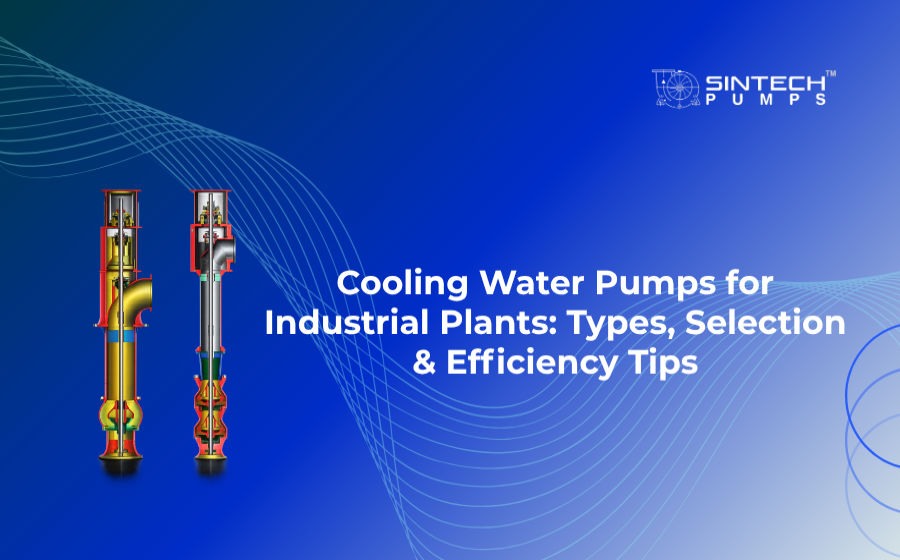
When the cooling water source is a sump, wet well, or river intake, a vertical turbine pump keeps the motor above the water line while the bowl assembly draws from depth. The SVT handles condenser water intake duty in power plants and large process facilities where a horizontal suction arrangement is impractical.
Axial Flow and Mixed Flow Pumps
These two pump families are the specialist tools for high-volume, low-to-moderate head cooling duties. They are routinely under-specified by engineers who default to centrifugal end-suction designs regardless of the operating point. Section 04 covers them in full.
Axial flow and mixed flow pumps in cooling water applications
Axial Flow Pumps (SAF / SVAF)
An axial flow pump moves fluid parallel to the shaft axis. The impeller functions like a propeller: it accelerates fluid axially rather than centrifugally. This makes axial flow pumps the highest-volume, lowest-head option in the pump family.
Optimised blade geometry in modern axial flow pumps achieves peak efficiencies of 88 to 92% across the operating range (Source: Dataintelo Axial and Mixed Flow Pumps Market Report, 2024). Variable frequency drive integration allows these pumps to adapt to fluctuating cooling demand, with energy savings of 25 to 35% compared to fixed-speed alternatives.
In cooling water applications, axial flow pumps are specified for:
- Condenser cooling in power plants: large thermal and gas turbine stations in UP and West Bengal circulate tens of thousands of cubic metres per hour through condensers using axial flow configurations. Sintech’s SAF (horizontal) and SVAF (vertical) models handle this duty.
- Cooling tower basin recirculation: where basin geometry and required flow volumes exceed what a centrifugal design can serve economically.
- Heat exchanger supply in steel plants: continuous casting and rolling mills in Maharashtra require large, steady cooling water flows at low to moderate heads.
Mixed Flow Pumps (SMF / SVMF)
A mixed flow pump sits hydraulically between a centrifugal pump and an axial flow pump. It develops head through both centrifugal force and axial thrust, making it the right choice when an application needs high volume AND moderate head simultaneously — a combination that neither a pure centrifugal nor a pure axial design handles at peak efficiency.
The mixed flow pump is the preferred type for:
- Chiller circulation: a chiller circulation pump feeding a large industrial chiller or multiple chiller modules in series benefits from the mixed flow’s ability to sustain high flow at the 15 to 30 metre heads typical of closed chilled water loops.
- Cooling water circulation pump duties in paper mills and process industries: these plants need high-volume, steady circulation with variable load conditions. Sintech’s SMF (horizontal) and SVMF (vertical) configurations serve both.
- Process cooling loops in sugar and petrochemical plants: the mixed flow pump handles the moderate head requirements of multi-circuit process cooling systems where the load varies through the production cycle.
The key selection distinction: if your cooling circuit demands very high flow at low head (below 10 metres), specify an axial flow pump. If you need high flow at moderate head (10 to 30 metres), the mixed flow pump is the right tool.