
Table of Contents
- What Is a Vertical Turbine Pump?
- What Is a Borewell Submersible Pump?
- Vertical Turbine Pump vs Submersible Pump: Where the Two Designs Diverge
- The Vertical Turbine Pump Working Principle, Stage by Stage
- Advantages and Limitations of Each Pump Type
- Deep Well Turbine Pump: When Depth and Duty Cycle Decide
- Borewell Pump: When a Narrow Bore Decides for You
- Where Each Pump Type Shows Up Across Indian Industry
- How Sintech Engineers Its Turbine Pump Range
- Conclusion
- Frequently Asked Questions
A vertical turbine pump vs submersible pump decision comes down to well diameter, flow duty, and how you plan to service the unit over its life. The turbine design mounts its motor above ground and drives submerged bowls through a long shaft, while the fully sealed design sits entirely underwater. Both lift water from depth, but they suit different wells and workloads.
What Is a Vertical Turbine Pump?
A vertical turbine pump lifts water using a motor mounted above ground, connected to submerged impeller bowls by a long vertical shaft. The bowls sit down inside the well or sump, while the motor, bearings, and discharge head stay accessible at surface level. This layout makes routine servicing far simpler than pulling an entire unit out of a borehole.
Sintech Pumps has built these units under its SVT range at its Ghaziabad, Uttar Pradesh facility since the 1980s, engineered to DIN 24255 and IS 9137 standards for verified hydraulic performance. Engineers reach for this pump type when a well needs to run for long hours without interruption, such as a deep well turbine pump feeding a canal irrigation network or supplying continuous cooling water to a thermal power plant. The trade-off is space: you need enough clearance above the wellhead to house the motor, discharge head, and column pipe assembly, which is not always available on compact industrial sites.
What Is a Borewell Submersible Pump?
A borewell submersible pump seals its motor inside a single housing that sits fully underwater, directly below the pump bowls. There is no long shaft and no surface-mounted motor; the whole assembly is lowered into the bore on a cable and discharge pipe. This design suits narrow bores, typically 100mm to 300mm in diameter, where there simply isn't room for a turbine's above-ground footprint.
A borewell pump of this kind is common on farms, small water supply schemes, and residential tube wells across India, largely because installation needs no civil structure at the wellhead. The motor's water-cooled jacket keeps it running, but repairing it means pulling the entire unit back to the surface, which adds downtime and rig hire cost compared with a turbine's surface-accessible motor.
Vertical Turbine Pump vs Submersible Pump: Where the Two Designs Diverge
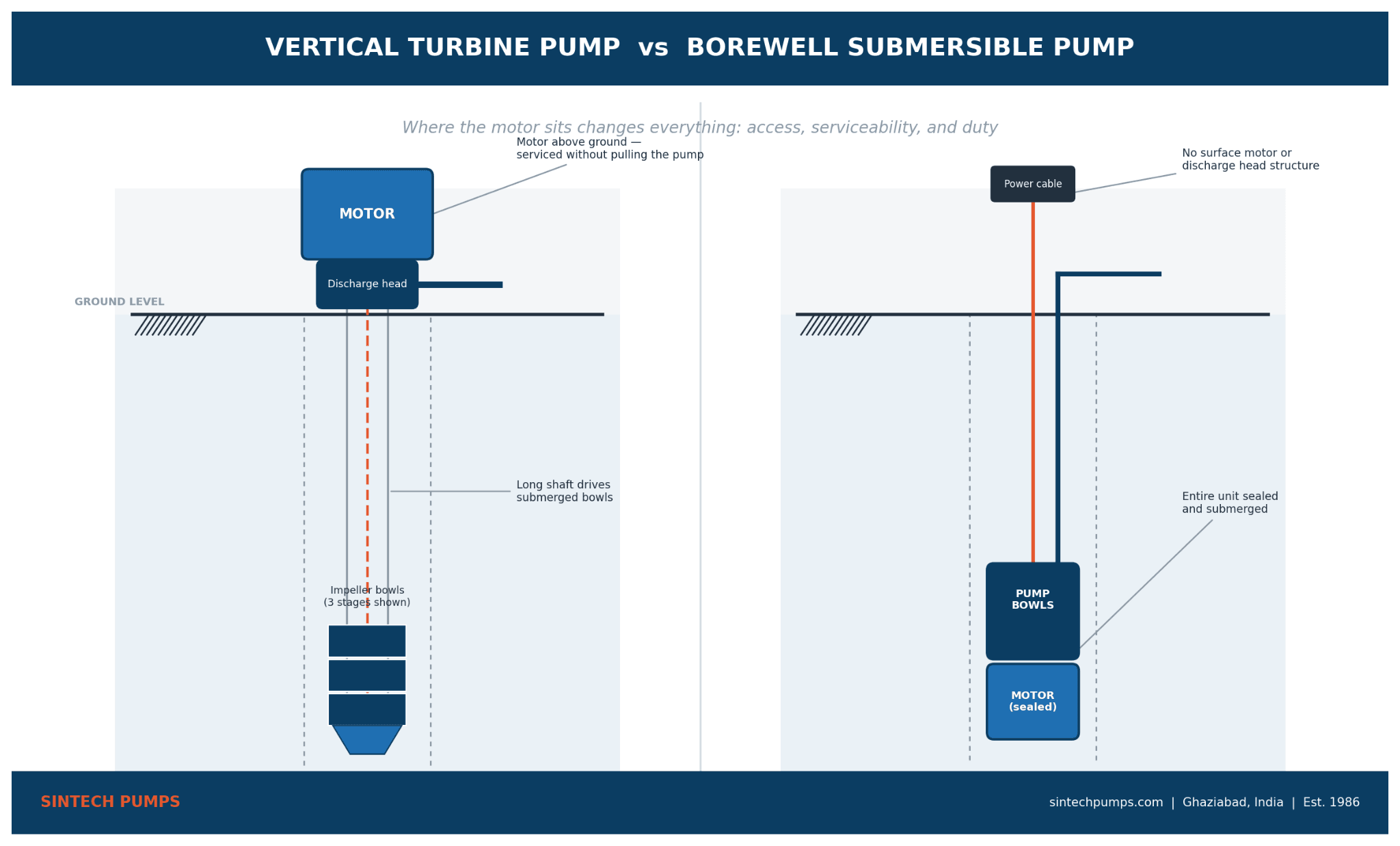
The vertical turbine pump vs submersible pump choice usually starts with the borehole itself. Turbine pumps need a wider casing to accommodate the bowl assembly and column pipe, generally above 250mm, while sealed underwater units can work in much narrower bores. Motor accessibility is the next factor. A turbine's motor sits at the surface, so a technician can inspect windings, bearings, and alignment without lifting anything out of the ground.
A sealed underwater motor cannot be inspected at all until the full string is pulled, which can mean a full day of rig time on a deep installation. Flow and head also separate the two. Turbine pumps handle higher continuous flow rates efficiently across multiple impeller stages, which is why canal irrigation schemes and power plant intakes lean toward them.
Sealed underwater pumps tend to suit lower to moderate flow, matched to a single household, farm, or small commercial site. On running cost, turbine units generally last longer between major overhauls because heat dissipates into open air rather than being trapped underwater against the motor casing.
Also Read – Types of Centrifugal Pumps: A Complete Classification Guide
The Vertical Turbine Pump Working Principle, Stage by Stage
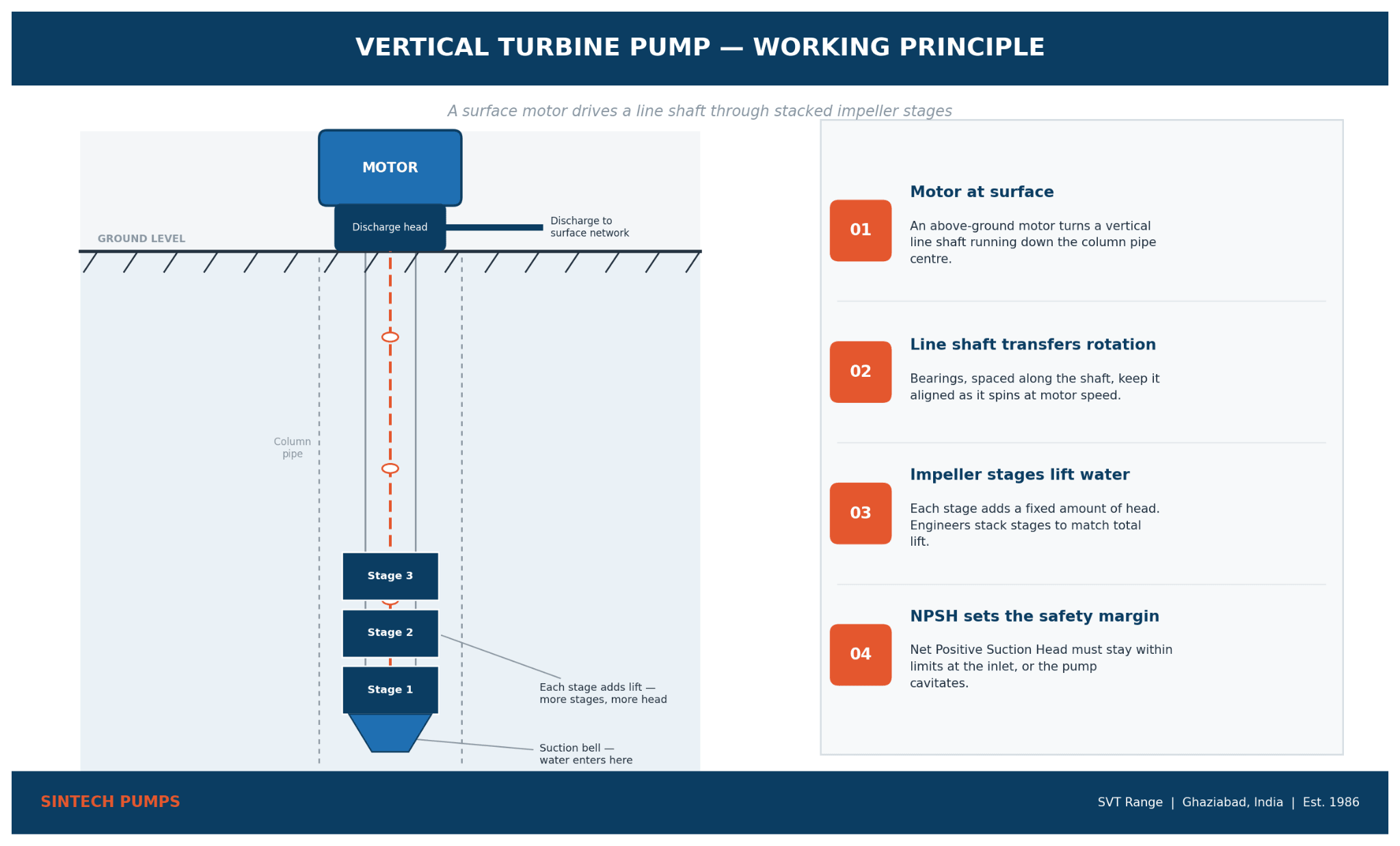
The vertical turbine pump working principle breaks down into four steps, from the motor at the surface to the water leaving the discharge head.
Stage One: Motor at Surface
A surface motor drives a line shaft running down the centre of the column pipe, turning the impellers at the bottom of the well.
Stage Two: Impellers Add Lift in Steps
Multiple impeller stages sit stacked inside the pump bowls, each one adding lift as water moves upward. Every stage raises the water a set height, so engineers add or remove stages to match the total lift a site needs, whether that's 40 metres or 250 metres.
Stage Three: Bearings Keep the Shaft Aligned
Bearings positioned along the shaft, lubricated by the water itself or by a separate oil line, keep it aligned as it spins at motor speed.
Stage Four: NPSH Sets the Safety Margin
Net Positive Suction Head (NPSH), the minimum pressure needed at the impeller inlet to prevent cavitation, has to stay within safe limits at every stage, or the pump loses efficiency and wears out early.
Once you understand how this works, sizing a unit for a specific bore and flow target becomes a matter of matching stage count and impeller diameter to the site's head and capacity requirement.
Advantages and Limitations of Each Pump Type
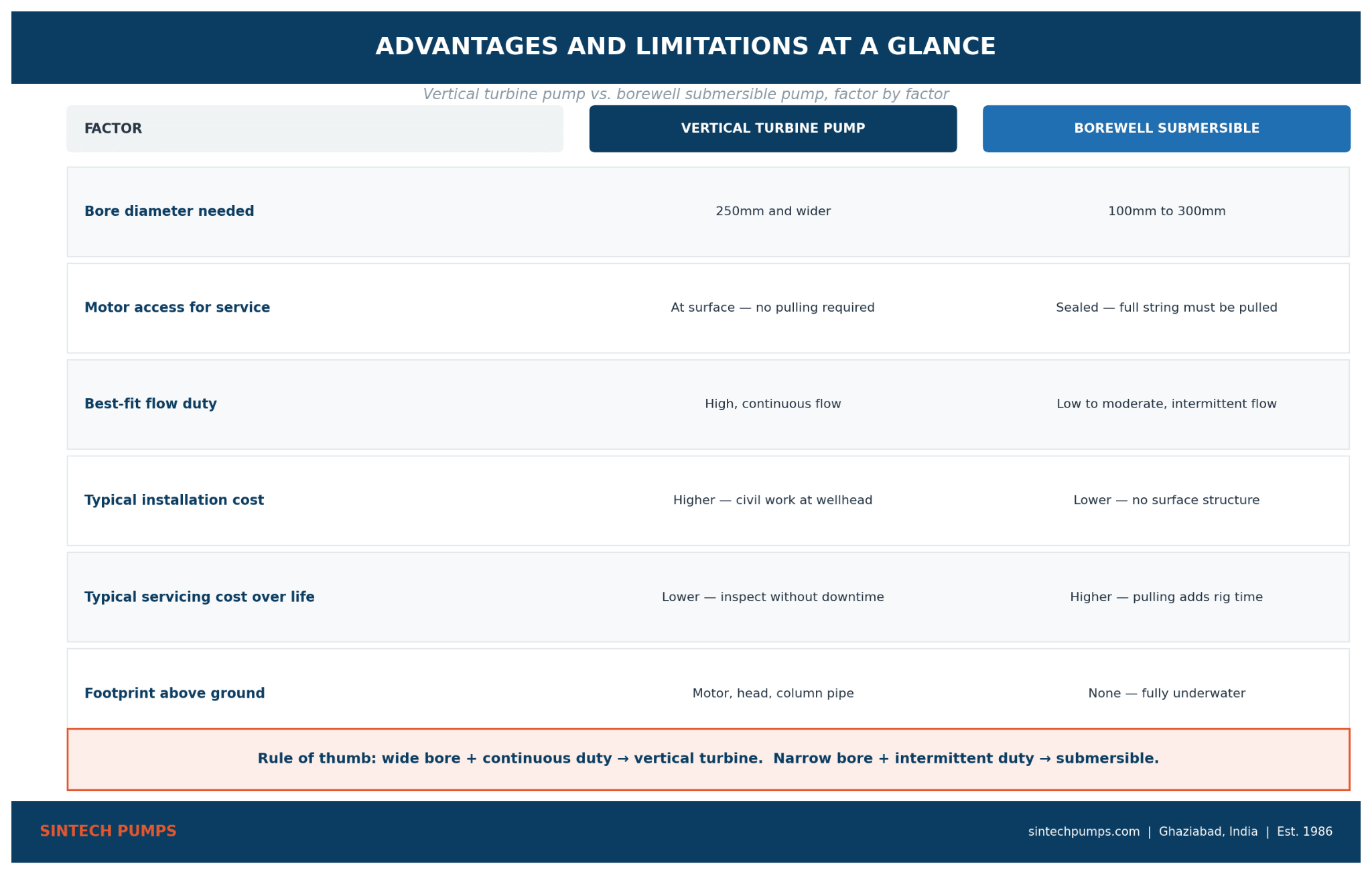
The turbine design wins on serviceability and continuous-duty efficiency. Because the motor sits above ground, a technician can inspect bearings and rewind windings without touching the wellhead, and multi-stage impellers handle high flow with less energy loss than a compact underwater motor working at the same duty point. The trade-off is footprint: you need surface space for the discharge head, column pipe, and motor pedestal, plus a wider bore to fit the bowl assembly.
The sealed underwater design wins on installation speed and upfront cost. There's no civil structure to build above the wellhead, the cable and motor arrive as one unit, and the whole assembly disappears into a narrow bore with minimal site disruption. The trade-off shows up later: a failed motor or worn seal means pulling the entire string to surface, and that downtime is harder to plan around than scheduled turbine maintenance.
Deep Well Turbine Pump: When Depth and Duty Cycle Decide
A deep well turbine pump is the practical choice whenever a site needs high, steady flow from a bore wide enough to house the column assembly. Canal-fed irrigation networks across Punjab and western Uttar Pradesh often run these units for ten to fourteen hours a day through the growing season, and the ability to service the motor without pulling the whole string matters when downtime costs a farmer an entire watering cycle. Thermal power stations use the same logic for cooling water intake, where a deep well turbine pump has to run around the clock with predictable maintenance windows rather than emergency pulls. Municipal water boards specify turbine pumps for similar reasons: planned maintenance is far easier to schedule when the motor sits above the wellhead instead of a hundred metres below it.
Borewell Pump: When a Narrow Bore Decides for You
A borewell pump earns its place on sites where the bore itself is too narrow for a turbine's column assembly, or where space above the wellhead is limited. Farmers irrigating a few acres, housing societies drawing from a single tube well, and small workshops topping up a water tank rarely need the flow capacity a turbine pump delivers, and the lower upfront cost of a compact sealed unit fits tighter budgets. Installation is quicker too, since there's no discharge head, column pipe, or surface foundation to build. For genuinely deep, high-volume, continuous-duty applications, though, the servicing drawback of a sealed underwater motor tends to outweigh the installation savings over the life of the pump.
Where Each Pump Type Shows Up Across Indian Industry
Sugar mills across the Uttar Pradesh belt lean on a deep well turbine pump to feed wash water and boiler makeup through the crushing season, when a single unplanned stoppage can back up an entire production line. Desalination plants along the western coast use similar turbine units for raw seawater intake ahead of pre-treatment, valuing the same surface-accessible motor for scheduled upkeep. Smaller water utilities and rural drinking water schemes, by contrast, often rely on a borewell submersible pump where bore width and budget rule out a turbine installation, particularly for standalone tube wells serving a single village or housing cluster. Sintech supplies both categories from its Ghaziabad works, sizing each pump to the site's actual head and flow rather than defaulting to a standard catalogue size.
How Sintech Engineers Its Turbine Pump Range
Every SVT unit leaving the Ghaziabad plant is tested against ISO 9906 performance curves before dispatch, so the numbers on the datasheet match what a customer actually gets on site. The vertical turbine pump working principle behind the SVT design keeps stage count to what a duty point genuinely needs, rather than over-specifying impellers that waste energy at partial load. Where a client's bore is too narrow for a turbine assembly, Sintech's team will recommend a borewell submersible pump instead and say so plainly, rather than force-fitting a product that won't serve the application well. That kind of honest sizing conversation, backed by 38 years of application data across sugar, power, and water utilities, is what a solutions-first manufacturer owes its customers.
Conclusion
Weighing the vertical turbine pump vs submersible pump decision one last time, start with your bore diameter and confirmed flow requirement, then work backward to what fits. If the numbers point to high, continuous duty and the site can spare the surface footprint, the vertical turbine pump working principle of stacked stages and an above-ground motor will generally pay for itself in lower servicing cost over the pump's working life. If the bore is narrow, the duty is intermittent, or budget is the deciding factor, a borewell pump remains the sensible, well-proven option. Either way, get an actual site survey done before ordering; a pump sized on assumptions rarely performs the way its datasheet promised.
Frequently Asked Questions
How deep can a turbine pump be installed?
Most turbine units handle depths up to 300 metres, though very deep installations need staged bowl assemblies and stronger line shafts to manage the added torque and weight.
Is a sealed underwater pump cheaper to install than a turbine pump?
Usually yes, upfront. There's no discharge head or column pipe to erect, so installation cost is lower, though servicing costs over the pump's life often even things out.
Can a turbine pump run continuously for months at a time?
Yes, provided bearings and lubrication are checked on schedule; that's exactly why irrigation canals and power plant cooling systems specify this pump type for round-the-clock duty.
What bore diameter does a turbine assembly need?
Generally 250mm or wider, since the bowl assembly, column pipe, and shaft all need clearance inside the casing without touching the well wall.
How often should a sealed underwater motor be inspected?
Because it can't be checked in place, most operators follow a fixed replacement or overhaul schedule based on running hours rather than waiting for a fault to appear.
Does Sintech manufacture both pump types?
Yes. Sintech's SVT range covers turbine applications, and the team also advises on borewell submersible pump options for narrower bores where a turbine assembly won't fit.
What standards should an industrial buyer check before ordering?
Look for ISO 9906 or IS 9137 performance testing, plus DIN 24255 or ISO 2858 dimensional compliance, so the datasheet reflects tested, not estimated, performance.
Hey, like this? Why not share it with a buddy?
« What Is a Sump Facility? Sump Design, Types & Industrial Uses ExplainedSubmersible Axial Flow Pump: Working Principle, Types & Applications »