
Table of Contents
- What Is a Sump Facility?
- What Is a Sump Pump? The Sump Pump Meaning Explained
- Sump Pump Working Principle
- Sump Design: Getting the Pit Right the First Time
- Industrial Sump vs. a Household Sump Pit
- Vertical Centrifugal Sump Pump
- Where a Sump Facility Shows Up in Indian Plants
- Sump Pit Sizing and Pump Selection
- Maintenance Realities
- Where Sintech Fits In
- Conclusion
- Frequently Asked Questions
A sump facility is a below-grade pit or chamber that collects drainage, process overflow, or wastewater so a pump can lift it back out to a safe discharge point. In Indian plants, it keeps floors from flooding, protects equipment from corrosion, and prevents unplanned shutdowns. Getting the sump pump meaning right at the outset, rather than assuming it works like a household unit, is where most specification mistakes start.
What Is a Sump Facility?
Most plants have at least one: a concrete or lined pit, sometimes a few feet deep, sometimes twenty metres, built to catch liquid that would otherwise pool on the process floor. Liquid drains into the sump pit by gravity, and a pump installed inside lifts it back out to a treatment system, a discharge channel, or the process itself.
Get the pit's location or depth wrong, and it does nothing useful. Get the pump inside it wrong, and you're looking at repeated failures. Before deciding what is a sump pump you actually need, it helps to settle the pit itself. A well-planned sump facility solves both problems together, not as two separate purchases made at different stages of a project.
What Is a Sump Pump? The Sump Pump Meaning Explained
The sump pump meaning is simple: it's the pump installed inside, or directly over, a pit to remove accumulated liquid before it overflows. In a home, that means basement drainage after heavy rain. In a plant, the sump pump meaning stretches further, covering hot condensate at a power station, sugarcane juice residue at a mill, or fibre-heavy white water at a paper unit, each of which changes what the pump has to survive.
So what is a sump pump, mechanically? It's a pump built to sit in a pit, submerged or dry-mounted, and lift liquid vertically against gravity. Plant engineers rarely ask what is a sump pump in the abstract is; they ask it while standing next to a pit that's already flooding. A standard centrifugal pump assumes a steady, controlled suction condition; a sump pump doesn't get that luxury, since liquid levels rise and fall as inflow varies through the day. That variable, often dirty, operating environment is what a sump pump is built for, and it's the main reason a general-purpose process pump isn't a substitute.
Sump Pump Working Principle
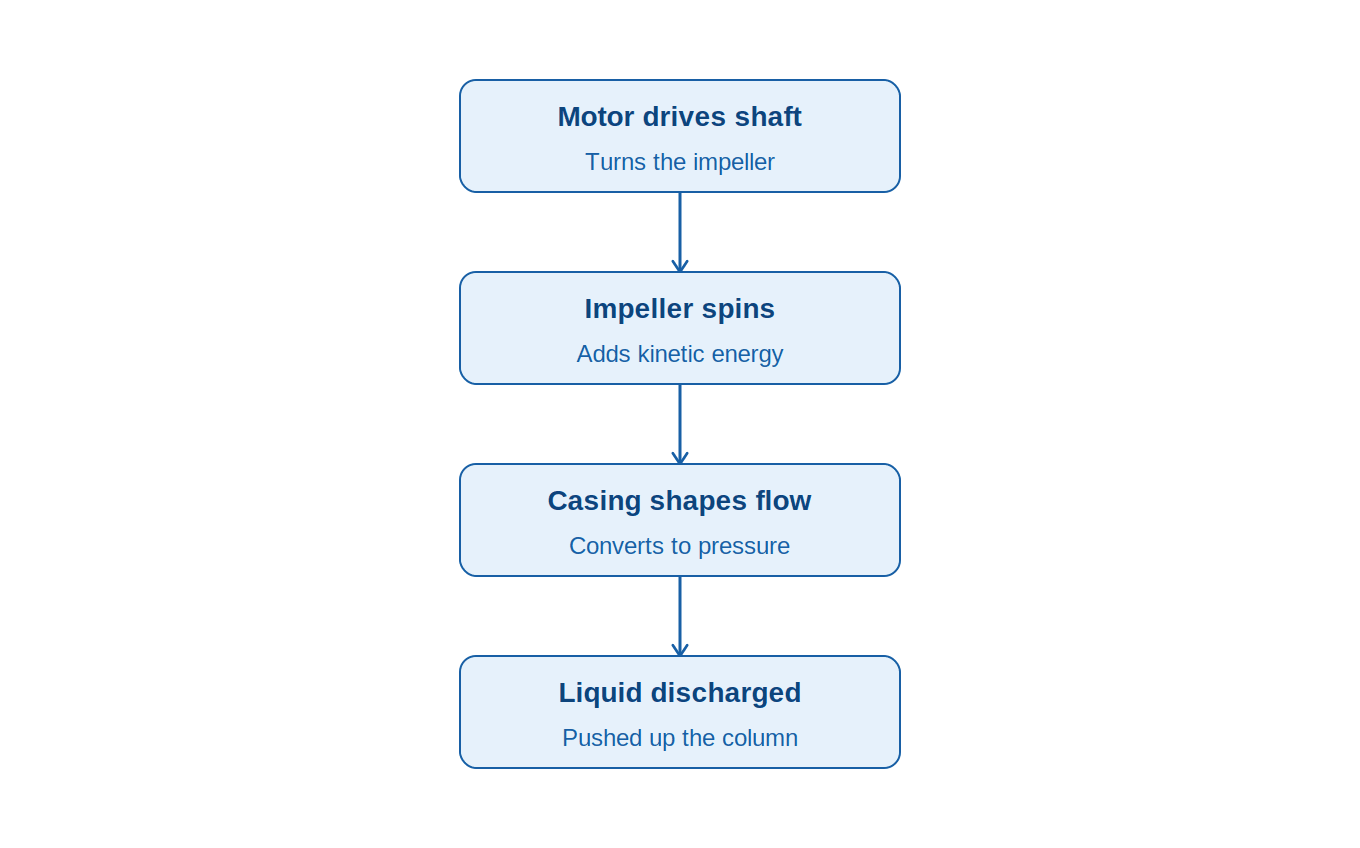
The sump pump working principle rests on a straightforward mechanical idea: a rotating impeller converts motor energy into kinetic energy in the liquid, which then converts to pressure as the liquid moves through the casing and up the discharge column.
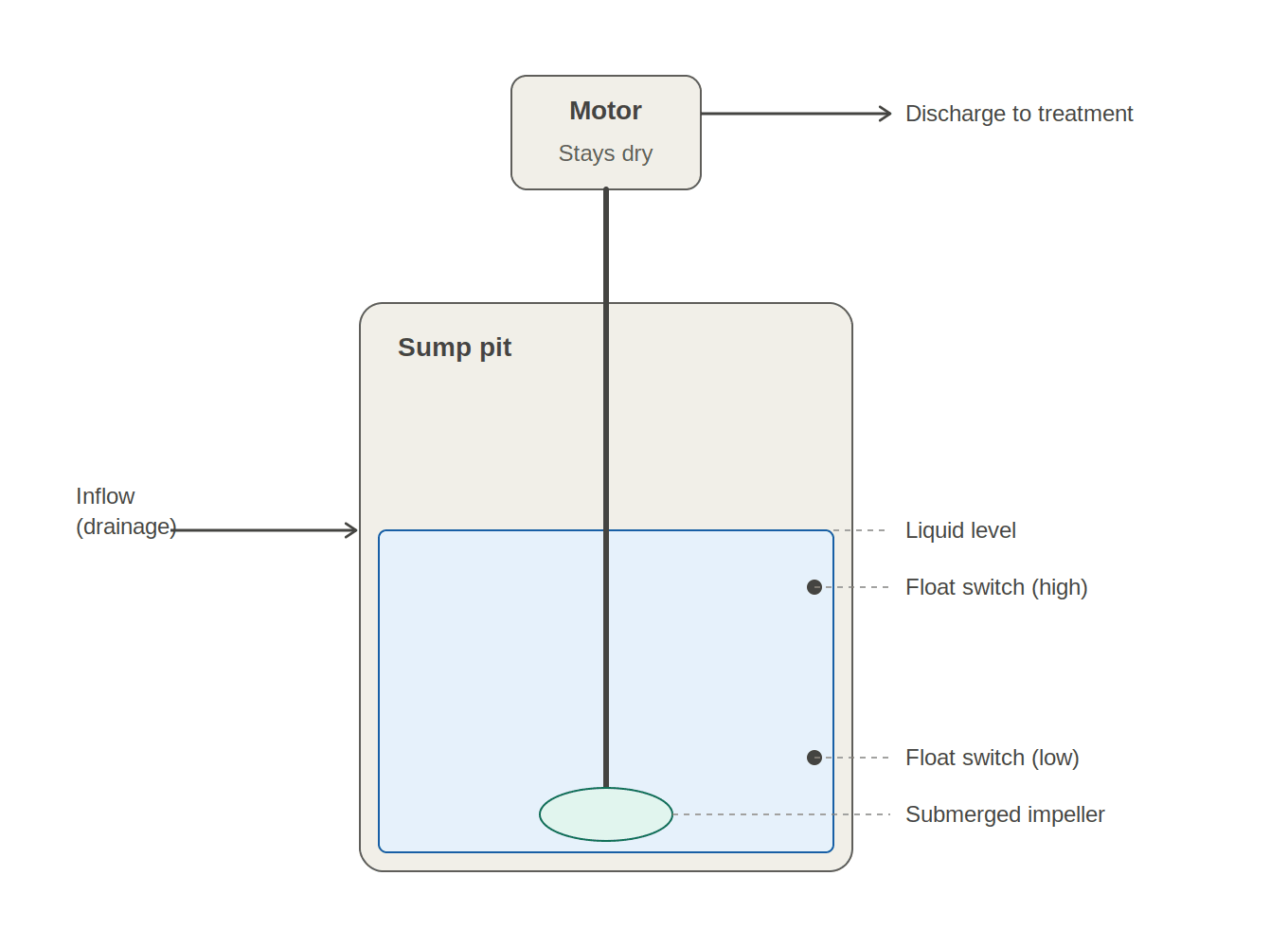
In most deep pits, the pump uses a long vertical shaft reaching toward the floor, with the impeller submerged near the bottom and the motor mounted above, away from moisture. Liquid enters through a suction bell near the base, and the impeller flings it outward and up the column. This vertical arrangement keeps the motor dry while the wet end does the work, and it's central to the sump pump working principle in any deep installation.
Float switches or level sensors handle the last part: starting and stopping the pump as levels rise and fall. It's the piece of the sump pump working principle most engineers overlook, right up until a switch fails and the pit runs dry or overflows.
Sump Design: Getting the Pit Right the First Time
Good pit planning decides whether the pump inside performs for ten years or fails within one. Skipping it is one of the most common, and most preventable, causes of early pump failure across Indian plants.
Three things drive sound sump design. The pit needs enough retention volume to stop the pump from short-cycling, since rapid start-stop wear burns through motors fast. The approach to the suction bell has to stay free of sharp turns or dead corners where solids settle and vortex, because a vortex pulls air into the pump and triggers cavitation. And the layout has to account for the actual liquid, not an idealised version of it: abrasive slurry, high-temperature condensate, and fibrous effluent each demand different pit geometry and lining.
Also Read – Vertical Sump Pumps: Applications, Working Principle & Selection Guide
Industrial Sump vs. a Household Sump Pit
A household pit deals with occasional rainwater or basement seepage. An industrial sump runs continuously or near-continuously, handles far higher flow volumes, and often carries suspended solids, chemicals, or elevated temperatures that a domestic pump was never built to survive. One in a sugar mill or steel plant can run in shifts around the clock during a crushing or casting season.
Material choice reflects that gap. This kind of installation usually needs cast-iron or stainless-steel wetted parts, hardened impellers, and mechanical seals rated for the specific chemistry involved, none of which is necessary or economical for a home. Engineers specifying an industrial sump shouldn't simply scale up a domestic pump.

Vertical Centrifugal Sump Pump
For most deep industrial pits, a vertical centrifugal sump pump is the practical choice. It keeps the motor above the liquid level while the pumping element stays submerged, solving the two biggest problems in sump service: motor protection and priming.
Because it doesn't rely on suction lift from a dry-mounted position, a vertical centrifugal sump pump can be lowered to whatever depth the pit requires, sometimes several metres, without complicated priming arrangements. The shaft length is simply matched to pit depth, which is why sugar mills and paper plants across UP and Maharashtra rely on this configuration for bagasse pit drainage and white water recovery.
Sintech's STFV and CPSV ranges are built this way: a vertical, submerged-impeller design pairing torque-flow or centrifugal hydraulics with a column suited to variable pit levels and solids-laden liquid.
Where a Sump Facility Shows Up in Indian Plants
Thermal power plants use condensate pits and ash slurry pits to keep boiler areas and ash handling systems from flooding. Paper mills rely on white water pits to recover fibre-laden process water before it reaches effluent treatment. Steel plants use them at cooling water return points and scale pit drainage, and water treatment plants use the same principle at lift stations wherever water needs to move between elevation changes.
A sump facility in a thermal power plant looks nothing like one in a paper mill, though the underlying idea, catch the liquid, pump it out, is identical. No two are specified the same way, because the liquid, temperature, and duty cycle differ from one plant to the next.
Sump Pit Sizing and Pump Selection
Selection starts with inflow rate, not a catalogue. An engineer needs peak and average inflow, the total dynamic head the pump must overcome, and the nature of the liquid, clean, abrasive, or fibrous, before a model number means anything. The sump pit dimensions and the pump curve should be chosen together, not one after the other, because the sump pump meaning changes slightly with every application it serves.
Retention time matters just as much as flow rate. Too small a pit, and the pump short-cycles, wearing out the motor and bearings fast. Too generous, and solids settle and compact before the pump ever engages. Materials matter too: a pit handling sugarcane juice residue needs different wear-resistant coatings than one handling boiler condensate, and the pump specification should reflect that from day one.
Maintenance Realities
Even a well-designed sump facility needs consistent attention. Float switches drift out of calibration, impellers wear down from abrasive solids, and discharge lines scale up internally, quietly raising system head until the pump can no longer meet its design flow.
A practical routine checks float switch operation monthly, inspects wear rings and impeller clearance during scheduled shutdowns, and monitors motor current draw for early signs of wear. Neglect anywhere in the sump pit shows up as reduced flow long before the pump actually fails. Plants that skip this tend to find out during a monsoon surge or crushing-season peak, exactly when the system can least afford to fail. Retrofitting an ageing sump pump with a modern hydraulic design is often worth evaluating during a major overhaul, particularly if plant expansion has changed the original layout.
Where Sintech Fits In
Sintech Pumps has manufactured pumps out of Ghaziabad, Uttar Pradesh, since 1986, and sump duty has been part of that work from early on. Plants across the sugar, power, and paper sectors, including Balrampur, Triveni, and Dhampur Sugar Mills, have relied on Sintech's vertical sump pumps for drainage that runs through an entire season without failure. For most of these applications, Sintech recommends a vertical centrifugal sump pump from the STFV or CPSV range, matched to the pit rather than pulled off a standard catalogue page.
What tends to matter most to engineers isn't the datasheet. Sintech's team starts by asking what is a sump pump expected to handle on a given site, not just how big it needs to be, and that approach to sump design begins with the pit drawings, not the pump curve, so geometry and pump selection are matched from the start instead of reconciled after installation problems show up. Every recommendation follows the same sump pump working principle Sintech applies across industries: build for the liquid and the duty cycle in front of you, not a generic one. If you're planning a new pit, or dealing with a pump that keeps failing prematurely, that's worth raising before the concrete gets poured.
Conclusion
Getting the pit layout, sizing, and pump selection right from the start is the difference between a sump facility that runs quietly for a decade and one that becomes a recurring maintenance headache. If you're specifying a new pit, or trying to work out why an existing one keeps giving trouble, it's worth talking to engineers who've solved this across sugar, power, and paper plants for close to four decades. Learn more about Sintech's sump design services and vertical sump pump range at sintechpumps.com.
Frequently Asked Questions
What is a sump facility used for in industrial plants?
It collects excess process liquid or seepage at a low point and pumps it out to a treatment system or discharge channel, protecting equipment and floor areas from flooding.
What is a sump pump, in simple terms?
A pump designed to sit within or above a pit and lift accumulated liquid vertically to a discharge point, usually triggered automatically by float switches.
What does sump pump mean actually in an industrial setting?
At home, the sump pump stops at basement drainage. In a plant, the same term covers pumps handling hot condensate, abrasive slurry, or fibrous effluent, which is why that definition needs context on a datasheet, not a one-line answer.
How deep should an industrial sump pit be?
Depth depends on inflow volume, retention time, and the total dynamic head the pump needs to overcome; most range from a few feet to several metres, sized through calculation rather than guesswork.
Why use a vertical centrifugal sump pump instead of a horizontal one?
It keeps the motor above liquid level while the impeller stays submerged, removing priming issues and allowing greater depth without a separate dry-pit chamber.
What causes premature failure in an industrial sump?
Usually poor pit planning, undersized volume causing short-cycling, worn impellers from abrasive solids, or float switches that were never recalibrated after installation.
How often should a sump facility be inspected?
Float switches monthly; impeller and wear ring clearances during scheduled shutdowns, ideally before peak-season demand hits hardest.
Can an old sump pump be retrofitted instead of replaced?
Often, yes, if the pit geometry hasn't changed significantly. Upgrading to a modern hydraulic design can extend service life without a full rebuild.
Hey, like this? Why not share it with a buddy?
« Dynamic Sealing Pump for Juice & Food Processing: How It WorksVertical Turbine Pump vs Submersible Pump: Which One Should You Use, and When? »