Follow us

Follow us

Home » Blog » Process Pumps for Chemical & Pharmaceutical Plants: What Engineers Need to Know

Process Pumps for Chemical & Pharmaceutical Plants: What Engineers Need to Know

Posted: 31/07/2026
Category: Blog

Table of Contents

  1. Why Chemical and Pharma Plants Need a Different Kind of Pump
  2. What Makes Centrifugal Process Pumps Suitable for Chemical Duty?
  3. Chemical Transfer Pump vs. General-Purpose Pump: What’s the Real Difference?
  4. Material Compatibility and Sealing: The Two Decisions You Can’t Get Wrong
  5. Why ISO 5199 and ISO 2858 Compliance Actually Matters
  6. The Most Common Pump Failures on Chemical and Pharma Lines
  7. Choosing an Industrial Pump Manufacturer for Chemical and Pharma Applications
  8. Where Sintech Fits Into This Picture
  9. FAQs

Process pumps for chemical and pharmaceutical plants are built to handle corrosive, high-temperature, or contamination-sensitive fluids that a standard pump cannot survive. The right choice depends on wetted-part material, seal type, and compliance with ISO 5199 and ISO 2858, the two standards governing chemical-duty centrifugal pumps. Engineers should match material and sealing to actual fluid chemistry, not general fluid categories, before specifying a pump for chemical or pharma duty.

Why Chemical and Pharma Plants Need a Different Kind of Pump

Ask any plant engineer who has worked both a general industrial line and a chemical process unit, and they’ll tell you the pumps are not interchangeable. Not because of marketing, but because the operating conditions are genuinely different. A pump moving treated water and a pump moving 30% hydrochloric acid at 80°C are solving two completely different engineering problems, even if they look similar from the outside.

Process industry pumps in chemical and pharmaceutical settings routinely handle fluids that are corrosive, abrasive, flammable, or sensitive to cross-contamination. Add in the fact that many pharma processes require validated, traceable equipment with no risk of product adulteration, and it becomes clear why pump selection here is closer to a materials-engineering decision than a catalogue pick. A wrong choice doesn’t fail gracefully: seals degrade fast, casings pit, and impellers erode well before their expected service life.

This is also why plants in chemical hubs across Gujarat, and process units around the Delhi-NCR belt near Ghaziabad, tend to specify pumps with far more care than a typical water-utility project would. The cost of pump failure in a chemical plant is measured in batch loss and downtime, not just a repair invoice.

What Makes Centrifugal Process Pumps Suitable for Chemical Duty?

Centrifugal process pumps are the workhorse of chemical plants for a simple reason: they handle a wide range of flow rates and heads efficiently, and their design can be adapted with different wetted materials, seal arrangements, and impeller geometries to suit almost any fluid.

What separates a chemical-duty centrifugal pump from a general industrial one comes down to a few specific engineering choices. The casing and impeller need to be cast in a material that won’t react with the process fluid, such as stainless steel grades, alloy variants, or lined constructions depending on the chemical involved. The shaft sealing arrangement needs to prevent leakage of hazardous or high-value fluid, which usually means a mechanical seal rather than gland packing. The hydraulic design also needs enough margin above the Best Efficiency Point (BEP), the flow rate at which the pump operates most efficiently, to handle the process swings that are normal in batch chemical operations.

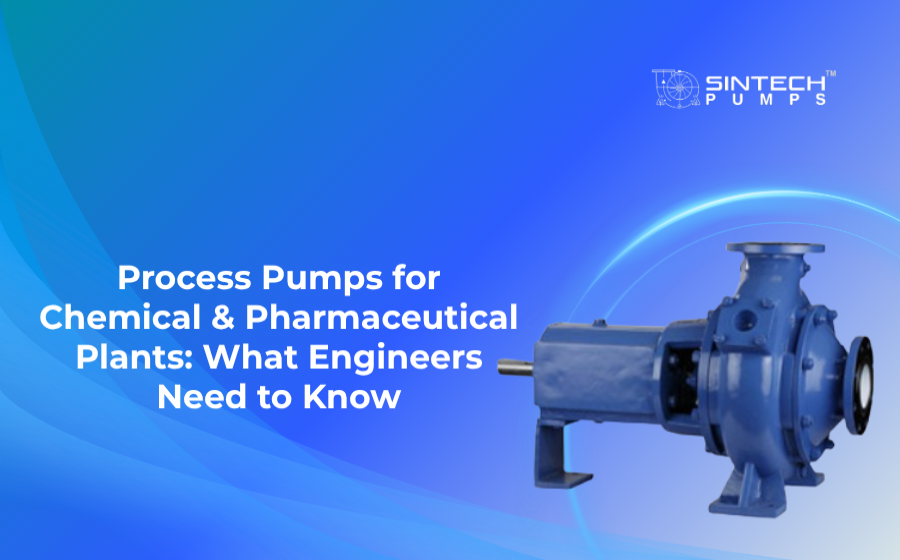
Sintech’s CPS range of centrifugal process pumps is built around exactly this logic: back pull-out design for easy maintenance without disturbing piping, wide material options for corrosive duty, and hydraulic profiles designed to ISO 5199 and ISO 2858, the two standards most referenced in chemical process pump specifications.

Chemical Transfer Pump vs. General-Purpose Pump: What's the Real Difference?

Engineers new to process specification sometimes assume a chemical transfer pump is just a centrifugal pump with a fancier name. It isn’t. The difference is in the assumptions baked into the design.

A general-purpose pump is designed around the assumption of a relatively benign fluid, such as clean water, mild effluent, or non-reactive liquids. A chemical transfer pump, by contrast, is designed around the assumption that the fluid could attack the pump itself. That changes almost every design decision: wetted-part metallurgy, seal face material, gasket compound, even the coating on fasteners exposed to fumes.

There’s also a duty-cycle difference worth flagging. Chemical transfer duty often involves batch operation: start, run, stop, restart, rather than continuous flow. Pumps not designed for this cycling can suffer premature seal wear or bearing fatigue. A properly specified chemical process pump accounts for this from the outset rather than treating cycling as an edge case.

Material Compatibility and Sealing: The Two Decisions You Can't Get Wrong

If there’s one section of this guide worth reading twice, it’s this one. Material compatibility and sealing account for the overwhelming majority of pump failures on chemical and pharma lines, and both are solvable at the specification stage, not after installation.

Material selection starts with the fluid’s chemical composition, concentration, and temperature, not just its general category. “Acid-resistant” is not a specification; the actual pH, chloride content, and operating temperature determine whether standard stainless steel, a higher alloy grade, or a lined pump is required. Getting this wrong shows up as pitting corrosion within months, sometimes weeks, in aggressive service.

Sealing is the second decision, and it’s where downtime is usually won or lost. Mechanical seals are standard for chemical duty because they contain the fluid far better than gland packing, but seal face material, elastomer compatibility, and flush plan all need to match the process fluid and its vapour pressure. A pump that’s otherwise perfectly specified will still leak, seize, or dry-run its seal if this step gets rushed. For pharma applications specifically, seal design also has to account for cleanability, with no dead zones where product can stagnate or contaminate the next batch.

Why ISO 5199 and ISO 2858 Compliance Actually Matters

Standards get mentioned a lot in pump literature, often without explaining what they actually guarantee. Here’s the plain version.

ISO 2858 defines the dimensional standard for end-suction centrifugal pumps. It ensures a pump’s mounting dimensions, shaft height, and nozzle positions are interchangeable across manufacturers, which matters enormously for spares availability and future replacement. ISO 5199, the standard most relevant to chemical duty, goes further: it specifies stricter requirements for casing thickness, shaft deflection limits, and mechanical seal chamber design specifically for pumps handling hazardous or corrosive fluids in the process industries.

In practice, ISO 5199 compliance means a pump has been engineered with the safety margins chemical duty demands: thicker castings to survive corrosion allowance, tighter shaft deflection to protect seal life, and a seal chamber designed for reliable mechanical seal performance rather than packing. When a procurement team asks whether a pump is “process-duty” or just “industrial,” ISO 5199 compliance is the honest answer to that question. Sintech manufactures its process pump range under ISO 9001 quality systems with design compliance to ISO 5199 and ISO 2858, alongside IS 9137 acceptance testing where required for Indian project specifications.

The Most Common Pump Failures on Chemical and Pharma Lines

Field experience across sugar, paper, power, and chemical process plants points to a handful of failure patterns that repeat far more often than plant teams expect.

Seal failure from mismatched flush plans is the most frequent one: a seal rated correctly for the fluid but starved of proper cooling or flushing will fail early regardless of how good the seal itself is. Cavitation from insufficient Net Positive Suction Head (NPSH), the minimum suction-side pressure a pump needs to avoid vapour bubble formation at the impeller eye, is another repeat offender, especially on suction-lift installations with long pipe runs. Casing erosion from running a pump well off its BEP for extended periods, often because the process flow rate changed after installation but the pump specification never did, shows up as gradually declining efficiency long before it shows up as an obvious fault.

None of these are exotic problems. They’re specification and operating discipline problems, and they’re preventable with the right pump selection and a realistic look at actual operating conditions rather than nameplate assumptions.

Choosing an Industrial Pump Manufacturer for Chemical and Pharma Applications

Procurement teams evaluating an industrial pump manufacturer for chemical or pharma duty are usually weighing the same handful of factors: material and metallurgy options, documented standards compliance, spare parts lead time, and whether the manufacturer actually understands the application or is simply selling from a catalogue.

This is where the distinction between a commodity supplier and an application-focused manufacturer shows up. A supplier that asks about fluid concentration, temperature, cycling frequency, and NPSH available before quoting is thinking about your process. One that just asks for flow and head in isolation is thinking about a transaction. For chemical and pharma projects specifically, it’s also worth confirming testing documentation, including hydrostatic test certificates, material test certificates, and performance curves verified against IS 9137 or ISO 9906, since these become part of the plant’s compliance record.

Among centrifugal pump manufacturers in India, the field ranges from large multinational operations with premium pricing to regional manufacturers with narrower technical depth. Sintech Pumps has operated from Ghaziabad, Uttar Pradesh since 1986, building process pumps to ISO 9001 quality standards for chemical, sugar, power, and paper industries across India and export markets in Africa, Southeast Asia, and the Middle East.

Where Sintech Fits Into This Picture

None of this changes if the pump comes from a well-known brand or a regional manufacturer. The physics of corrosion, cavitation, and seal wear don’t care about the label on the nameplate. What changes outcomes is whether the manufacturer engages with the actual process conditions before recommending a pump.

Sintech’s CPS centrifugal process pumps are engineered to ISO 5199 and ISO 2858 with material options suited to chemical transfer duty, and the company’s application engineering team reviews fluid data, NPSH available, and duty cycle before finalising a specification rather than after installation problems surface. For plants running chemical or pharma process lines and evaluating a chemical process pump replacement or a new installation, that upfront review is usually where the real value shows up, long before the first invoice.

If your plant is specifying pumps for a new chemical process line, or replacing an underperforming unit, Sintech’s engineering team can review your fluid and process data and recommend a pump built for your actual operating conditions rather than a generic fit. Learn more about what the right process pump selection can do for your plant’s uptime before your next shutdown window.

Frequently Asked Questions

  1. What is the difference between a process pump and a standard centrifugal pump?

A process pump is engineered for corrosive, hazardous, or temperature-sensitive fluids, with material and sealing choices matched to the application. A standard centrifugal pump is typically built for benign fluids like water and lacks the same material or seal customisation.

  1. Which standard applies to chemical process pumps in India?

ISO 5199 is the primary standard for chemical-duty centrifugal pumps, covering casing thickness, shaft deflection, and seal chamber design. ISO 2858 governs dimensional standardisation, and IS 9137 covers acceptance testing for Indian project specifications.

  1. Why do mechanical seals fail on chemical transfer pumps?

Most seal failures trace back to an incorrect flush plan or seal face material mismatched to the fluid’s temperature and chemistry, not the seal itself. Verifying the flush plan against actual process conditions prevents the majority of early seal failures.

  1. Can the same pump be used for both chemical and pharmaceutical applications?

Not usually. Pharma applications require cleanable, dead-zone-free designs to prevent cross-contamination, while chemical duty prioritises corrosion resistance and containment. The base hydraulic design can be similar, but wetted surfaces and finish requirements differ.

  1. How do I know if my pump is running off its Best Efficiency Point (BEP)?

A pump running well off BEP shows symptoms like unusual vibration, elevated bearing temperature, or gradually declining flow despite no obvious blockage. Comparing actual operating flow against the pump’s performance curve is the fastest way to confirm it.

  1. What should I ask an industrial pump manufacturer before ordering a process pump?

Ask for material test certificates, standards compliance (ISO 5199/2858), documented NPSH requirements, and performance curve verification. A manufacturer who asks about your fluid chemistry and duty cycle before quoting is evaluating your application, not just your flow and head numbers.

Hey, like this? Why not share it with a buddy?

Leave a Reply

Top
Thanks!

Want us to call you back?

*Please share your details so that our representative can reach out to you. Please schedule a call between 9:30 AM to 5:30 PM (IST) Mon-Sat.

    SCS Pump Your phone number will not be used for marketing purposes.