Table of Contents
- Introduction
- Understanding Vertical Turbine Pumps
- What Is a Vertical Turbine Pump?
- Working Principle Explained
- Types of Vertical Turbine Pumps
- Canned & Deep‑Well Pumps
- Mixed‑Flow & Axial‑Flow Pumps
- Submersible Turbine Pumps
- Open‑ vs Closed‑Line‑Shaft Designs
- Applications of Vertical Turbine Pumps
- Irrigation & Agricultural Water Management
- Municipal Water Supply & Treatment
- Industrial Processes & Power Generation
- Fire Protection & Emergency Systems
- Why Vertical Turbine Pumps Excel in Irrigation
- High Flow & High Head Performance
- Energy‑Efficient Operation
- Robust Construction for Dirty Water
- Space‑Saving Installations
- Vertical Turbine Pumps for Municipal Use
- Deep‑Well Water Extraction
- Consistent Pressure & Flow for Distribution
- Ease of Maintenance & Reliability
- Vertical Turbine Fire Pumps
- Comparison with Horizontal Pumps
- Selecting the Right Vertical Turbine Pump
- Key Parameters (Flow, Head, Fluid Properties)eing distributed through irrigation pumps and sprinklers. A horizontal centrifugal pump might struggle or require priming and long suction pipes, increasing the risk of cavitation. Now picture a city’s waterworks. The municipal well extends 200 metres below ground, and the system must deliver thousands of cubic metres of water daily at steady pressure despite fluctuating demand. Vertical turbine pumps are built for these challenges.
- Unlike standard horizontal pumps, vertical turbine pumps mount their motor above ground and have a long vertical shaft that connects to an impeller assembly submerged in the water source. This configuration offers several benefits:
- Customisation & Materials
- Maintenance Tips for Long‑Term Reliability
- Conclusion
Introduction
Imagine a large farm in a semi‑arid region. Groundwater lies deep below the surface and must be lifted hundreds of metres before High head and high flow
: Multi‑stage impellers can generate strong pressure while moving large volumes. - Deep‑well operation: Because the pumping elements are submerged, VTPs can lift water from depths exceeding 100 m.
- Small footprint: The vertical configuration saves valuable floor space, making these pumps ideal for crowded pump stations or agricultural setups.
- Positive suction & minimal priming: Submerged impellers avoid the need for priming, reducing cavitation risk and ensuring reliable start‑up.
Throughout this blog we’ll show how these features translate into tangible benefits for irrigation and municipal systems. We’ll also discuss potential drawbacks and how to mitigate them through proper selection and maintenance.Understanding Vertical Turbine Pumps
What Is a Vertical Turbine Pump?
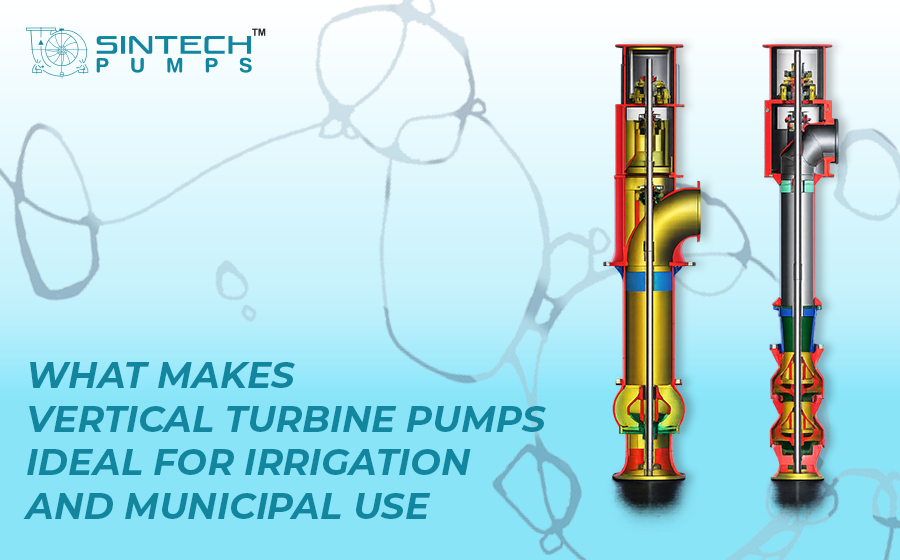
A vertical turbine pump is a specialised type of centrifugal pump designed to move fluid from deep wells, reservoirs or pits to the surface. Its motor is mounted at ground level, while a long vertical shaft connects to a submerged pump bowl assembly. Water enters through a suction bell at the bottom and passes through one or more impeller stages that add velocity; diffusers convert the velocity into pressure before water is pushed up the discharge column. Because the pumping elements are below the water level, these pumps do not require priming and can handle high suction lifts.Vertical turbine pumps differ from turbine water pumps used in hydropower, but the names are sometimes used interchangeably in industry. In essence, a vertical turbine pump
is a multi‑stage centrifugal pump oriented vertically. This design makes them particularly well‑suited to applications where water must be lifted from significant depths or where floor space is at a premium.Working Principle Explained
The working principle of a vertical turbine pump
can be summarised in four stages:- Motor & Shaft Rotation – An electric or diesel motor mounted above ground transmits torque to a long vertical shaft.
- Impeller Action – The shaft drives multiple impellers submerged in the fluid. Each impeller stage increases the velocity of the water.
- Diffusion & Pressure Increase – After the water leaves an impeller, it enters a diffuser (or bowl). The diffuser’s curved vanes convert velocity into pressure. Stacking several impeller–diffuser stages in series multiplies the head.
- Discharge to Surface – The pressurised water travels up the column pipe to the discharge head, where it enters the distribution system.
Components at a Glance
A typical vertical turbine pump consists of several key components:- Discharge head – A surface‐mounted assembly that houses the thrust bearing, connects to the motor and directs discharge flow.
- Column pipe & line shaft – The column carries water to the surface and holds the line shaft that transmits torque to the impellers. An enclosed (oil‑lubricated) or open (water‑lubricated) lineshaft design influences maintenance and lubrication requirements.
- Pump bowl assembly – A stack of impeller stages and diffusers. Each stage adds head and contributes to the overall performance.
- Suction bell & strainer – The bottom component that guides water into the impellers while preventing large debris from entering.
- Bearings & support bushings – Ensure the long shaft remains aligned; they are lubricated by either pump water or oil, depending on design.
Understanding these elements helps engineers configure a pump that delivers the required flow and pressure while keeping maintenance manageable.Types of Vertical Turbine Pumps
Vertical turbine pumps are not one‑size‑fits‑all. Different designs have evolved to suit various applications, fluid types and installation requirements. Below are the most common types you’ll encounter.Canned and Deep‑Well Turbine Pumps
Canned pumps
(also called suction barrel pumps) use a suction barrel or “can” fitted to the pump bowl assembly. The barrel encloses the suction line, preventing air from entering and improving priming. Canned pumps are common in the petrochemical industry and for handling hydrocarbons or volatile fluids.Deep‑well pumps
are designed specifically for extracting groundwater from wells that may be hundreds of metres deep. These pumps have long line shafts and multiple stages to overcome significant static head. They often use a water‑lubricated open lineshaft
to avoid oil contamination of potable water, though oil‑lubricated enclosed shafts are used where lubricant isolation is critical. Deep‑well pumps are widely used in irrigation
and municipal water supply
.Mixed‑Flow & Axial‑Flow Turbine Pumps
In applications where extremely high flow is needed at comparatively low heads, manufacturers turn to mixed‑flow and axial‑flow vertical pumps
. Mixed‑flow pumps combine radial and axial impeller designs to move large volumes (up to tens of thousands of gallons per minute). They are common in flood control, drainage and industrial cooling systems.Axial‑flow pumps
are essentially propeller pumps oriented vertically. They generate high flow at low head and are used for flood control, fish hatcheries and moving large volumes of water in shallow reservoirs.Submersible Turbine Pumps
A submersible turbine pump
integrates the motor into the submerged bowl assembly. Instead of a long lineshaft, power is transmitted directly to the impellers through a short shaft. Submersible turbine pumps
are used in deep wells, lakes or offshore applications where installation is challenging or where mechanical complexity of a lineshaft must be avoided.Open‑ vs Closed‑Lineshaft Designs
Vertical turbine pumps
can be further classified by how the shaft is lubricated:- Open lineshaft pumps use the pumped fluid itself to lubricate bearings. This design is common for potable water or irrigation systems because there is no risk of contamination. However, it requires careful attention to water quality and depth to ensure proper lubrication.
- Closed (enclosed) lineshaft pumps enclose the shaft within a tube filled with oil. Oil‑lubricated bearings allow use with dirty or corrosive fluids and in situations with air pockets in the column. The oil must be food grade if the pump is used for potable water.
Choosing between open and closed lineshaft designs depends on water quality, maintenance requirements and regulatory concerns.Applications of Vertical Turbine Pumps
One of the reasons vertical turbine pumps
are so versatile is their ability to handle a wide range of flows, heads and fluids. Let’s explore the key application categories.Irrigation & Agricultural Water Management
Irrigation is perhaps the largest single market for vertical turbine pumps
worldwide. Farmers need to lift water from deep tube wells
, canals or reservoirs and distribute it evenly across fields through drip or sprinkler systems. Deep‑well turbine pumps
are ideally suited because they can extract water from depths far beyond the suction capability of surface pumps. Moreover, by stacking impeller stages, they can deliver the high pressure required for spray irrigation
over large distances.The ability to handle high flow rates while maintaining efficiency
makes VTPs indispensable for large‑scale farms. Modern designs achieve flows ranging from a few hundred to tens of thousands of gallons per minute. Combined with variable frequency drives (VFDs), farmers can adjust speed to match crop demand, saving energy and ensuring uniform water distribution.Municipal Water Supply & Treatment
Municipalities depend on vertical turbine pumps
for potable water extraction and distribution
. Many towns draw water from deep aquifers
, where the water surface is too far below ground for horizontal centrifugal pumps. Vertical turbine pumps
are purpose‑built for such conditions; they lift water from deep wells to the treatment plant
and then pump it into storage towers or distribution mains at consistent pressure.Municipal pumping stations also use VTPs for stormwater control
, wastewater treatment
and reclaimed water reuse
. Because these pumps can be made from stainless steel, bronze or even duplex alloys, they resist corrosion and abrasion from raw water, brackish water or light industrial fluids. The reliability and longevity of VTPs mean fewer interruptions in water service and lower operating costs for municipalities.Industrial Processes & Power Generation
Vertical turbine pumps
play a critical role in industries such as petrochemicals, mining, desalination and power generation. In refineries and petrochemical plants, canned turbine pumps
handle hydrocarbons and volatile liquids where vapour suppression is crucial. Power plants use mixed‑flow vertical pumps
for circulating cooling water or feeding raw water to boilers. Mining operations employ deep‑well turbines for dewatering and process water transport. Desalination plants use vertical turbines to draw seawater into reverse‑osmosis systems and then pump permeate to storage reservoirs.Fire Protection & Emergency Systems
Vertical turbine pumps
also serve as fire pumps
in settings where water supply comes from underground tanks, wells or reservoirs. A vertical turbine fire pump
draws water from the source and pumps it at high pressure to the fire sprinkler system. Its vertical design saves floor space and allows it to lift water from depths beyond the reach of horizontal split‑case pumps
. Because the motor is above ground and not submerged, maintenance is easier and the pump can run on either electric or diesel power, providing redundancy during emergencies. Fire pumps must meet rigorous standards such as NFPA 20
, so choosing an experienced manufacturer like Sintech ensures compliance and reliability.Don’t leave your project’s success to chance. Trust Sintech Pumps to deliver dependable, customized vertical turbine solutions tailored to your specific irrigation, municipal, or industrial needs. Reach out to our experts at Sintech Pumps and take the first step toward a more efficient and reliable water management system today.Why Vertical Turbine Pumps Excel in Irrigation
Irrigation systems must deliver water to crops efficiently, reliably and at the right pressure. Here’s why vertical turbine pumps are the preferred solution for farms and plantations.
High Flow & High Head Performance
Crops often require high volumes of water, especially in large farming operations. Vertical turbine pumps
are designed to handle flow rates from hundreds to tens of thousands of gallons per minute
. When multiple impeller stages are stacked, the pump can also achieve high discharge heads
, making it capable of powering long sprinkler lines or travelling irrigators.Compared with horizontal pumps, vertical turbines can generate higher heads without massive increases in footprint or complexity. This makes them ideal for pumping water through hilly terrain or delivering water to elevated storage tanks. The ability to adjust the number of stages allows engineers to fine-tune the pump for the exact pressure required, maximising efficiency and reducing energy consumption.Energy‑Efficient Operation
Energy is a major cost in irrigation, especially where pumps run for hours each day. Modern vertical turbine pumps
are engineered for high hydraulic efficiency
, meaning they convert more input energy into useful water movement. Multi‑stage designs
reduce frictional losses, and precision‑machined impellers minimise turbulence.Research shows that VTPs can be more efficient than horizontal pumps
when operating at high head and low flow conditions. Because the pump is directly above the water source, suction losses are minimal, further improving efficiency. The addition of variable frequency drives
enables farmers to modulate speed based on real‑time demand, leading to significant energy savings.Robust Construction for Dirty Water
Irrigation water often contains suspended solids, sand or organic matter. Vertical turbine pumps
can be customised with abrasion‑resistant materials
such as hardened iron, stainless steel or special coatings. When an enclosed lineshaft
is used, bearings are protected from contaminated water, extending pump life. Sintech offers various material combinations tailored to the water quality of each project.Space‑Saving Installations
Farm equipment yards are busy places, so saving space is always a plus. The vertical configuration
places the motor above the well casing, leaving more room for pipelines, valves and control panels. As noted in a 2025 industry guide, vertical turbine pumps fit well into restricted layouts and wells
. They also require less excavation than installing long suction pipes for horizontal pumps.No Priming Required
Because the pump bowl is always submerged, vertical turbine pumps never need to be primed
. This saves time and reduces the risk of pump damage due to dry running. A constant supply of water to the impellers prevents cavitation and ensures long‑term reliability.Durability & Ease of Maintenance
Farms operate in harsh environments, so durability is paramount. VTPs are built with robust materials and can include oil‑lubricated enclosed shafts to prevent corrosion or wear from dirty water. Many models feature above‑ground motors
and modular bowl assemblies
that allow impellers or bearings to be inspected and replaced without pulling the entire pump. According to a 2025 blog on pump benefits, the above‑ground motor layout simplifies maintenance and lowers downtime.Vertical Turbine Pumps for Municipal Use
Municipal water supply and sanitation demand continuous, reliable pumping. Whether extracting groundwater, moving treated water or controlling stormwater, vertical turbine pumps offer several advantages.Deep‑Well Water Extraction
Many towns and cities rely on wells or boreholes
where static water levels may lie 100–300 metres below ground. Horizontal pumps cannot handle such suction lifts. Vertical turbine pumps are specifically designed to pump from deep wells
. By placing the pump bowl at the desired depth and using multiple impellers, they lift water to the surface with minimal risk of cavitation. Because the motor is on the surface, electrical connections remain dry and accessible.Consistent Pressure & Flow for Distribution
Once water reaches the surface, it must be pressurised and transported through pipelines to storage tanks or distribution mains. Multi‑stage VTPs produce high discharge heads
that maintain pressure even over long distances. Municipal engineers can adjust the number of stages to match system requirements, ensuring steady pressure even during peak demand.Additionally, the surface‑mounted motor
facilitates coupling with diesel engines
for backup power in case of electrical outages. This redundancy is critical for municipalities that must provide water 24/7.Ease of Maintenance & Long Service Life
Municipal budgets cannot afford frequent pump replacements. Vertical turbine pumps
are known for their reliability and long service life
. A 2025 industry blog notes that their corrosion‑resistant materials
and protective coatings
enable them to withstand harsh water conditions for decades
. Additionally, because the motor is above ground, routine maintenance such as oil changes or bearing inspections is simpler and does not require pulling the pump column. If wear does occur, individual bowls or impellers can be replaced, minimising downtime.Flexible Material & Drive Options
Municipal engineers often deal with varying water chemistries—from fresh groundwater to slightly saline coastal aquifers or even seawater. Vertical turbine pumps
can be constructed from stainless steel, bronze, duplex stainless or specialized alloys
. Motors can be electric, diesel or even turbine‑driven depending on available power sources. This flexibility ensures that the pump system fits local infrastructure and regulatory requirements.Reduced Noise & Vibration
Municipal pump stations are often located near residential areas. One of the benefits of vertical turbine pumps
is low noise and vibration
. Because the pump bowls are submerged, operational noise is dampened by the water. A 2025 blog emphasised that VTPs operate quietly and are suitable for installations near sensitive environments. Low vibration also prolongs the life of bearings and surrounding structures.Vertical Turbine Fire Pumps
Fire protection systems must deliver water rapidly and reliably during emergencies. In facilities where the water source is below ground or in a remote reservoir, vertical turbine fire pumps
are the preferred solution. Here’s why.- Deep‑water capability: Vertical turbine fire pumps can lift water from depths exceeding 100 m, ensuring access to underground tanks, wells or natural reservoirs. A vertical fire pump draws water directly from the source and provides the high head necessary for fire sprinkler systems
- Compact footprint: Fire pump rooms often have limited space. A vertical turbine design occupies minimal floor space compared to horizontal split‑case pumps.
- Easy maintenance & flexible power: With the motor above ground, maintenance of couplings, bearings and seals is straightforward. VTP fire pumps can be powered by electric motors or diesel engines, providing redundancy. Compliance with standards such as NFPA 20 ensures reliability.
- Suitable for remote and industrial sites: Industries such as chemical plants, power stations, data centres, airports and high‑rise buildings often use vertical fire pumps because they can draw from deep or remote water sources and deliver high pressures.
Sintech supplies UL‑listed and FM‑approved vertical turbine fire pumps
tailored to meet Indian and international fire codes. Our engineers can advise on pump sizing, materials and compliance requirements.Comparison with Horizontal Pumps
To appreciate the advantages of vertical turbine pumps, let’s compare them with horizontal split‑case or end‑suction centrifugal pumps
, which are often the alternative. The table below summarises the key differences.| Feature | Vertical Turbine Pump | Horizontal Centrifugal Pump |
| Installation Orientation | Pump bowl assembly submerged in well or reservoir; motor above ground. | Pump and motor on same horizontal plane; requires flooded suction or priming. |
| Suction Capability | Can lift water from deep wells (>100 m) because impellers are submerged. | Limited by atmospheric pressure; cannot draw from deep wells; requires priming. |
| Footprint | Small footprint – ideal for sites with limited space. | Requires larger floor space for pump and motor; suction piping adds to footprint. |
| Priming & Cavitation | No priming required; positive suction prevents cavitation. | Must be primed; risk of cavitation if suction conditions are poor. |
| Maintenance Access | Motor and thrust bearing above ground; easier access to coupling and drive components. | Entire pump assembly accessible at ground level; easier to inspect impellers but requires more space and may need disassembly of piping. |
| Applications | Deep‑well water supply, irrigation, fire protection, desalination, industrial processes. | Surface water transfer, booster pumping, HVAC systems, low head applications. |
| Cost | Higher initial cost due to vertical shaft, bowls and installation; lower operating cost because of efficiency and reliability. | Lower initial cost; may require additional infrastructure for suction lift and priming; potentially higher energy consumption for high‑head applications. |
Selecting the Right Vertical Turbine Pump
Choosing a vertical turbine pump is not simply about picking a model off the shelf. Each project has unique requirements that influence pump sizing, materials and features. Below are the critical factors to consider.Key Parameters: Flow, Head & Efficiency
- Design Flow Rate – Determine the maximum and minimum flow requirements. For irrigation, consider peak watering demand and future expansion. For municipal systems, account for daily consumption patterns and fire‑flow requirements.
- Total Dynamic Head (TDH) – Calculate the static lift (distance from water surface to discharge point), friction losses in the column and pipeline, and any pressure requirements at the discharge. Vertical turbine pumps allow you to choose the number of stages to match the required head with optimal efficiency.
- Net Positive Suction Head (NPSH) – Although VTPs mitigate cavitation by having submerged impellers, you should still evaluate the available NPSH in your well or reservoir to ensure proper submergence. Adequate submergence prevents vortex formation and air entrainment.
- Efficiency at Operating Point – Pump efficiency varies with flow. Choose a pump whose efficiency curve peaks near your design operating point to minimise energy consumption.
Fluid Properties & Materials Selection
- Water Quality – Determine whether the water contains sand, silt, corrosive chemicals or high salinity. For clean groundwater, bronze or stainless steel impellers may suffice. For corrosive or abrasive water, materials like duplex stainless steel or hardened iron extend service life.
- Temperature – Standard VTPs handle water up to 60–95 °C. For higher temperatures (e.g., hot process water), specialised bearings and materials may be required.
- Viscosity & Solids – Vertical turbine pumps are not ideal for slurries or very viscous fluids because the narrow passages can clog. If the fluid contains high solids, consider using a mixed‑flow or axial‑flow pump or consult Sintech for custom solutions.
Open vs Closed Lineshaft
- Open Lineshaft – Uses water for lubrication. Suitable for clean water applications but may wear quickly if water contains sand.
- Closed Lineshaft – Encloses the shaft in an oil‑filled tube. Better for dirty water and deeper wells; protects bearings from contaminants but requires oil maintenance. Food‑grade oil may be necessary for potable water.
Drive Options & Controls
- Electric Motors – Most common; available in various voltages and speeds. Pairing with a variable frequency drive (VFD) allows precise flow control and energy savings.
- Diesel Engines – Provide redundancy for critical systems such as fire pumps or remote irrigation where electricity is unreliable.
- Controls & Monitoring – Modern vertical turbine pumps integrate with SCADA systems for remote monitoring, performance tracking and predictive maintenance. Sensors measure vibration, temperature and flow to alert operators before failures occur.
Compliance & Standards
Irrigation and municipal pumps must comply with local and international standards. For fire pumps
, NFPA 20
(National Fire Protection Association) sets strict requirements for pump performance, reliability and testing. Sintech’s vertical turbine fire pumps
are manufactured to meet UL and FM standards and are fully tested before delivery.Customisation & Modular Design
One of the key advantages of vertical turbine pumps
is customisability
. Manufacturers can adjust:- Number of stages – More stages increase head; fewer stages reduce head but increase efficiency.
- Bowl diameter – Larger bowls increase flow capacity; smaller bowls are suited to lower flows.
- Material combinations – Bronze, stainless steel, cast iron or duplex materials can be mixed to handle different fluids.
- Discharge head configuration – Flange sizes and orientations can be tailored to site piping.
- Column length & shaft type – Each well depth requires a specific column length. Shafts may be keyed or threaded; couplings can be rigid, adjustable or flanged.
A reliable manufacturer like Sintech will help you configure the exact pump to meet your requirements, ensuring optimum performance and longevity.Maintenance Tips for Long‑Term Reliability
Although vertical turbine pumps are highly reliable, proper maintenance ensures they continue to operate efficiently for decades. Consider the following best practices:- Regular Inspection – Visually inspect the discharge head, motor, couplings and stuffing box for signs of wear or leaks. Check vibration and noise levels, as changes may indicate misalignment or bearing wear.
- Lubrication & Bearing Care – Maintain proper lubrication of thrust bearings and lineshaft bearings. For open lineshaft pumps, ensure the water used is clean and free of abrasive particles. For closed lineshaft pumps, monitor oil level and quality; replace or top up with the appropriate lubricant.
- Monitor Performance – Record flow, head, power consumption and vibration regularly. Significant deviations from the baseline could indicate impeller wear, obstructions or alignment issues.
- Submergence & Vortex Control – Maintain adequate submergence above the suction bell to prevent vortex formation and air entrainment. Install anti‑vortex plates or suction screens if necessary.
- Alignment Checks – Because the pump assembly extends several metres underground, misalignment can cause vibration and wear. Use precision alignment tools during installation and re‑check after major maintenance or seismic events.
- Impeller & Bowl Inspection – Depending on water quality, schedule periodic removal of the bowl assembly to inspect impellers, diffusers and wear rings. Trim impellers if necessary to match new operating conditions.
- Electrical & Control System Maintenance – Test motors, control panels and VFDs regularly. Keep the area free from dust and moisture; update firmware for remote monitoring systems.
By adhering to a proactive maintenance regimen, operators can extend the life of their vertical turbine pumps
and prevent costly downtime.Conclusion
Vertical turbine pumps
have cemented their place as the go‑to solution for irrigation
, municipal water supply
and fire protection
because of their ability to handle deep wells, high flow rates and high pressure while occupying minimal space. Their unique vertical orientation allows them to lift water from depths exceeding 100 metres without priming, while multi‑stage impellers generate the head needed to push water through miles of pipeline or up to elevated storage tanks.Modern designs incorporate energy‑efficient hydraulics
, corrosion‑resistant materials and modular components that simplify maintenance and reduce lifecycle costs. By carefully selecting the right pump type (deep‑well, canned, mixed‑flow or submersible), choosing appropriate materials and engaging experienced manufacturers like Sintech, you can ensure your pumping system delivers reliable performance for decades.If you’re designing a new irrigation scheme, upgrading a municipal pump station or looking for a fire pump solution, now is the time to consider vertical turbine pumps
. Contact Sintech Pumps today to discuss your project. Our engineers will analyse your requirements, recommend the best pump configuration and guide you through installation and commissioning. With Sintech by your side, you can be confident that your water supply will remain efficient, reliable and ready for the future.FAQs
When to use vertical turbine pumps?
Use vertical turbine pumps
when you need to move large volumes of water from deep wells or open reservoirs, where a surface-mounted motor keeps maintenance easy. These turbine pump
s are ideal for irrigation systems, municipal wells, and industrial processes where floor space is limited and high head is required. They outperform typical irrigation pumps
in depth, energy efficiency, and reliability. What are the advantages of vertical turbine pumps?
Vertical turbine pumps
offer a space-saving design and can handle high flow rates with high efficiency, making them well-suited for irrigation, fire pumps
, and municipal water supply. Their submersible turbine water pump
configuration eliminates priming, and the above-ground motor allows for easy maintenance. Durable materials and multi-stage impellers ensure long service life, reducing downtime and energy costs. Which type of turbine pump is often used as a booster pump in municipal water systems?
For municipal booster systems, line-shaft vertical turbine pumps are commonly used. They deliver high head and consistent pressure for distributing potable water across towns and cities. Unlike vertical turbine irrigation pumps
designed primarily for agriculture, these turbine pumps
(often called vertical turbine fire pump
s when configured for firefighting) provide the reliability needed for municipal pumping stations. How do you select a vertical turbine pump?
Begin by identifying the required flow rate, total dynamic head, and fluid characteristics. Consult reliable vertical turbine pump manufacturers
to choose materials that resist corrosion and abrasion. Consider whether you need an open or enclosed line shaft, and check local standards for fire pumps
or irrigation pumps
. A thorough site survey ensures your vertical turbine pump
is tailored to your pumps & irrigation
needs.