Follow us

Follow us

Home » Blog » Axial flow pumps for irrigation: canal, lift scheme and selection guide

Axial flow pumps for irrigation: canal, lift scheme and selection guide

Posted: 14/05/2026
Category: Blog

Table of Contents

  1. Introduction
  2. India’s irrigation challenge: why the right pump matters
  3. How Axial Flow Pumps Work
  4. Horizontal vs Vertical Axial Flow Pumps; Choosing the Right Configuration
  5. Key Selection Parameters for Irrigation and Canal Applications
  6. Sintech SAF/SVAF Axial Flow Pumps; Technical Specifications
  7. Civil and Sump Design Considerations for Irrigation Pump Stations
  8. Lifecycle Cost and Maintenance for Large Irrigation Pu

Introduction

India has more agricultural land under irrigation than almost any country on earth. Managing that water, lifting it from canals, rivers, and reservoirs and pushing it across hundreds of kilometres of distribution networks is a civil engineering challenge of the first order. At the centre of that challenge sits a decision that many project engineers still get wrong: choosing the right pump for the right application.

Centrifugal pumps are the default for most industrial procurement teams. But in large-scale irrigation pumps applications where you need enormous volumes of water moved over modest heads, centrifugal pumps are often the wrong tool for the job. The better answer, in most cases, is an axial flow pump: a machine specifically designed to move high volumes at low differential pressures with a level of efficiency that conventional centrifugal designs simply cannot match at this operating point.

This guide is written for government irrigation engineers, EPC project teams, and pump specifiers working on canal intake stations, lift irrigation schemes, and flood management infrastructure. It covers the engineering fundamentals, configuration decisions, selection parameters, and lifecycle realities that determine whether a pump station performs for twenty years or becomes a chronic maintenance liability.

India's irrigation challenge: why the right pump matters

India irrigates roughly 70 million hectares of agricultural land through surface water systems, canals, rivers, and reservoirs, with another 70 million hectares relying on groundwater. Government programmes like the Pradhan Mantri Krishi Sinchayee Yojana (PMKSY) and the Jal Jeevan Mission have accelerated public investment in rural water infrastructure, creating a substantial pipeline of new pump station projects and rehabilitation contracts for ageing equipment.

The fundamental hydraulic challenge in surface water irrigation is this: you need to move very large volumes of water, often thousands of cubic metres per hour, across relatively small elevation differences, anywhere from 2 to 15 metres, in a typical canal or lift irrigation scenario. This is an application defined by high specific speed (Ns), which is the engineering parameter that describes how much flow a pump delivers per unit of head. High-Ns applications demand propeller-type flow pump designs, not the radial impeller geometry of a conventional centrifugal pump.

Run a conventional centrifugal pump at its design point for an application that calls for an axial design, and you will find yourself dealing with a pump that is operating far outside its Best Efficiency Point (BEP). Power consumption rises. Cavitation risk increases. Bearing and seal loads climb. What looks like a familiar, easy-to-procure pump in the beginning becomes an expensive liability within two to three monsoon seasons.

The axial pump solves this problem at its root by matching impeller geometry to the actual hydraulic demands of large-volume, low-head water transfer.

How Axial Flow Pumps Work

An axial flow pump moves fluid in a direction parallel to the pump shaft axis. Where a centrifugal pump uses centrifugal force to throw fluid radially outward through a volute, an axial flow design uses a propeller-shaped impeller, typically two to five blades, to push fluid forward along the axis of rotation, much like a ship’s propeller through water.

The result is a pump that is hydraulically optimised for high flow rates and low heads. Specific speed values for axial flow pumps typically range from 8,000 to 16,000 (SI units), compared to 500 to 3,000 for conventional radial centrifugal pumps. This is not a marginal difference; it is a fundamentally different class of machine.

Operating characteristics and typical performance ranges

A typical agricultural irrigation water pump of the axial flow type operates in these ranges:

ParameterTypical Range for Irrigation Applications
Flow rate1,000 – 50,000 m³/hr
Total head2 – 12 metres
Specific speed (Ns)8,000 – 16,000
Shaft speed375 – 1,500 rpm
Motor power37 kW – 2,500 kW
Impeller blades2 – 5 (fixed or adjustable pitch)

The low shaft speed is worth noting. Because axial flow designs work most efficiently at low rpm for large-volume duty, they are often direct-coupled to slow-speed motors or driven through a gearbox where a standard four-pole motor is used. The choice between direct coupling and gearbox drive has implications for both capital cost and long-term maintenance, which we cover in the selection parameters section.

Axial vs Mixed Flow vs Centrifugal: When Each Is Right

Understanding where axial flow sits in the broader pump taxonomy is essential for correct specification:

Pump TypeSpecific Speed RangeHead RangeFlow RangeBest For
Radial centrifugal500 – 2,50010 – 200+ mLow to moderateHigh-head, moderate-flow process applications
Mixed flow2,500 – 8,0005 – 40 mModerate to highMedium-head, high-flow canal/drainage duties
Axial flow8,000 – 16,0002 – 12 mVery highLow-head, very high-flow irrigation, flood control

If a project specification calls for a Total Dynamic Head (TDH) above 15 metres with moderate flows, a mixed flow or centrifugal design is the more appropriate choice. If TDH falls below 10 metres and flows exceed 3,000 m³/hr, an axial flow pump is almost always the correct answer from an efficiency and lifecycle cost standpoint.

Horizontal vs Vertical Axial Flow Pumps: Choosing the Right Configuration

One of the most consequential decisions in specifying irrigation water pumps for large schemes is the orientation of the pump. Both horizontal and vertical configurations use the same fundamental axial flow hydraulic principle, but their civil structure requirements, installation logic, and maintenance profiles differ significantly.

Horizontal Axial Flow Pumps (SAF Configuration)

Horizontal axial flow pumps, such as Sintech’s SAF series, are installed with the shaft running horizontally. The pump typically sits at or near the water surface level, with the suction coming from an open channel or canal intake bay. Water enters axially through the suction bell, passes through the impeller, and discharges through a right-angle elbow or a diffuser into the rising main.

The SAF configuration is well-suited to canal intake structures where the water level is relatively stable, and the pump can be mounted on a concrete plinth at or above the water surface. These installations are common in headworks pumping stations and irrigation canals, where the civil structure allows for above-surface motor mounting. The motor is directly accessible for inspection and maintenance without the need for extraction lifting equipment, which is a practical advantage in remote rural pump stations.

Approach velocity in the intake channel is a critical design parameter for horizontal configurations. Too high an approach velocity creates uneven inflow to the suction bell, leading to swirl, air entrainment, and performance instability. The civil design must ensure that the approach velocity does not exceed 0.3 to 0.5 m/s at the bell mouth entry.

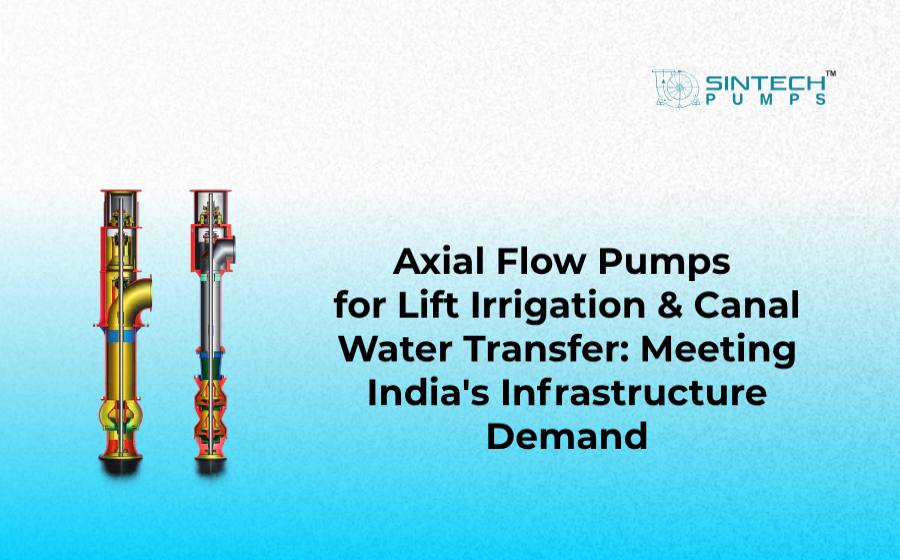
Vertical Axial Flow Pumps (SVAF Configuration)

Vertical axial flow pumps Sintech’s SVAF series are installed with the shaft running vertically, typically in a sump or dry pit. The pump column hangs from a discharge head mounted at ground level, with the impeller submerged in the sump. The motor sits above the flood level, protected from inundation even during high-water events.

The SVAF configuration is the standard for lift irrigation schemes, where water must be drawn from sumps fed by intake canals at varying seasonal levels. It is also the preferred choice for flood control pump stations, where the water level in the wet well can vary by several metres across the monsoon season.

The vertical axial pump arrangement allows the impeller to remain submerged and primed regardless of these surface-level fluctuations, which eliminates the priming problems that plague horizontal installations when water levels drop.

From a civil design standpoint, SVAF installations require a deeper sump structure but a more compact surface footprint, a useful trade-off where land is at a premium or where the pump station is integrated into a canal headwall.

Choosing Between SAF and SVAF: A Decision Framework

The choice between horizontal axial flow pumps and vertical axial flow pumps comes down to four factors: sump depth and water level variability, land availability, motor access requirements, and civil construction budget. Where seasonal water level variation exceeds 2 metres, the SVAF configuration is almost always the more reliable long-term solution. Where water levels are stable, and the civil structure allows for above-surface pump mounting, the SAF configuration may offer a lower initial capital cost.

Key Selection Parameters for Irrigation and Canal Applications

Specifying an irrigation motor pump for a large canal or lift scheme is not a catalogue exercise. The operating conditions in surface water irrigation are more demanding and more variable than in most industrial process applications. The following parameters must be calculated accurately before any pump is selected.

Flow Rate and Hydraulic Gradeline

The design flow rate is typically set by the irrigation command area and crop water demand. Large-scale schemes in India may require flows from 5,000 m³/hr for a minor irrigation canal scheme up to 30,000–50,000 m³/hr for a major lift irrigation project serving multiple districts. These flows are not steady state; they vary seasonally as cropping patterns change and canal water levels fluctuate.

The pump selection must account for the full range of operating flows, not just the design point. A pump that performs efficiently at design flow but hunts unstably at 60% or 70% load will cause operational problems across most of the irrigation season, since pumping stations rarely run at exactly 100% capacity.

Total Dynamic Head (TDH) and Available Head

TDH in a canal scheme includes the static head (elevation difference between suction and discharge water levels), pipe friction losses in the rising main, and minor losses in fittings. For a large irrigation water pump station, even a 0.5 metre error in TDH calculation can push the pump significantly away from its BEP, with material consequences for efficiency and shaft loading.

Head calculations must account for the full range of seasonal water levels at both suction and discharge. The difference between minimum and maximum TDH across a monsoon season can be 2 to 4 metres in a typical UP or Bihar lift irrigation scheme, a variation that spans much of the operating range of an axial flow machine. This is one reason Variable Frequency Drives (VFDs) are increasingly used in larger irrigation pump stations.

Water Quality: Silt, Debris, and Seasonal Variation

Indian surface water in the monsoon season carries substantial suspended silt, often 500 to 2,000 mg/litre in rivers and major canals during peak inflow. This has direct implications for impeller wear, particularly at the tip clearance and on the impeller blade faces. Irrigation pump manufacturers who design for Indian surface water conditions specify hardened impeller materials, typically high-chrome cast iron or stainless steel overlays in high-wear zones, rather than standard grey cast iron.

Trash racks and coarse screens are standard on all canal intake structures, but fine sediment passes through. The pump must be sized and specified to handle this. Adjustable-pitch impellers allow the operator to back off the blade angle and reduce tip speed during peak silt season, extending impeller service life.

Motor and drive configuration for irrigation motor pumps

The choice between direct-coupled slow-speed motors and high-speed motor-plus-gearbox drives is a significant capital and lifecycle cost decision. Direct-coupled drives with slow-speed motors (375 or 500 rpm) eliminate the gearbox maintenance burden and gearbox losses but require a custom motor that costs more upfront.

Gearbox drives use standard four-pole motors, which are cheaper and more widely available for replacement, but add gearbox lubricant servicing, seal maintenance, and the risk of gear tooth wear in abrasive dust environments. For government-operated irrigation pump stations where maintenance capability may be limited, the direct-coupled arrangement often results in lower total lifecycle cost despite the higher initial motor price.

Sintech SAF/SVAF Axial Flow Pumps: Technical Specifications

Sintech Precision Products Limited, based in Ghaziabad, Uttar Pradesh, manufactures both the SAF (horizontal) and SVAF (vertical) series axial flow pumps for large-scale irrigation, canal water transfer, and flood control applications. With over 38 years of pump manufacturing experience and ISO 9001 certification, Sintech has supplied axial flow pump installations across major lift irrigation and canal schemes in India.

The SAF and SVAF series are designed and tested to IS 9137 and ISO 9906 standards for hydraulic performance acceptance. This means that every pump is tested on a calibrated test bed before dispatch, with the measured performance curve verified against the guaranteed duty point. In government infrastructure procurement, where performance guarantees are contractual obligations, this matters.

Key standard features of the SAF/SVAF range include cast iron casing and impeller as standard, with high-chrome impeller options for abrasive silt service. Shaft sealing is by a mechanical seal or a packing gland, depending on the application. Bearing arrangements are designed for the high axial thrust loads characteristic of axial flow pumps, a loading regime that is often underestimated by specifiers more familiar with centrifugal pump shaft dynamics.

Customisation is available for non-standard hydraulic duties, unusual inlet conditions, or where the civil structure imposes constraints on overall pump dimensions. Sintech’s application engineering team works with EPC contractors and government project offices to review sump drawings, verify NPSH availability, and confirm that the selected pump configuration is compatible with the civil structure before manufacture.

For detailed technical specifications, performance curves, and dimensional drawings for the SAF and SVAF series, visit Sintech’s axial flow pump product page.

Civil and Sump Design Considerations for Irrigation Pump Stations

The pump station’s civil structure is not an afterthought. In many cases, a poorly designed sump is the primary cause of pump performance problems, even when the pump itself has been correctly specified.

Submergence and Air Entrainment Prevention

Every axial flow pump requires a minimum submergence above the impeller (or above the bell mouth for vertical configurations) to prevent air entrainment. If the water level in the sump drops below the minimum submergence, air is drawn into the impeller, causing a sudden drop in flow, increased vibration, and the risk of cavitation damage within seconds.

For SVAF installations in sumps with variable water levels, the pump column length must be designed so that the bell mouth remains submerged at the minimum design water level, with an adequate safety margin.

Minimum submergence values for vertical axial flow pumps are a function of bell mouth diameter and inflow velocity. As a general rule, submergence should be at least 1.0 to 1.5 times the bell mouth diameter. For a 600 mm diameter bell mouth, this means at least 600–900 mm of water cover above the bell entry at the minimum operating level.

Sump Geometry: Approach Velocity and Bell Mouth Entry

The approach velocity to the pump inlet must be controlled to prevent swirling and uneven velocity distribution across the impeller inlet face. SVAF sump design typically follows Hydraulic Institute Standards guidelines, which specify sump width, pump-to-wall clearances, and pump-to-pump centreline spacing to minimise inter-pump hydraulic interference in multi-pump stations.

Trash racks are mandatory on all irrigation pump sumps. Rack bar spacing should be sized to exclude debris that could contact the impeller. The rack open area must be large enough that even at 50% blockage, a realistic condition in the monsoon season with high debris load, velocity through the rack remains below 0.5 m/s to prevent suction problems.

Sintech offers a dedicated sump design service for irrigation pump stations. For EPC teams and government project offices designing new pump stations or rehabilitating existing ones, Sintech’s engineers can review sump geometry and flag potential hydraulic problems before civil work begins.

Lifecycle Cost and Maintenance for Large Irrigation Pumps

An irrigation motor pump station that runs unreliably costs far more than the capital difference between a well-specified pump and a cheaply procured alternative. Large irrigation water pumps in government schemes often operate 3,000 to 5,000 hours per year during cropping seasons, a demanding duty cycle that exposes any design shortcut quickly.

Wear Parts in High-Silt Environments

The components most vulnerable to wear in silt-laden surface water are the impeller blades, wear rings, and shaft bearings. Impeller blade erosion in high-silt service is progressive it increases tip clearance, which reduces hydraulic efficiency, which forces the motor to draw more current for the same output flow.

A 5% efficiency loss on a 500 kW agricultural irrigation water pump motor running 4,000 hours per year at ₹8 per kWh costs approximately ₹8 lakh annually in excess energy, enough to justify impeller replacement or refurbishment well before the next scheduled overhaul.

Wear rings protect the impeller eye from recirculation, but they themselves wear in silt service. Wear ring clearance should be checked annually in high-silt applications, with replacement when clearance exceeds twice the design specification.

Energy Efficiency and VFD Drives for Seasonal Load Variation

Axial flow pump energy consumption is sensitive to head variation. As canal water levels rise during the monsoon season, TDH decreases, and without speed control, the pump will operate at higher-than-design flow, potentially beyond the safe operating range. Variable Frequency Drives (VFDs) allow shaft speed to be adjusted to match actual head conditions, keeping the pump operating near its BEP across seasonal variation. For large irrigation pumps above 200 kW, VFD investment typically achieves payback within three to five years through energy savings alone.

Sintech’s energy management and audit service can baseline existing pump station energy consumption and identify whether VFD retrofitting or impeller re-trimming offers the fastest efficiency improvement path.

Contract Maintenance for Government-Operated Stations

Government irrigation departments often face constrained technical manpower for specialised pump maintenance. A structured contract maintenance programme covering scheduled inspections, wear part replacement, performance monitoring, and emergency response reduces the risk of unexpected breakdowns during peak irrigation season, when pump availability is most critical. Sintech provides contract maintenance support for pump stations across India, with spare parts stocking and field service engineers available from Ghaziabad.

For axial flow pump manufacturers supplying government irrigation schemes, the ability to support the pump station through its operational life, not just deliver equipment at commissioning, is an increasingly important differentiator in procurement evaluation.

Conclusion

Specifying axial flow pumps for a large irrigation scheme is an engineering decision with consequences that play out over twenty to thirty years of pump station operation. Get the hydraulic selection right, matching specific speed to the operating conditions, choosing the correct configuration for the civil structure, and accounting for seasonal variability in both flow and head, and you have a pump station that delivers water reliably for decades.

The selection decision is not just about the pump. It is about the civil interface, the sump geometry, the motor drive arrangement, the maintenance strategy, and the operational realities of the site. Irrigation pump manufacturers who understand this full picture, rather than simply offering catalogue selections, are the ones worth specifying.

If you are working on a new pump station project or evaluating options for rehabilitating existing axial flow pumps in an irrigation scheme, Sintech’s application engineering team can review your hydraulic brief, sump drawings, and TDH calculations, and recommend the appropriate SAF or SVAF configuration for your specific conditions.

Frequently Asked Questions

1. What is an axial flow pump, and how is it used in irrigation?
An axial flow pump uses a propeller impeller to move water parallel to the shaft, delivering very high flow at low heads (2–10 m). In irrigation, it is used in canal intakes, lift schemes, and flood control, where large water volumes must be moved efficiently over small elevation differences.

2. What is the difference between axial-flow and mixed-flow pumps for irrigation?
Axial pumps handle very high flow at low heads (<10–12 m) and high specific speeds (>8000). Mixed-flow pumps handle moderate-to-high flow at higher heads (5–40 m) with broader operating stability. Axial suits low-head canals; mixed flow suits higher head or variable TDH conditions.

3. How do you select an axial flow pump for a lift irrigation scheme?
Selection depends on Total Dynamic Head (TDH) and required flow. For TDH below 10 m and flows above 3,000 m³/hr, axial flow is preferred. Configuration (horizontal or vertical) depends on water level variation, civil design, and maintenance accessibility.

4. What head and flow ranges are typical for axial flow irrigation pumps?
Axial flow irrigation pumps typically handle 1,000 to 50,000 m³/hr at heads of 2 to 12 metres. Large Indian lift irrigation projects operate at higher ranges, delivering up to 30,000 m³/hr at 8–12 metres ahead using high-capacity vertical pump systems.

5. How are axial flow pumps installed for canal water pumping stations?
Horizontal pumps are installed near the canal level with elbow discharge. Vertical pumps are installed in a sump with submerged impellers and motors above flood level. Proper submergence, smooth inlet flow, and controlled approach velocity are critical for efficient and cavitation-free operation.

6. What maintenance do axial flow pumps require in irrigation applications?
Maintenance includes monitoring impeller wear, tip clearance, wear rings, bearings, and seals. Regular inspections are essential in silt-laden water. Annual overhauls are standard, with more frequent checks in high-silt conditions. Preventive maintenance is critical to avoid efficiency loss and unexpected failures.

Hey, like this? Why not share it with a buddy?

Leave a Reply

Top
Thanks!

Want us to call you back?

*Please share your details so that our representative can reach out to you. Please schedule a call between 9:30 AM to 5:30 PM (IST) Mon-Sat.

    SCS Pump Your phone number will not be used for marketing purposes.