Follow us

Follow us

Home » Blog » Desalination of water: pumps, process and sea water purification guide

Desalination of water: pumps, process and sea water purification guide

Posted: 19/06/2026
Category: Blog

Table of Contents

  1. Why pumps decide whether a desalination plant succeeds
  2. What does desalination actually involve?
  3. The desalination plant process, stage by stage
  4. Which pumps are used at each stage of desalination of ocean water?
  5. How to select high-pressure pumps for desalination
  6. Why material choice makes or breaks a sea water purification pump
  7. Operating and maintaining desalination pumps for the long run
  8. How Sintech engineers pumps for desalination of seawater projects
  9. Conclusion
  10. FAQs

Pumps are the working heart of every desalination plant. They lift ocean water, push it through filters, and raise it to the pressure that forces salt out across a membrane. This guide walks through the full desalination plant process, the pump used at each stage, how to select high-pressure pumps for desalination, and how to keep them running in harsh, saline conditions.

Introduction

A desalination plant is, in many ways, a chain of pumps. Take any one of them offline and the whole line stops. That is why engineers who design, buy, or run these plants spend so much time thinking about pumping. The membranes get the attention, but the desalination pumps are what make the membranes work.

If you are specifying equipment for a coastal water project or maintaining an existing plant along the Indian coast, this guide is for you. We will move through the desalination of water from intake to clean output, look closely at each pump’s job, and cover the practical questions of selection and day-to-day operation.

Why pumps decide whether a desalination plant succeeds

Desalination is energy-intensive, and most of that energy goes into pumping. Pushing seawater through a reverse osmosis membrane needs roughly 55 to 80 bar of pressure. That is the single largest power draw in the plant. So even a small gain in pump efficiency shows up directly on the electricity bill, month after month.

There is a second reason pumps matter here more than in an ordinary water supply. Seawater is corrosive, gritty, and never stops moving through the plant. The pumps run almost continuously, often 24 hours a day. A pump that fails early, leaks, or pits in the salt does not just cost a repair. It interrupts the water supply that a city or industry depends on.

What does desalination actually involve?

Desalination of water simply means removing dissolved salts and minerals from saline sources to make the water fit for drinking, agriculture, or industry. The two most common sources are the open ocean and brackish groundwater near the coast.

The headline numbers explain why it matters. About 97% of the planet’s water is saltwater, and average seawater carries roughly 3.5% salt far too much for people to drink. Seawater purification through desalination turns that abundant, unusable resource into a reliable supply. For water-stressed coastal regions, the desalination of ocean water has shifted from a luxury to basic infrastructure.

Two main technologies do the work. Thermal methods boil seawater and condense the vapour. Reverse osmosis, or RO, forces water through a semi-permeable membrane that traps the salt. RO now dominates new plants because it uses less energy, and almost all of that energy is delivered by pumps. So seawater purification at scale is, at its core, a pumping problem with a membrane attached.

The desalination plant process, stage by stage

Understanding the desalination plant process makes pump selection far easier, because each stage asks for a different kind of pump. Here is how the desalination of seawater moves through a typical RO plant.

First comes intake. Raw seawater is drawn from the sea through intake structures and lifted toward the plant. This calls for high flow at modest pressure, since the goal is simply to move a very large volume of water inland.

Next is pretreatment. The raw feed passes through filters that strip out sand, silt, marine organisms, and other particles. Booster pumps push the water through these filters, and backwash pumps periodically clean the filter beds by reversing the flow.

Then comes the heart of the desalination plant process: high-pressure feed. Filtered seawater is raised to RO operating pressure and forced against the membranes. The membrane lets pure water pass while holding back the salt. This is where high-pressure pumps for desalination do the heaviest work in the entire plant.

After the membrane, two streams leave. One is the product water, clean and low in salt, which is pumped to post-treatment and storage. The other is brine concentrated reject water which must be circulated and safely discharged. Many plants also recover energy from this high-pressure brine to cut power use.

So the desalination of ocean water is not one pumping task but several, each with its own flow, pressure, and fluid condition. That is the key insight behind good pump selection.

Which pumps are used at each stage of desalination of ocean water?

Now to the practical part. Different stages need genuinely different machines, and the right pumps for desalination are matched to the duty, not bought off a single shelf.

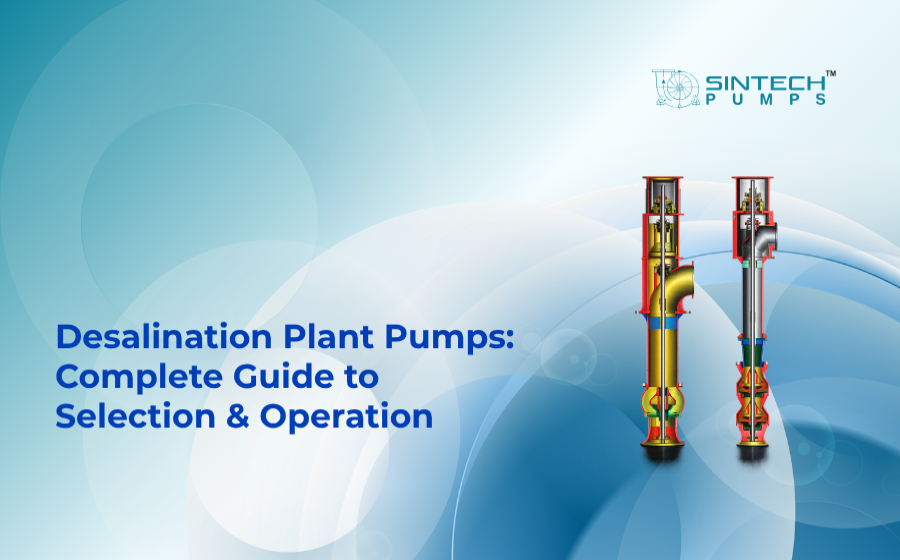
For seawater intake, the plant needs to move enormous volumes at low to moderate head. A split-casing double-suction pump is well suited here. Its twin-suction design balances the load on the shaft and handles very high flow with low vibration, which is exactly what a continuous intake duty demands. For installations where floor space is tight or the suction level changes with the tide, a vertical mixed flow pump (SVMF) is the stronger choice. Sintech’s SVMF series can deliver flows up to 44,000 m³/hr at heads up to 300 m, sits submerged so it never loses prime, and resists cavitation at the inlet.

For low-pressure transfer and filter feed, the water needs to move from pretreatment toward the high-pressure stage at moderate head. A horizontal mixed-flow pump (SMF) fits this duty cleanly. Sintech’s SMF series handles up to 7,000 m³/hr at around 45 m head, with a semi-open, hydraulically balanced impeller that copes with lightly turbid or saline water. Standard centrifugal process pumps (CPS), built to ISO 2858 and ISO 5199, cover transfer and flushing duties around the plant.

For the high-pressure RO feed, only a purpose-built machine will do. A multistage high-pressure pump raises filtered seawater to the 55 to 80 bar needed to drive reverse osmosis. Multiple impeller stages build the pressure in steps, which is why these are the high-pressure pumps for desalination that define the plant’s output and its energy use.

The remaining duties are handled by auxiliary desalination pumps: backwash pumps for cleaning filters, brine recirculation pumps that run at modest head, flushing pumps for membrane cleaning cycles, and dosing pumps for precise chemical addition such as anti-scalant and pH correction. None of them is glamorous, but a weak auxiliary pump can stall the whole line just as surely as a failed main pump.

How to select high-pressure pumps for desalination

Choosing high-pressure pumps for desalination comes down to a handful of questions, answered in order.

Start with flow and head. Size the pump to the plant’s design output and the membrane’s required operating pressure, then check where that point falls on the pump curve. You want the duty point at or near the Best Efficiency Point (BEP), because running far from BEP wastes energy and shortens the life of the pump.

Next, look hard at suction conditions. Net Positive Suction Head, or NPSH, is the margin that keeps the pump from cavitating. Cavitation vapour bubbles forming and collapsing inside the pump pits impellers and destroys efficiency. Seawater intakes are especially prone to it, so the available NPSH at the site must comfortably exceed what the pump needs.

Then consider efficiency over the plant’s life, not just the purchase price. On a high-pressure feed pump drawing hundreds of kilowatts, even a two- to three-point efficiency gain saves a substantial sum every year at Indian industrial power tariffs. Pairing the high-pressure stage with an energy recovery device compounds those savings.

Finally, confirm the materials and the standard the pump is built and tested to. For India, look for testing to IS 9137 or ISO 9906, which verify that the pump actually meets its rated curve before it ships. Reliable pumps for desalination are proven on a test bed, not just on paper.

Why material choice makes or breaks a sea water purification pump

This is where many specifications quietly go wrong. Seawater is one of the most aggressive fluids a pump will ever handle. It carries chloride, dissolved oxygen, silt, and marine life, and it attacks ordinary metals quickly.

Standard 304 or 316 stainless steel can suffer pitting and crevice corrosion within months in raw seawater. For wetted parts, the casing, impeller, and shaft sleeves, Duplex stainless steel such as SS2205 or Super Duplex such as SS2507 is the dependable choice. These alloys combine high strength with strong resistance to chloride attack, which is why Sintech machines the wetted components of its seawater pumps from Duplex grades.

Material selection is matched to the water itself. Salinity and temperature both influence the right grade, and the brine side runs even harsher than the feed side because the salt is concentrated. Getting the metallurgy right is just as important as getting the hydraulics right. A poorly specified pump may pit and fail within a year, while a correctly built Duplex pump can run for decades. This is the difference between a cheap pump and a low-cost one, and it shapes the real economics of the desalination of ocean water.

Operating and maintaining desalination pumps for the long run

Selection gets the plant started. Operation keeps it profitable. Because desalination pumps run nearly around the clock, small habits make a large difference over the years.

Keep the intake clear. Debris, weed, and silt at the suction starve the pump and raise the cavitation risk. Monitor vibration and bearing temperature, since a rising trend usually warns of trouble long before a failure. Watch the pump’s operating point too; if flow or pressure drifts from the design curve, efficiency is leaking away, and energy cost is climbing.

For the high-pressure stage, mechanical seals and wear rings deserve close attention, as they take the brunt of the pressure and the salt. Vertical intake pumps that sit submerged tend to run cooler and resist cavitation, which is one reason they suit continuous seawater duty so well.

When a pump has run well past its design life, a full replacement is not always the answer. A pump health check and energy audit often reveal that retrofitting or overhauling restores most of the lost efficiency at a fraction of the cost. For plants under pressure to cut power bills, that is frequently the smartest first move.

How Sintech engineers pumps for desalination of seawater projects

For desalination specifically, the portfolio maps neatly onto the plant: split casing double suction and vertical mixed flow SVMF pumps for high-volume seawater intake, horizontal mixed flow SMF pumps for low-pressure transfer and backwash, multistage units for the high-pressure RO feed, and centrifugal process pumps for transfer and flushing. 

Wetted parts are built in Duplex and Super Duplex for life in salt. Just as important, Sintech’s engineers will match the grade and the curve to a plant’s actual salinity, temperature, and flow rather than handing over a catalogue number. That application-first approach is what separates a pump that fits from a pump that lasts.

Conclusion

Desalination is no longer a frontier technology in India; it is steadily becoming part of how coastal cities and industries secure their water. And behind every litre of clean output sits a carefully chosen pump doing quiet, demanding work. Get the desalination pumps right, the correct type at each stage, the right metallurgy for the salt, and disciplined operation and a plant rewards you with reliable water and predictable running costs for years.

If you are planning a new plant, comparing suppliers, or rethinking an ageing system, it is worth talking the choices through with engineers who have specified these pumps before. The Sintech application team can review your process conditions, recommend the right pump for each duty, and help you weigh efficiency against lifecycle cost.

Frequently Asked Questions

1. What is the desalination plant process?

The desalination plant process removes salt from seawater in stages: intake, pretreatment filtration, high-pressure reverse osmosis through a membrane, and post-treatment of the product water. Pumps drive every stage, and the high-pressure feed pump does the heaviest work by forcing water across the membrane.

2. Which pumps are used for the desalination of seawater?

The desalination of seawater uses several pump types. Split casing double suction and vertical mixed flow pumps handle intake, horizontal mixed flow pumps manage transfer and backwash, and multistage pumps deliver the high pressure for reverse osmosis. Auxiliary pumps cover brine recirculation, flushing, and chemical dosing.

3. What are high-pressure pumps for desalination?

High-pressure pumps for desalination are multistage centrifugal pumps that raise filtered seawater to roughly 55 to 80 bar. That pressure forces water through the reverse osmosis membrane while the salt is rejected. They are the largest energy consumer in the plant, so efficiency directly affects running costs.

4. What materials are best for seawater desalination pumps?

Wetted parts of desalination pumps should use Duplex stainless steel like SS2205 or Super Duplex like SS2507. These alloys resist the chloride pitting and crevice corrosion that quickly damage ordinary 304 or 316 stainless steel in seawater, giving far longer service life in continuous saline duty.

5. How is seawater purification different from normal water treatment?

Sea water purification must remove dissolved salt, not just suspended particles, so it relies on reverse osmosis at very high pressure. Ordinary water treatment handles fresher sources at much lower pressure. This is why the desalination of water from the ocean needs specialised high-pressure and corrosion-resistant pumps.

6. How can plants reduce the energy cost of pumps for desalination?

Choosing efficient pumps for desalination that run near their Best Efficiency Point is the first step. Adding an energy recovery device on the brine stream, monitoring the operating point, and retrofitting worn pumps all cut power use. On large high-pressure pumps, small efficiency gains save significant money annually.

Hey, like this? Why not share it with a buddy?

Leave a Reply

Top
Thanks!

Want us to call you back?

*Please share your details so that our representative can reach out to you. Please schedule a call between 9:30 AM to 5:30 PM (IST) Mon-Sat.

    SCS Pump Your phone number will not be used for marketing purposes.