
Table of Contents
- When Does a Standard Pump Stop Being Enough for Hot Liquids?
- What a Recirculating Pump Actually Does in a Hot Water Loop
- Cast Iron, Cast Steel, or Stainless: Which Material Survives the Heat?
- Pump Material Selection by Temperature Band: A Working Reference
- Beyond the Casing: Seals, Bearings, and Thermal Expansion
- Inside Boiler Feed Pumps: Why This Duty Breaks Ordinary Pumps
- Hot Water Circulation Pump or Standard Centrifugal: How to Decide
- NPSH and Sizing Rules for Pumps Running Hot
- How Sintech Approaches High-Temperature Pump Selection
- Conclusion
- Frequently Asked Questions
Selecting the right pump for high-temperature liquids comes down to matching materials, seals, and design margins to the actual operating temperature and thermal cycling of the system. A poorly matched recirculating pump running hot water above 80°C will suffer seal failure, bearing wear, and casing distortion within months. This guide breaks down the metallurgy, seal design, and sizing logic that keep a high-temperature pump running reliably for years, not weeks.
When Does a Standard Pump Stop Being Enough for Hot Liquids?
Most standard centrifugal pumps are built for water at ambient temperature, somewhere between 20°C and 40°C. Once you push past 80°C, and further still into the 120°C to 180°C range common in boiler and process loops, the physics of the pump changes. Metal expands unevenly. Elastomer seals that seal perfectly at room temperature harden and crack. Bearing lubricant breaks down faster. And the fluid itself becomes more aggressive, carrying less dissolved oxygen but more dissolved minerals that can scale on impeller surfaces.
This is exactly where a standard recirculating pump, designed for a swimming pool filter or a cold-water loop, starts to fail. Ghaziabad-based manufacturers like Sintech Pumps design their high-temperature pump ranges with these realities built in from the casting stage, not bolted on afterward. The difference shows up not in the spec sheet but in the maintenance log three years later.
What a Recirculating Pump Actually Does in a Hot Water Loop
A recirculating pump does one job continuously: it keeps hot water moving through a closed loop (a boiler circuit, a district heating system, or a process heat exchanger) so temperature stays even and sediment doesn't settle. Unlike a pump that moves fresh liquid from point A to point B, a recirculating pump runs almost continuously against the same fluid, often for 8,000-plus hours a year.
That duty cycle changes the design priorities. A pump used for occasional transfer duty can tolerate some wear because it rests between cycles. A recirculating pump in a boiler house doesn't get that rest. Bearings, seals, and impeller clearances all need to hold their tolerances through months of continuous operation at elevated temperature.
This is also why a pump specified for a heating loop needs a different mechanical seal arrangement than one specified for cold makeup water. The seal faces see more heat, more thermal cycling during start-stop sequences, and more risk of dry running if the loop loses prime momentarily.
Also Read – Pumps for the Steel Industry: Handling Scale Pits, Cooling & Descaling
Cast Iron, Cast Steel, or Stainless: Which Material Survives the Heat?
Pump material selection for hot liquids isn't just about picking a metal that won't melt. At 150°C, cast iron casings are still structurally fine, but the real risk is differential expansion between the casing and the shaft sleeve, which can throw the impeller out of tolerance and cause rubbing.
For most Indian process and boiler applications, Sintech specifies cast steel or stainless steel casings above 120°C, paired with hardened stainless shaft sleeves and graphite-based or metal-bellows mechanical seals rated for continuous high-temperature pump duty. Bronze impellers, common in cold-water pumps, are generally avoided above 100°C because bronze loses strength faster than steel as temperature climbs.
Good pump material selection also accounts for thermal shock: what happens when a hot pump is suddenly fed with cooler makeup water during a boiler trip. Materials with similar thermal expansion coefficients across the casing, sleeve, and impeller reduce the chance of cracking during these transients.
Pump Material Selection by Temperature Band: A Working Reference
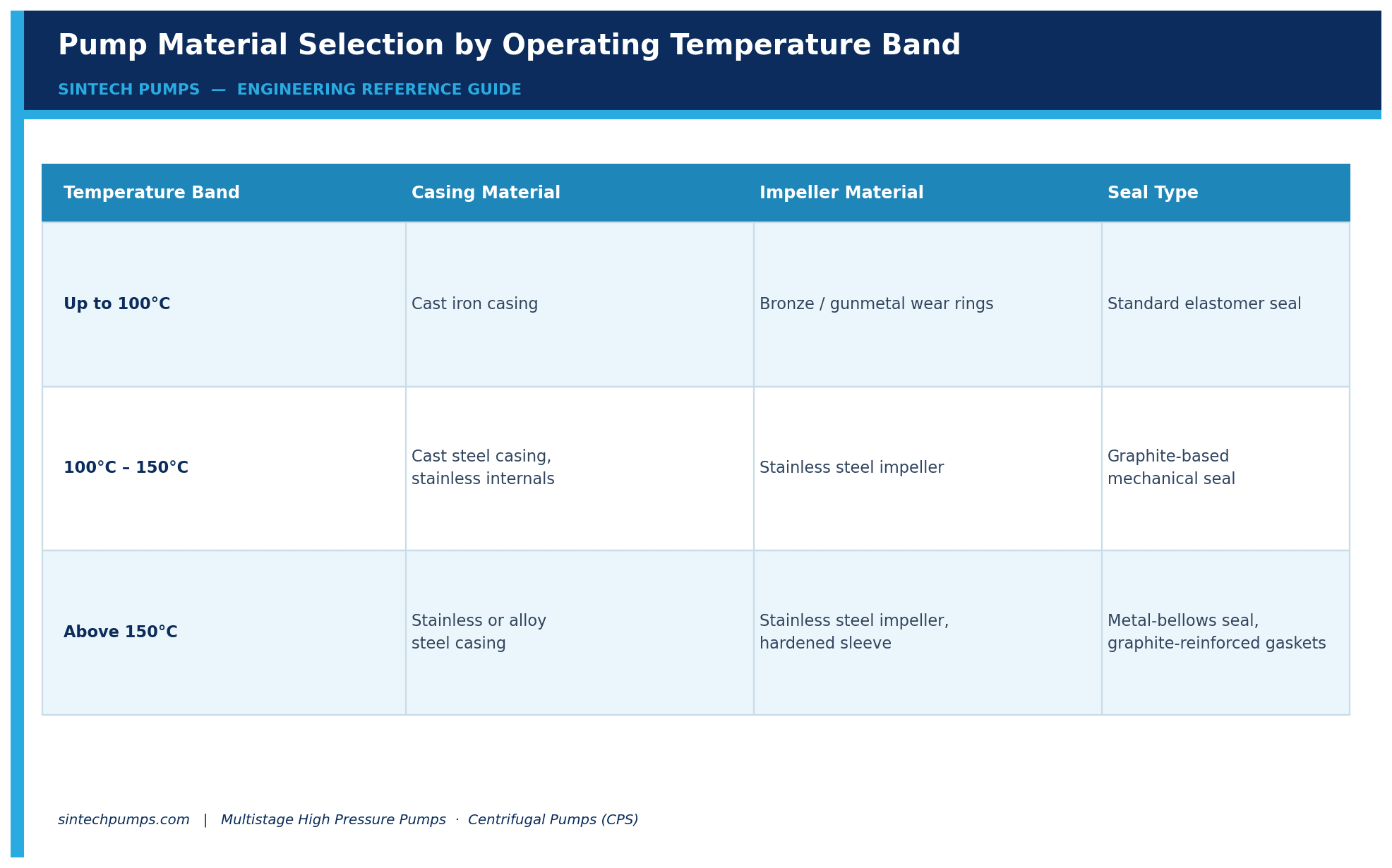
As a rough working guide, pump material selection for industrial hot water and process duty follows temperature bands rather than a single rule. Up to 100°C, standard cast iron with bronze or gunmetal wear rings performs well and keeps costs down. Between 100°C and 150°C, cast steel casings with stainless internals become the safer default, particularly for a recirculating pump that never gets a chance to cool between cycles.
Above 150°C, the range typical of boiler feed and high-pressure process loops, full stainless steel or alloy steel construction is standard practice, along with high-temperature-rated gaskets like graphite-reinforced composites instead of standard rubber.
None of this pump material selection logic is exotic. It's the same approach global manufacturers use, adapted to what's practical to source, machine, and service within India. Sintech's 38 years of manufacturing in Ghaziabad, Uttar Pradesh, means these material combinations have already been tested across sugar mills, paper plants, and power houses rather than just modelled on paper.
Beyond the Casing: Seals, Bearings, and Thermal Expansion
Materials solve half the problem. The other half is mechanical design. A recirculating pump handling hot fluid needs a cooling jacket or a heat-dissipating bearing frame so the bearing housing doesn't inherit the process temperature directly. Without that separation, bearing grease breaks down years ahead of schedule, and unplanned downtime follows.
Shaft alignment matters more at high temperature too, because thermal growth of the casing can pull the pump and motor out of alignment if the baseplate and coupling weren't designed with that expansion in mind. A well-engineered hot water circulation pump accounts for this by specifying expansion joints on suction and discharge piping, not just at the pump flanges.
Mechanical seals deserve particular attention. Standard elastomer O-rings in a seal can harden within weeks above 120°C. Viton or PTFE-based seal components, along with a seal flush plan that keeps the seal faces cooler than the bulk fluid temperature, extend seal life substantially, often the single biggest driver of maintenance cost on hot-duty pumps.
Inside Boiler Feed Pumps: Why This Duty Breaks Ordinary Pumps
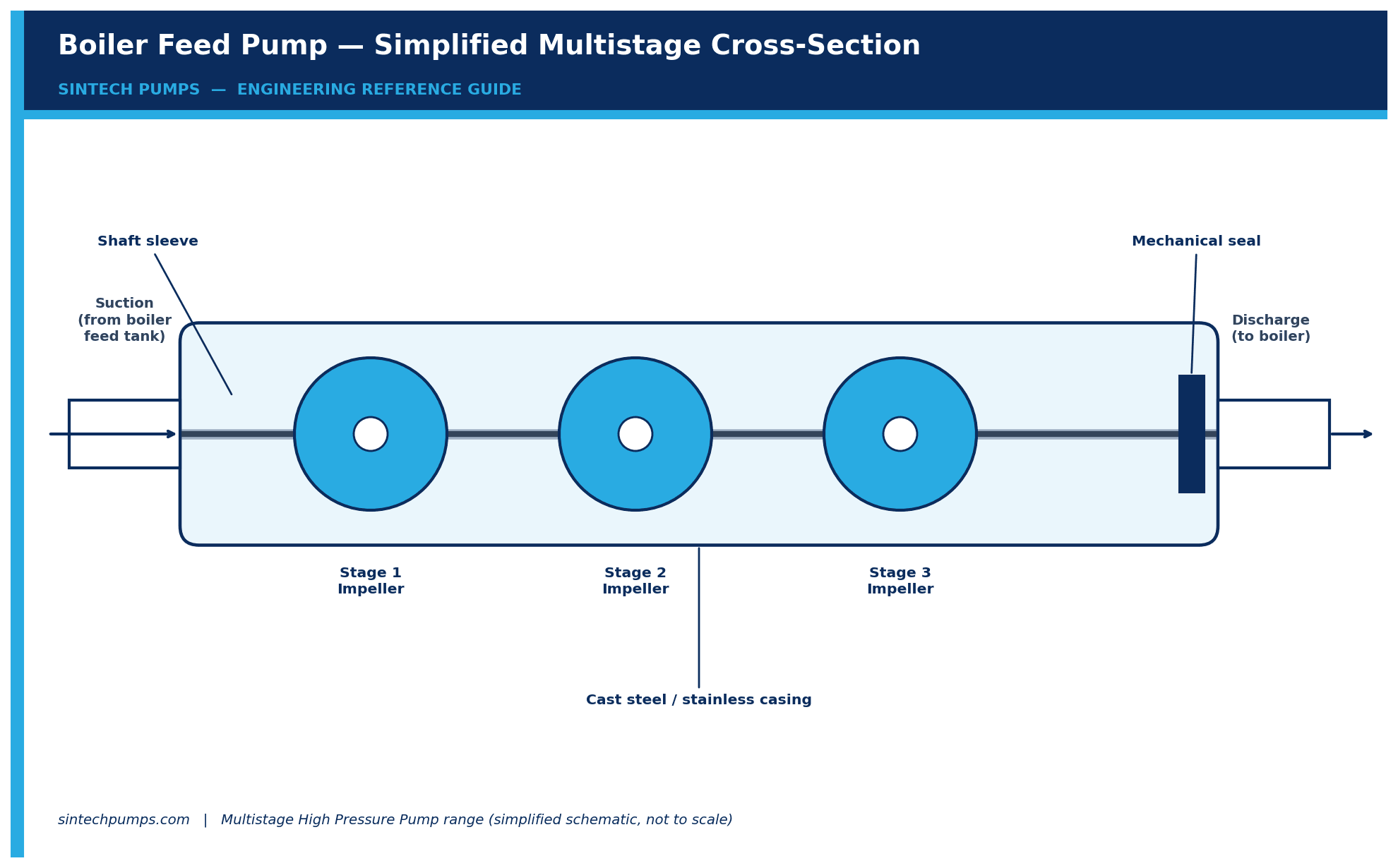
Boiler feed pumps sit at the sharp end of high-temperature pump engineering. They move water at temperatures often exceeding 150°C into a boiler operating at significant pressure, which means the pump has to overcome both thermal stress and hydraulic head simultaneously. Sintech's multistage high-pressure pump range is built specifically for this duty, using stacked impeller stages to build pressure gradually rather than forcing a single impeller to do the entire job.
A hot water pump for boiler feed duty also needs adequate Net Positive Suction Head, or NPSH, the minimum pressure required at the pump suction to prevent the liquid from flashing into vapour inside the casing. Because hot water is closer to its boiling point than cold water, the safety margin is thinner, and a hot water pump for boiler applications with inadequate NPSH will cavitate, damaging the impeller within weeks.
Reliability data from sugar mill and power plant installations shows that boiler feed pumps with cast steel casings and mechanical seals rated above 180°C typically run 3 to 4 years between major overhauls, compared to under 18 months for pumps specified with generic mid-temperature components. Selecting boiler feed pumps correctly at the design stage avoids most of this rework, and it costs far less than an emergency replacement during a shutdown.
Also Read – Boiler feed pumps for thermal power plants: selection, sizing, and maintenance
Hot Water Circulation Pump or Standard Centrifugal: How to Decide
Not every hot liquid application needs the same pump. A hot water circulation pump for a closed heating loop, where the fluid volume stays roughly constant and the main job is moving heat around a building or plant, is a different specification problem than a process pump moving fresh hot water continuously from a tank.
The key distinction is duty cycle and head requirement. A hot water circulation pump typically runs against a relatively low, stable head, overcoming pipe friction rather than lifting liquid to height, so it can often use a smaller motor than a general process centrifugal pump for the same flow rate. A standard centrifugal pump, by contrast, is sized around the full range of a process: startup surges, varying flow demand, and higher discharge pressure.
Where the two overlap is reliability expectations. Whether you call it a hot water circulation pump or a recirculating pump, if it's serving a continuous industrial loop, it needs continuous-duty bearings and seals, not the lighter components found in a typical residential unit. Getting this distinction right at the specification stage is where the choice either becomes a 24/7 asset or a recurring maintenance headache.
NPSH and Sizing Rules for Pumps Running Hot
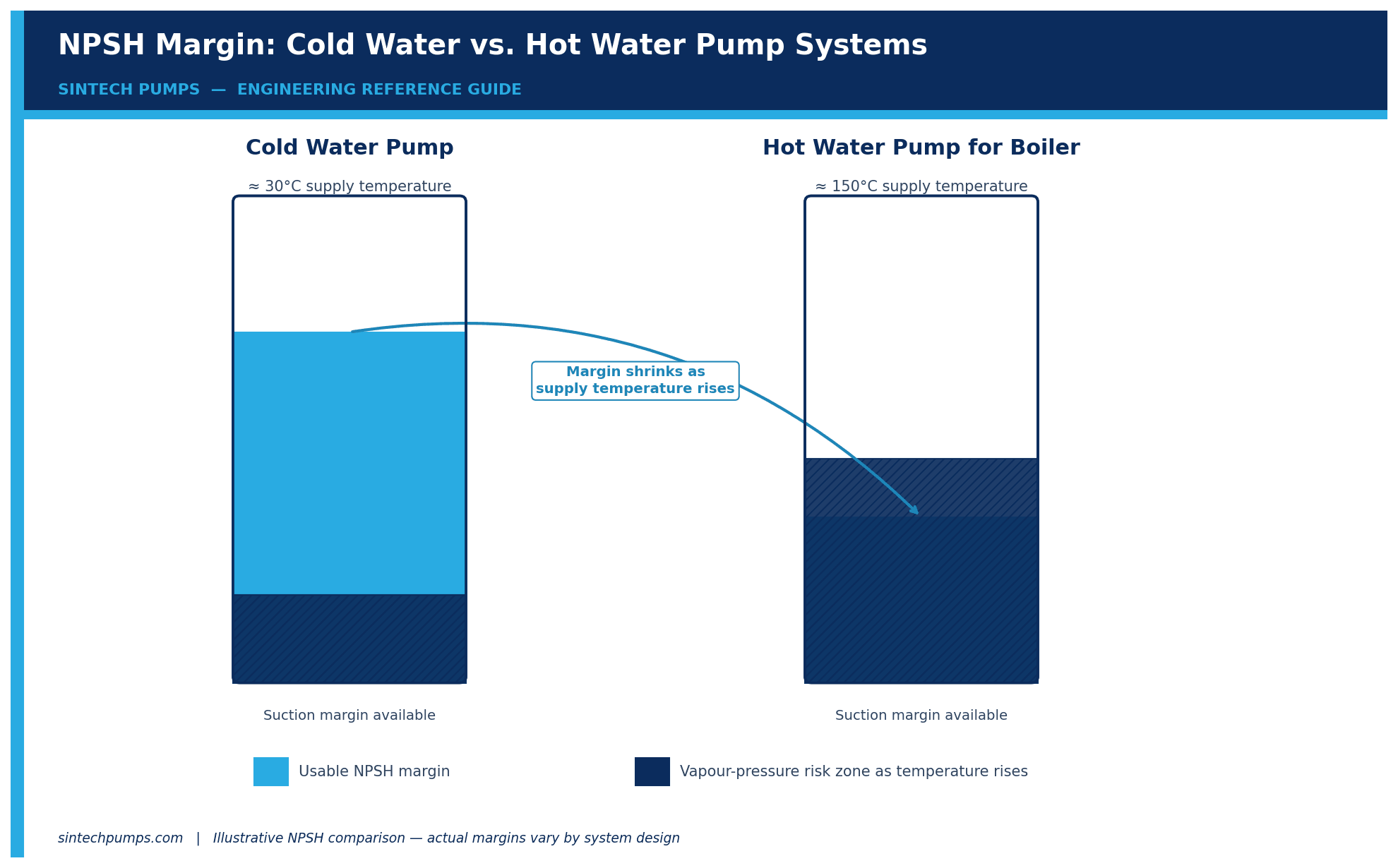
Sizing a high-temperature pump correctly starts with vapour pressure, not just flow and head. As liquid temperature rises, its vapour pressure rises too, which shrinks the available NPSH margin even if the physical suction conditions haven't changed. Many pump failures blamed on "bad bearings" actually trace back to marginal NPSH that only becomes a problem once the system runs hot.
For a recirculating pump running continuously in a heating loop, the practical fix is usually straightforward: raise the suction tank elevation slightly, minimise suction-side pipe fittings that add friction loss, and keep suction piping short and direct. These changes cost little at the design stage but are expensive to retrofit once a plant is running.
Flow and head sizing should also account for eventual scale buildup inside pipework, which increases friction loss over time. Specifying a slightly conservative duty point, rather than the exact calculated minimum, gives the system headroom as pipes age and internal surfaces roughen with mineral deposits from hard water.
How Sintech Approaches High-Temperature Pump Selection
None of this happens by accident. Sintech's engineering team has been through this pump material selection exercise for boiler houses, sugar mills, and paper plants across India for more than three decades, and the questions they ask before recommending a pump are almost always the same: what's the continuous operating temperature, what's the thermal cycling pattern, and what happens to the system during a trip or shutdown?
For a recirculating pump destined for continuous hot-duty service, that conversation happens before a casting is poured, not after a failure. It's a slower way to sell a pump than pointing to a catalogue number, but it's the reason Sintech pumps installed decades ago are still running in some plants today, serviced rather than replaced.
Every high-temperature pump application is a little different, which is why Sintech treats each one as an engineering problem first and a transaction second.
Conclusion
Getting pump selection right for high-temperature liquids isn't about finding the most expensive option on a catalogue page; it's about matching materials, seals, and mechanical design to the actual temperature, pressure, and duty cycle your system runs every day. A well-specified recirculating pump, sized and built for the heat it will actually see, quietly does its job for years. A poorly matched one becomes a recurring line item in the maintenance budget.
If you're specifying pumps for a boiler house, process loop, or heating system and want a second opinion on materials or sizing before you commit to an order, Sintech's engineering team is happy to review your application details. Learn more about Sintech's high-temperature pump range at sintechpumps.com.
Frequently Asked Questions
At what temperature does a pump actually need special design features?
For most industrial water and process duty, standard pump construction holds up to roughly 100–120°C. Past that point, elastomer seals, bearing lubrication, and casing tolerances start working against each other, which is why continuous service above 120°C generally calls for upgraded materials rather than a stock catalogue unit.
What is the difference between a recirculating pump and a transfer pump?
A recirculating pump moves the same fluid continuously through a closed loop, such as a heating circuit, to maintain even temperature. A transfer pump instead moves liquid from one point to another and then stops. The continuous duty cycle of a recirculating pump means it needs components rated for constant operation, not intermittent use.
How is a hot water circulation pump different from a cold water pump?
A hot water circulation pump needs seals, bearings, and casing materials that can handle sustained elevated temperature without hardening, corroding, or losing dimensional tolerance. A cold water pump built with standard elastomers and cast iron will typically fail faster if placed into hot water circulation pump duty without modification.
What NPSH margin does a hot water pump for boiler feed need?
A hot water pump for boiler feed duty generally needs a larger NPSH margin than a cold-water pump of similar size, because hot water sits closer to its vapour pressure. Plant engineers typically add at least 1 to 1.5 metres of additional margin above the calculated minimum for continuous boiler feed service.
Why does pump material selection matter more above 100°C?
Above 100°C, thermal expansion, seal hardening, and metallurgical strength all change at different rates. Careful pump material selection ensures the casing, shaft sleeve, and seal faces expand and wear together instead of working against each other, which is what actually causes premature failure in hot-duty pumps.
How often should boiler feed pumps be serviced?
Well-specified boiler feed pumps with correct materials typically run 3 to 4 years between major overhauls. Under-specified boiler feed pumps, using generic mid-temperature components, often need seal or bearing attention within 12 to 18 months.
Can a standard centrifugal pump be modified for high-temperature service?
Sometimes, but only within limits. Impeller and casing tolerances, seal types, and bearing lubrication can be upgraded, but the base casting material and shaft design set a ceiling on how hot the pump can safely run. Beyond that ceiling, replacement is more reliable than modification.
What causes premature seal failure in hot water systems?
The most common causes are elastomer seals rated for the wrong temperature, inadequate seal flush cooling, and thermal shock from sudden cold makeup water entering a hot casing. Addressing all three during specification, rather than after failure, extends seal life significantly.
Is a bronze impeller suitable for hot water applications?
Bronze performs adequately up to around 100°C but loses mechanical strength faster than steel as temperature rises further. For continuous duty above 100°C, stainless steel or cast steel impellers are the more reliable choice.
Does Sintech manufacture pumps suitable for high-temperature industrial applications?
Yes. Sintech Pumps, based in Ghaziabad, Uttar Pradesh, has manufactured multistage, centrifugal, and process pumps for boiler, sugar, paper, and power industry applications for more than three decades, with material and seal configurations specified for each operating temperature range.
Hey, like this? Why not share it with a buddy?
« Sludge Pump Selection for Thickened Sludge and High-Solids WastewaterNPSHa vs NPSHr: Key Differences, Formula & How to Avoid Pump Cavitation »