
Table of Contents
- Introduction
- What Is NPSH? Understanding NPSHa and NPSHr
- NPSHa vs NPSHr: The Core Difference Explained
- NPSHr: What the Pump Demands
- NPSHa: What Your System Actually Delivers
- The NPSH Available Formula, Explained Term by Term
- How to Calculate NPSHa: A Step-by-Step Walkthrough
- Common Reasons NPSHa Falls Short on Indian Plant Floors
- How Sintech Pumps Designs Around NPSHa and NPSHr
- Conclusion
- Frequently Asked Questions
NPSHa (Net Positive Suction Head Available) is the suction pressure your piping system actually delivers to a pump. NPSHr (Net Positive Suction Head Required) is the minimum the pump needs to run without cavitating. When NPSHa falls below NPSHr, vapour bubbles form and collapse inside the pump, causing noise, vibration, and impeller damage. Keeping NPSHa above NPSHr, typically by 0.5 to 1 metre, is the simplest way to prevent pump cavitation.
Introduction
If a centrifugal pump in your plant has ever started rattling like it swallowed gravel, chances are the problem wasn't the motor or the bearings. It was NPSH, Net Positive Suction Head, the pressure margin that decides whether liquid arrives at the impeller eye as a clean column or as a froth of collapsing vapour bubbles. Get the NPSHa vs NPSHr comparison wrong at the design stage, and you inherit years of premature seal failures, pitted impellers, and vibration complaints that maintenance teams chase for months.
This guide breaks down NPSHa (available) versus NPSHr (required), the NPSHa formula you'll actually use on a job site, and the practical steps that stop cavitation before it starts, beginning with a simple NPSHa calculation you can run before you ever finalise a pump order. These are the same steps we walk through with plant engineers at Sintech Pumps almost every week.
What Is NPSH? Understanding NPSHa and NPSHr
Every centrifugal pump needs a minimum pressure at its suction to keep liquid from flashing into vapour as it accelerates into the impeller eye. That pressure, expressed as head, is what engineers are really comparing when they weigh NPSHa against NPSHr, not one fixed number but a relationship the entire discipline of suction-side pump design exists to protect.
Get this relationship wrong, and the liquid partially vaporises inside the casing. Those vapour pockets travel a few millimetres downstream, hit a zone of higher pressure, and collapse violently against the impeller vanes. That's mechanical damage, not the electrical fault most plant teams suspect first.
We get more field calls about a mismatched suction margin than almost any other pump problem, largely because it's invisible until the damage already shows on the impeller.
Also Read – NPSH Explained: How to Calculate NPSHa and Prevent Cavitation
NPSHa vs NPSHr: The Core Difference Explained
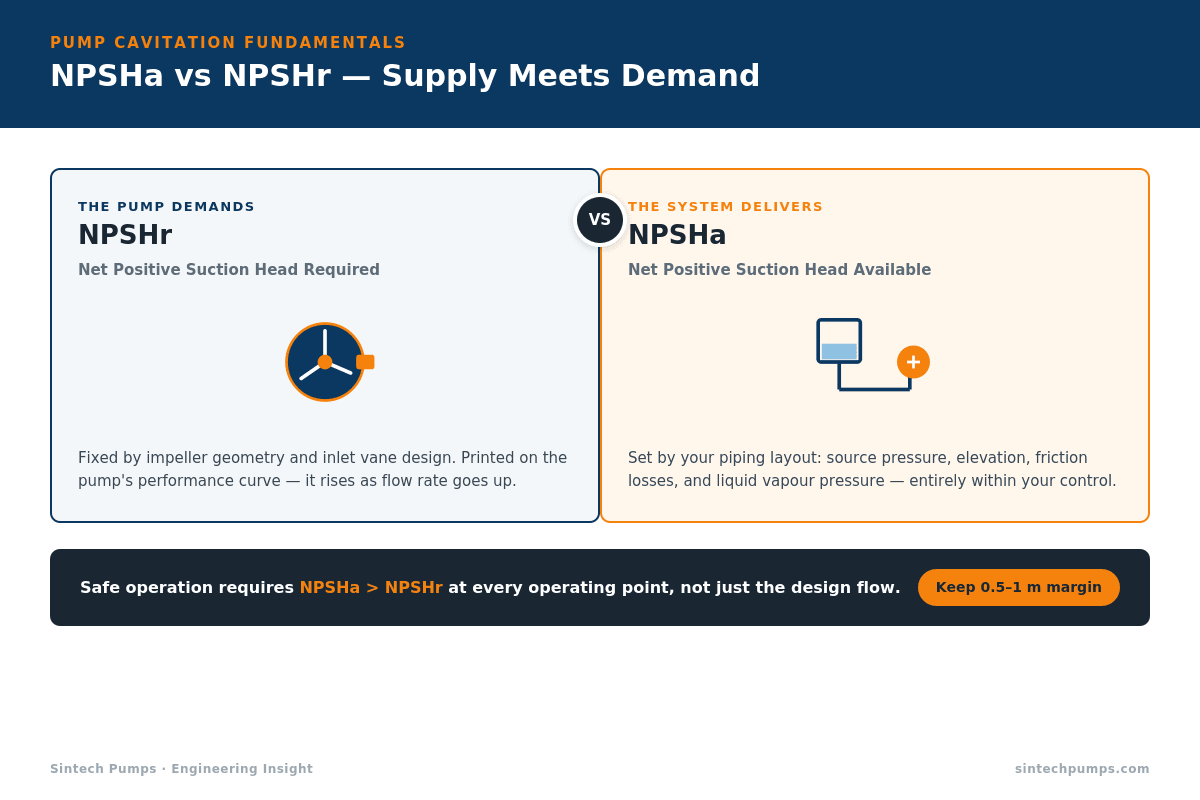
NPSHa vs NPSHr is really a question of supply versus demand. NPSHr (Net Positive Suction Head Required) is a property of the pump itself, set by its impeller geometry and printed on the pump curve. NPSHa (Net Positive Suction Head Available) is a property of your suction piping & system: how the tank, pipe run,tank elevation, and fittings deliver liquid to the pump's suction flange.
A pump doesn't know or care what your piping layout looks like. It simply demands a certain NPSHr to run without cavitating. Your job is to make sure NPSHa comfortably clears that demand at every operating point, not just at the design flow rate.
NPSHr: What the Pump Demands
NPSHr comes out of the manufacturer's test lab, not your plant. For a Sintech centrifugal pump (CPS series) or a split casing double suction unit (SCS series), NPSHr rises as flow rate increases, because faster-moving liquid needs more pressure margin to avoid local vaporisation at the vane tips. That's the NPSH of the pump formula plotted as a curve rather than a fixed figure.
Two pumps with identical duty points can carry noticeably different NPSHr values depending on impeller eye diameter and inlet vane design. A double-suction impeller splits the incoming flow across two eyes, which lowers NPSHr for the same flow rate compared to a single-suction design, which is one reason Sintech recommends SCS pumps where suction conditions are already marginal.
NPSHa: What Your System Actually Delivers
NPSHa is entirely under your control, which is the good news. It depends on four things: the pressure above the liquid surface at the source, the static elevation between that surface and the pump centreline, the friction losses in the suction pipework, and the vapour pressure of the liquid at its operating temperature.
Get any one of those four wrong (an undersized suction pipe, a pump mounted too high above the sump, a hot process liquid) and NPSHa drops, sometimes well below what the pump curve calls for.
The NPSH Available Formula, Explained Term by Term
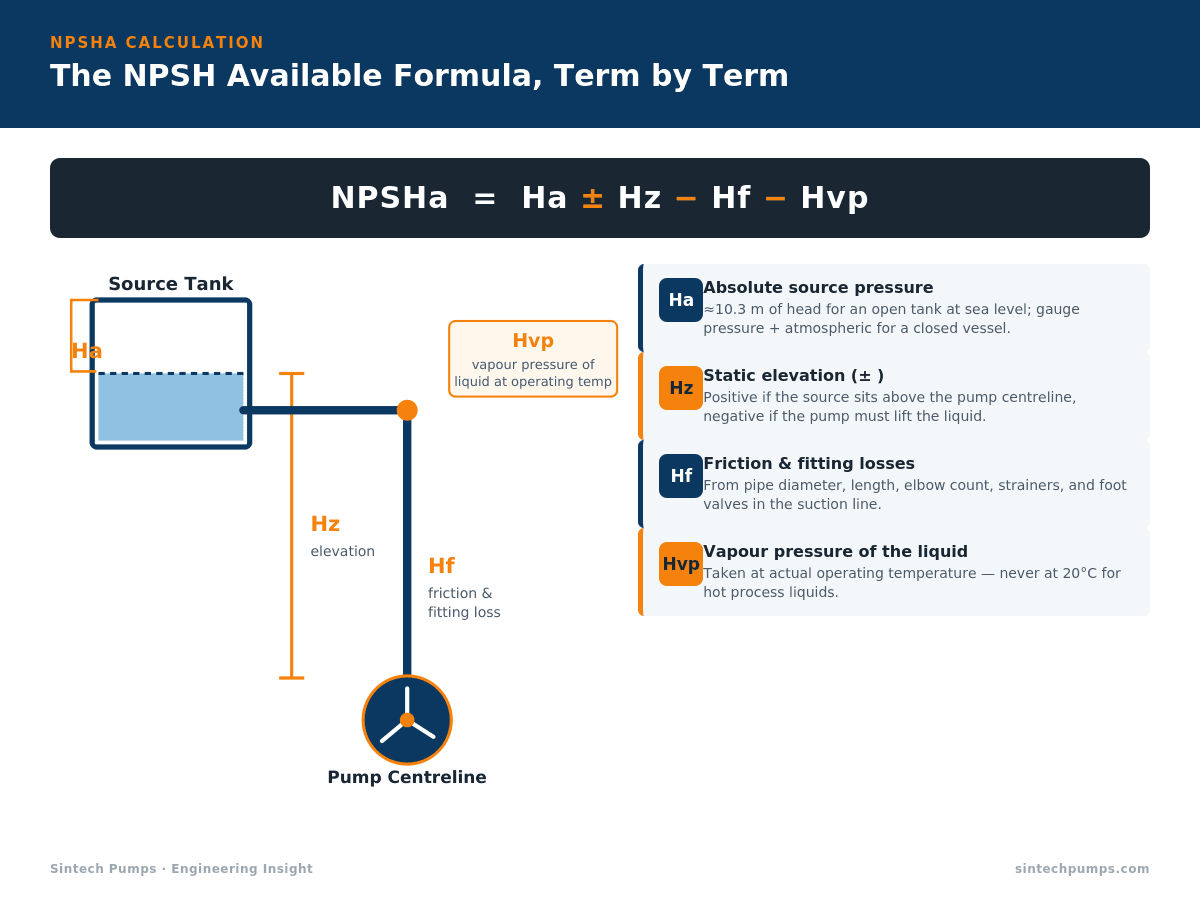
The NPSH available formula is the working equation every project engineer needs before finalising a suction layout:
NPSHa = Ha ± Hz − Hf − Hvp
Where Ha is the absolute pressure on the liquid surface at the source (atmospheric pressure at sea level is roughly 10.3 m of head), Hz is the static elevation between the liquid surface and the pump centreline (positive if the source sits above the pump, negative if the pump has to lift the liquid), Hf is the total friction and fitting losses in the suction line, and Hvp is the vapour pressure of the liquid at operating temperature, also expressed as a head.
This same NPSH available formula applies whether you're sizing a vertical sump pump for a paper mill effluent pit or a vertical turbine pump for a canal irrigation intake; only the values of each term change.
Also Read – Cavitation in Centrifugal Pump Systems: Causes, Signs and How to Prevent It
How to Calculate NPSHa: A Step-by-Step Walkthrough
Knowing how to calculate NPSHa on paper is one thing; doing it correctly for a real suction line is where most selection errors creep in. Here's the sequence we walk through with clients before finalising any pump order.
First, establish Ha: 10.3 m for an open tank at sea level, or gauge pressure converted to head and added to atmospheric for a closed vessel. Second, measure Hz precisely, from the minimum liquid level at the source to the pump's suction centreline. Third, calculate Hf from the actual pipe diameter, length, elbow count, and any strainer or foot valve in the line; undersized suction piping is the most common cause of a low result when engineers work through how to calculate NPSHa for an existing installation rather than a clean-sheet design. Fourth, look up Hvp at the actual operating temperature, not at 20°C, since hot condensate or juice at 80°C carries a dramatically higher vapour pressure than the same liquid at room temperature.
Once all four terms are in hand, the NPSHa formula gives you a single number in metres. Compare it against the pump's NPSHr curve at your actual operating flow, and you have your answer.
Common Reasons NPSHa Falls Short on Indian Plant Floors
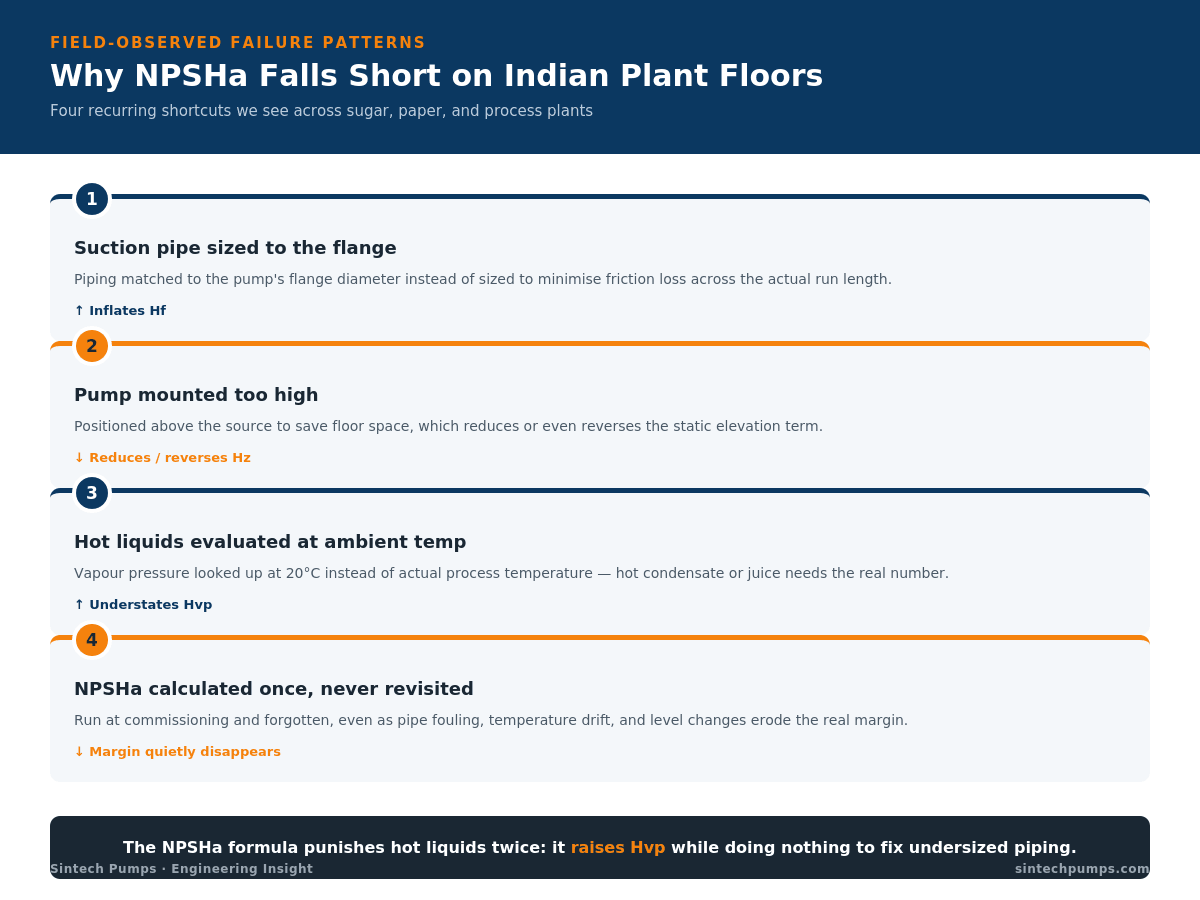
Across the sugar, paper, and process plants we work with, the same shortcuts show up repeatedly. Suction pipes get sized to match the pump's flange rather than to minimise friction loss, which inflates Hf. Pumps get mounted high above the source to save floor space, which reduces or reverses Hz. Hot liquids get evaluated at ambient temperature instead of actual process temperature, understating Hvp and overstating real NPSHa. The NPSH available formula punishes hot liquids twice, raising Hvp while doing nothing to fix undersized piping.
None of these are exotic problems. They're the ordinary consequence of specifying a suction line without running the NPSHa formula properly, or running it once at commissioning and never again as conditions drift. Skipping the NPSHa calculation at the design stage is the single most common root cause we find during failure investigations.
How Sintech Pumps Designs Around NPSHa and NPSHr
At Sintech, suction-side review isn't an afterthought bolted onto a quotation; it's part of how we specify every centrifugal, torque flow, split casing, and vertical turbine pump we supply. Our engineers ask for tank geometry, pipe layout, and liquid temperature before recommending an impeller design, because a pump that's technically correct on paper but ignores your suction line will still cavitate.
For applications where suction conditions are inherently tight, such as sugar juice transfer, hot condensate return, or vacuum-assisted sump drainage, our sump design service reviews the physical layout alongside the pump selection rather than treating them as two separate decisions. That's the kind of detail that keeps a pump running quietly for years instead of needing a seal change every eight months.
Conclusion
Suction head rarely gets the attention it deserves at the specification stage, mostly because the consequences take weeks or months to show up rather than failing a pump on day one. But once you understand the NPSHa vs NPSHr relationship, and you're willing to work through the NPSHa formula honestly for your actual suction layout rather than an assumed one, cavitation stops being a mystery and becomes a design variable you control. Whether you're checking the NPSH of the pump formula on a datasheet or running your own NPSHa calculation for a new sump, the discipline is the same: verify, don't assume.
If you're specifying a new pump or troubleshooting a chronic vibration complaint, it's worth revisiting the suction-side numbers before changing anything mechanical. Sintech's engineering team reviews suction layouts and NPSHa calculations as part of every pump selection: reach out with your tank geometry, pipe run, and liquid conditions, and we'll help you find the margin your system actually needs.
Frequently Asked Questions
What is NPSH in a centrifugal pump?
It's the pressure margin, expressed as a head of liquid, that keeps a centrifugal pump's suction flow above the liquid's vapour pressure and prevents flashing into vapour bubbles at the impeller eye.
What is the difference between NPSHa and NPSHr?
NPSHr is a fixed property of the pump, set by the manufacturer's test and shown on the pump curve. NPSHa is a property of your piping system, calculated from tank elevation, friction losses, and liquid vapour pressure. NPSHa must stay above NPSHr at every operating condition.
What is the NPSHa formula?
NPSHa = Ha ± Hz − Hf − Hvp, where Ha is source pressure head, Hz is static elevation, Hf is suction line friction loss, and Hvp is the liquid's vapour pressure head at operating temperature.
How to calculate NPSHa for an existing pump installation?
Measure the actual elevation between the liquid source and pump centreline, calculate friction losses from the real pipe diameter and fittings, look up vapour pressure at the actual operating temperature, and combine all three with the source pressure head using the NPSHa formula above.
What causes pump cavitation?
Cavitation happens when NPSHa drops below NPSHr: available suction pressure can't keep pace with what the pump demands, so liquid vaporises inside the casing and the bubbles collapse against the impeller, causing noise, vibration, and pitting.
Can cavitation damage a pump permanently?
Yes. Sustained cavitation pits impeller vanes, accelerates mechanical seal wear, and can eventually crack casing surfaces. Catching a thin NPSHa NPSHr difference early is far cheaper than replacing a pitted impeller.
Does liquid temperature affect NPSHa?
Significantly. Higher temperatures raise vapour pressure, which directly reduces NPSHa. A liquid that's safe at ambient temperature can push a pump into cavitation once it's heated, which is why hot condensate and process juice applications need extra suction margin.
How much margin should I design for between NPSHa and NPSHr?
Most engineers target at least 0.5 to 1 metre, with a wider allowance for hot, volatile, or variable-flow applications where small errors in an NPSHa calculation can quietly erode the buffer.
Can undersized suction piping cause cavitation even if the pump is correctly selected?
Yes. A pump with the right NPSHr can still cavitate if the suction pipe is too narrow or too long, because that raises friction losses and lowers NPSHa below what the pump needs.
Do all Sintech pumps come with NPSHr data?
Every Sintech centrifugal, torque flow, multistage, and split casing pump ships with a certified performance curve tested to ISO 9906 and IS 9137, showing NPSHr across the full flow range.