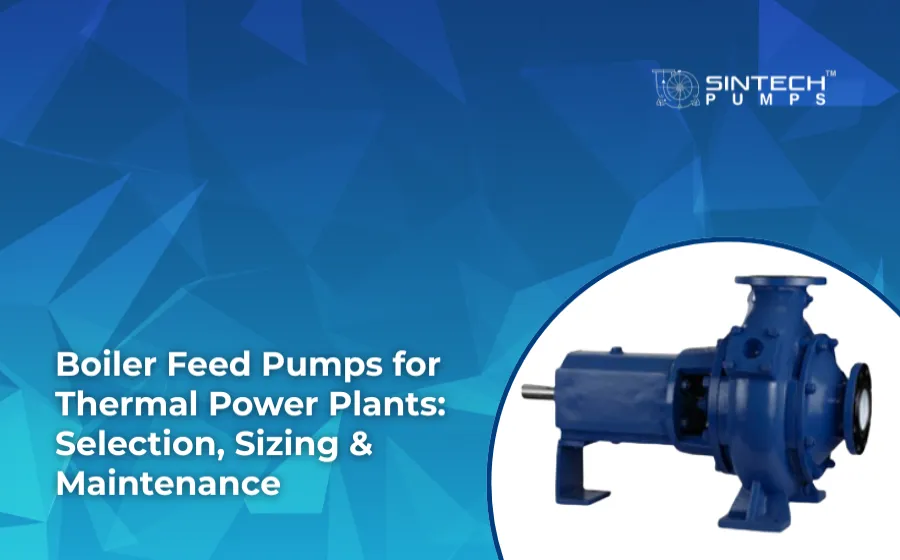
Picking a feed pump is more than laying a catalogue curve over a design point. Here’s what actually keeps the pump alive.
Flow has to be right across the whole operating band, not just at one point. Design flow usually lands at 110% of the boiler’s maximum continuous evaporation rate, converted to volume at feedwater density. But you also have to know the pump stays steady at minimum continuous stable flow, normally 25–35% of design, without cooking itself on recirculation or cavitating.
For total dynamic head, add up boiler drum pressure, the friction in the economiser and piping, the control valve drop, and the elevation head. A 150 bar boiler tends to want 1,800–2,200 metres of it. Leave yourself a 5–8% margin while you’re at it, because piping fouls up over the years and that number creeps.
NPSHa against NPSHr is where most of these pumps die. Deaerator pressure sags during a load transient, NPSHa sags with it, and if you only sized for the design case you’re in trouble. The rule I’d hold to: NPSHr at full flow stays at least 2 metres under the lowest NPSHa you’ll ever see, across every scenario, not the comfortable one.
Specific speed (Ns) decides the impeller shape. Feed pumps mostly sit between Ns 20 and 60 in SI units, radial-flow territory, which gives you a good head and a stable curve.
Materials get serious above 150°C feedwater. Casing, impellers, shaft in alloy steel, ASTM A217 Grade C12 or its equivalent. Wear rings and balance discs in 13Cr stainless. And skip the gland packing for hot service, go with mechanical seals or controlled-clearance seals.
One more, and it’s not optional: never run a single feed pump with no backup. Standard practice is 2×100% or 3×50%, with the standby changeover automatic and wired straight into the plant’s DCS.