Follow us

Follow us

Home » Blog » Water pumps for municipal supply: how to choose the right one

Water pumps for municipal supply: how to choose the right one

Posted: 19/06/2026
Category: Blog

Table of Contents

  1. Why pump selection makes or breaks a municipal water project
  2. Understanding the hydraulic demands of municipal pumping stations
  3. What type of water pump is used in municipal supply systems?
  4. When to use axial flow pumps in high-volume water transfer
  5. How to match pump type to your pumping station layout
  6. What role does energy efficiency play in municipal pump selection?
  7. Common pump selection mistakes in water supply projects
  8. Why Sintech Pumps is a trusted name in municipal water infrastructure
  9. Conclusion
  10. Frequently asked questions

Choosing the right municipal water pump comes down to three things, really. The flow rate you need, in litres per second, or cumecs, once the schemes get big. The total dynamic head, TDH. And what’s in the water, raw canal water, clear treated water, or wastewater that’s only had half the treatment? Pick wrong, and you get cavitation, wasted power, and the kind of downtime nobody wants to explain on a public scheme. This guide goes through the main pump types and how to actually make the call.

Why pump selection makes or breaks a municipal water project

A municipal supply system is only as reliable as the pump at the heart of it. Raw water intake station off a river, a booster in the distribution network, a high-lift station pushing treated water up to overhead reservoirs, doesn’t matter. That pump decides the efficiency, the energy bill, and how many years you get out of the whole thing.

India’s urban water infrastructure is stretched, no two ways about it. The Jal Jeevan Mission (JJM), the central government’s drive to put a working tap in every rural household, has pushed demand for dependable municipal water pumps way up. Municipal bodies and state utilities are buying and replacing pumps for schemes that move anywhere from 10 MLD to 200 MLD (million litres per day).

Get it right, and the system runs 20-plus years with barely a hand on it. Get it wrong, and you’ll know soon enough. Vibration and noise from cavitation. Motors tripping on overload. Impellers worn out years early. And eventually, an outage that lands on tens of thousands of households at once.

The engineers doing this work need more than a catalogue. They need a clear way to match pump to application, grounded in the numbers. That’s the whole point of this guide.

Understanding the hydraulic demands of municipal pumping stations

You can’t pick a pump type until you’ve pinned down two numbers: design flow rate (Q) and total dynamic head (TDH). Get those reasonably tight and half the work’s done.

Flow rate (Q) is just how much water the pump shifts per unit time. Litres per second (LPS), cubic metres per hour (m³/hr), or cumecs (m³/s) on the bigger jobs. Say you’ve got a water treatment plant (WTP) serving 100,000 people at 135 LPCD (litres per capita per day). Depending on the peaking factor, peak hourly flow into the network might hit 800–1,000 m³/hr.

TDH adds up the static head (the real height between source and delivery), the friction losses down the pipe, and the minor losses across fittings and valves. Flat terrain: you might see 8–12 metres. On hilly ground or a multistorey distribution scheme, it can climb past 60–80.

The way those two numbers sit against each other, high Q and low TDH, or moderate Q and high TDH, is the biggest single factor in which pump family you end up with. That’s the thing that points you at an axial flow pump, a mixed flow pump, a split casing pump, or a vertical turbine.

What type of water pump is used in municipal supply systems?

Depends on the head-and-flow combination. There’s no single answer. Municipal supply runs on four broad pump categories, each built for a different hydraulic regime.

Axial flow pumps move very high flows at very low heads. Roughly 2 to 8 metres TDH, flows of 500 to 10,000-plus m³/hr. Natural fit for raw water intakes pulling off canals, rivers, or low reservoirs.

Horizontal mixed flow pumps sit between axial and centrifugal. They work in the 6 to 20 metre TDH band at high flow, so you find them on lift irrigation schemes and the first-stage stations feeding big treatment plants.

Split casing double suction pumps, the double-entry centrifugals, cover 15 to 60 metres TDH at moderate-to-high flow. Common on booster stations, high-lift stations, and treated water going up to overhead reservoirs. The double-suction impeller balances out axial thrust, which is good for bearing life and keeps the pump dependable over the long run.

Vertical turbine pumps come in when the source is below ground. Deep tube wells, infiltration galleries, low-water-level sumps. Heads run from 20 to 200-plus metres depending on stages. A lot of municipal corporations across Rajasthan, Gujarat, and Haryana lean on vertical turbine pumps for groundwater supply.

And matching the family to the duty isn’t optional. Stick a centrifugal split casing pump where an axial flow pump belongs, and you’re running well off the Best Efficiency Point (BEP). That’s wasted energy and faster wear every time.

When to use axial flow pumps in high-volume water transfer

Big volumes at very low differential heads, that’s the axial flow pump’s job. Pumping from a canal feeder into a settling tank, or a river intake into a raw water reservoir. That’s where it earns its keep.

It works on a completely different principle from a radial centrifugal. The impeller acts like a ship’s propeller, pushing water along the shaft axis instead of flinging it outward. That’s exactly why it’s so efficient at the high-Q, low-H duties a centrifugal would choke on.

Sintech builds two of these out of Ghaziabad: the SAF (Horizontal Axial Flow) and the SVAF (Vertical Axial Flow). Both are made to DIN 24255 and ISO 2858, impeller diameters from 200 mm up to 1,200 mm depending on the flow.

The SAF horizontal version is for when the sump design allows a horizontal install, usually a large intake structure with a properly worked-out approach channel. Flows from around 500 m³/hr up to 20,000-plus, heads that mostly stay under 10 metres.

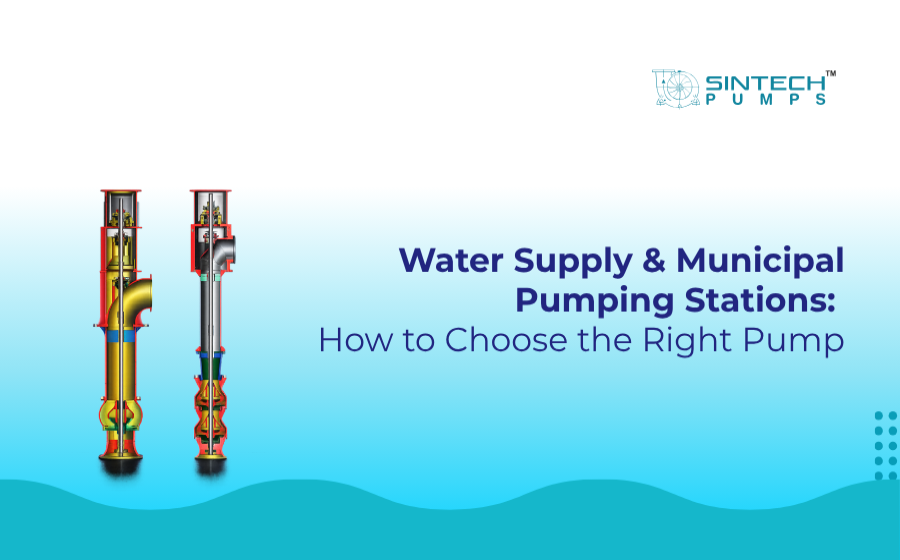
The SVAF vertical version saves floor space. Motor sits at the top of the column assembly, above the pump floor or sump level, which is handy when the civil structure’s tight on area. Easier to pull up for impeller inspection too, no draining the sump.

One thing to watch, though. Axial flow pumps have a steep, often unstable power curve at shut-off. A centrifugal pulls its minimum power at shut-off, near zero flow. An axial does the opposite, near-maximum power at shut-off. So starting one against a closed valve? Bad idea. The control philosophy has to allow for it, normally by keeping some open-channel flow path going at startup.

For irrigation lift schemes, flood control stations, and municipal raw water intakes across Uttar Pradesh, Madhya Pradesh, and Maharashtra, Sintech’s axial flow pumps have been specified to deliver at scale.

How to match pump type to your pumping station layout

Selection isn’t purely hydraulic. The physical layout of the station has a big say too. Sump design, floor area, motor height limits, how you get at the thing to maintain it, all of that shapes what’s practical.

Horizontal pumps (SAF, SMF, SCS) eat more floor, but they’re easier to maintain. Alignment checks, mechanical seal swaps, you can do them without lifting the pump out of the sump. Suits above-grade structures where the pump floor sits above water level.

Vertical pumps (SVAF, SVMF, SVT) are the answer when the pump has to drop below the pump floor. Wet pit installs, where the hydraulic floor sits well under the building floor. The motor stays above the flood line, and you draw the column straight up to service it.

Either way, CPHEEO (Central Public Health and Environmental Engineering Organisation) guidelines spell out bell mouth submergence depths and approach velocity limits when you design the sump. Get those wrong, and you get air entrainment and vortexing. Both wreck performance, and over time, the vibration can shake a pump apart. Sintech offers sump design consultancy as part of its technical support, which is worth a lot to an EPC contractor or a state utility doing a big station for the first time.

Sintech’s SMF Horizontal Mixed Flow Pump lands in a genuinely useful spot for mid-sized municipal stations. Flows from 500 m³/hr to over 8,000, heads from 6 to 20 metres. It handles the transition duty between raw water intake and first-stage treatment well, and its mixed flow impeller gives a flatter efficiency curve than an axial would. So it forgives flow variation more readily, which matters a lot when demand swings between the morning peak and the dead of night.

What role does energy efficiency play in municipal pump selection?

Energy is the single biggest running cost in municipal supply after staffing. The Bureau of Energy Efficiency (BEE), India, reckons pumping systems eat 50 to 70 percent of total electricity in water and wastewater utilities. So efficiency isn’t a nice-to-have. It’s where the money is.

And here’s where tender evaluators trip up all the time. They optimise on capital cost, the sticker price, and call it a day. Run the lifecycle numbers, and it looks different. A pump with 3% better hydraulic efficiency on a 75 kW motor saves you something like ₹60,000–75,000 a year at Indian industrial tariffs. Over a 20-year life that’s past ₹12 lakh, on one pump. Four duty pumps in a station, and the gap’s over ₹50 lakh by the time the project’s done.

This is where Sintech’s Split Casing Double Suction Pumps (SCS) earn their keep. The double-suction impeller balances hydraulic forces on both sides, cutting the axial thrust on the bearings. Lower bearing loads, lower mechanical losses, longer bearing life. Less downtime, lower lifecycle cost. The SCS range is tested to IS 9137 / ISO 9906 acceptance standards, so the efficiency figures on the datasheet are verified, not somebody’s hopeful estimate.

For anything under the Jal Jeevan Mission, the Smart Cities Mission, or a state urban water scheme, sourcing from ISO 9001-certified manufacturers with documented test performance, hydrostatic testing, and performance curve testing is more and more a hard clause in the tender these days. Sintech, based in Ghaziabad, Uttar Pradesh, has held ISO 9001 since its early production years and runs IS 9137 performance testing in its own in-house facility.

Common pump selection mistakes in water supply projects

Even good engineers make specification errors that only show up after commissioning. These are the ones I see come up again and again on municipal projects.

Picking on availability instead of duty point. A split casing pump that happens to be in stock locally gets shoehorned into a duty that really wanted a mixed flow or axial flow pump. Run it well off BEP, and you’ve got hydraulic surging, heavy vibration, and a failed seal inside 12–18 months.

Ignoring the NPSH Available at the sump. Net Positive Suction Head Available (NPSHa) has to clear the pump’s NPSHr (required) by a safe margin. CPHEEO says at least 0.5 metres for clean water. Skip it, and cavitation eats the impeller in months. Worst at raw water intakes, where the level rises and falls with the season.

Under-specifying for peak demand. Design for average daily demand and forget the peak hourly factor (usually 1.5 to 2.5 times average), and the station falls short during the morning peak. Which is precisely when the complaints land.

Spec’ing identical duty and standby pumps with no way to trim flow. Where demand moves around a lot, VFD (Variable Frequency Drive) compatibility needs to be on the table from day one. Not every pump stays stable across a wide speed range. Axial flow pumps, especially with limited turndown, you don’t run them below 70–75% of design speed without a stability check first.

Overlooking the civil-to-pump interface. The pump you choose drives sump dimensions, suction pipe sizing, and foundation loads. Leave that till late in the civil design, and you can end up with an awkward install that fights you on maintenance access for twenty-odd years.

Sintech: water pump manufacturers in India for municipal infrastructure

For municipal and infrastructure engineers sizing up water pump suppliers, here’s the relevant Sintech range.

SAF and SVAF axial flow pumps for the high-volume, low-head raw water intake duties. Horizontal and vertical builds, flow capacities from small-town supply right up to large irrigation lift stations.

SMF horizontal mixed flow pump for the mid-range municipal duties. Flows from 500 to 8,000-plus m³/hr at 6 to 20 metres TDH, a broad efficiency curve that copes with the daily swings.

SCS split casing double suction pump for clear water, booster, and high-lift work. High efficiency, low maintenance, IS 9137-tested performance for procurement compliance.

SVT vertical turbine pump for deep tube well and infiltration gallery duties. Good for heads past 200 metres across multiple stages, a regular on groundwater schemes across western and northern India.

As one of the established water pump manufacturers in India, Sintech works directly with EPC contractors, state utility engineers, and municipal corporations at the specification stage. Not just when the purchase order lands. Getting in that early is how you make sure the pump fits the actual site, and not just whatever happened to be in the catalogue.

So for anyone weighing up the best water pump company in India for a municipal project, the fact that Sintech can do sump design consultancy, factory acceptance testing to IS 9137, and post-commissioning service support is reason enough to bring them in early.

Conclusion

Municipal water infrastructure is long-term public money. A station you design today is expected to run 20 to 25 years, through shifting demand, changing water levels, and energy costs that never sit still. The pump at the heart of it carries a lot of that weight.

The right municipal water pump isn’t the cheapest line in the tender. It isn’t the one with the fastest delivery either. It’s the one matched properly to your hydraulic duty point, with verified efficiency data, the right impeller geometry, and a manufacturer that’ll stand behind it through its working life.

Frequently Asked Questions

1. Which type of pump is best for a municipal water supply pumping station?

The right pump depends on the duty point. Axial flow pumps suit high-flow, low-head raw water intake. Mixed flow or split casing pumps suit mid-range distribution duties. Vertical turbine pumps suit deep tube well sources. Matching the pump type to the specific TDH and flow requirement is the most important selection decision.

2. What is an axial flow pump, and when is it used in water supply systems?

An axial flow pump moves water along the shaft axis using a propeller-type impeller. It is used where very high flow rates (500–20,000+ m³/hr) are needed at low differential heads (2–10 metres), typically at river, canal, or reservoir intake pumping stations feeding water treatment plants.

3. How do I calculate the right pump size for a municipal pumping station?

Start with the design flow rate (based on population and per capita demand with a peaking factor of 1.5–2.5x). Calculate TDH by adding static head and friction losses. Plot the duty point on the pump’s H-Q curve and select the pump whose Best Efficiency Point (BEP) falls nearest to your duty point.

4. What standards should a municipal water pump comply with in India?

Municipal water pumps in India should comply with IS 9137 for acceptance testing and performance verification. Manufacturer quality systems should be ISO 9001 certified. For centrifugal process pumps, ISO 2858 and DIN 24255 are the applicable design standards. CPHEEO guidelines govern sump design and civil interface requirements.

5. Why is energy efficiency important in municipal pump selection?

Pumping systems account for 50–70% of total electricity consumption in water utilities (BEE, India). A 3% improvement in hydraulic efficiency on a 75 kW pump saves approximately ₹60,000–75,000 per year. Over a 20-year project life, this can exceed ₹12 lakh per pump, making efficiency a critical lifecycle cost factor, not a secondary consideration.

6. What is the difference between a horizontal axial flow pump and a vertical axial flow pump?

Both move high volumes of water at low heads. The horizontal (SAF) configuration suits installations with adequate floor space and a horizontal suction approach channel. The vertical (SVAF) configuration is used in wet pit installations where the motor must remain above the flood level and floor space is limited. It pulls water upward through a column assembly.

Hey, like this? Why not share it with a buddy?

Leave a Reply

Top
Thanks!

Want us to call you back?

*Please share your details so that our representative can reach out to you. Please schedule a call between 9:30 AM to 5:30 PM (IST) Mon-Sat.

    SCS Pump Your phone number will not be used for marketing purposes.