Follow us

Follow us

Home » Blog » Irrigation Pumps for Large Scale Agricultural Projects in India

Irrigation Pumps for Large Scale Agricultural Projects in India

Posted: 31/07/2026
Category: Blog

Table of Contents

  1. Introduction
  2. Why Choosing the Right Irrigation Pump Matters
  3. Types of Irrigation Pumps for Agricultural Applications
  4. How to Choose the Right Water Pump for Irrigation
  5. Selecting an Agricultural Irrigation Water Pump Based on Farm
    Requirements
  6. Improving Energy Efficiency with Irrigation Pumps
  7. Choosing the Right Irrigation Pump Manufacturer
  8. Why Choose Sintech Pumps for Irrigation Applications
  9. Conclusion
  10. Frequently Asked Questions

Selecting the right irrigation pump for a large farm depends on matching pump type (vertical turbine, axial flow, or centrifugal), total dynamic head, discharge rate, water source quality, and power availability to the crop cycle and terrain. Getting this match right protects yield and cuts running costs. Getting it wrong causes downtime, wasted energy, and poor water delivery during critical growth stages.

Introduction

For a large agricultural project, choosing the right irrigation pump is not a line item. It’s the decision that determines whether water reaches every acre on time, every season, at a cost the farm can sustain. The right irrigation water pumps balance flow rate, head, and energy draw against the specific soil, terrain, and crop cycle they’re serving. This guide walks through how to think about that choice, without the jargon that usually clouds it. Whether you’re commissioning fresh irrigation water pumps for a new command area or replacing units that have outlived their design life, the same fundamentals apply.

Why Choosing the Right Irrigation Pump Matters

Ask any farm manager who has run a 500-acre command area, and they’ll tell you the irrigation pump is rarely the glamorous part of the plan. The borewell gets attention. The canal network gets attention. The pump, tucked away in a small shed or a wellhead enclosure, is expected to just work. But when it doesn’t, everything downstream stalls.

A poorly matched irrigation pump either starves the fields of water during peak sowing weeks or burns through diesel and electricity trying to compensate for a design that was wrong from day one. Large-scale projects across India depend on irrigation pumps that are sized correctly from the very first season, because retrofitting a command area later is far costlier than getting the specification right upfront. A pump that underperforms by even 15% during a critical irrigation window, whether in sugarcane belts of western Uttar Pradesh, cotton farms in Gujarat, or paddy fields across the Cauvery delta, can shave real yield off the harvest.

This is why selection deserves the same rigour that goes into choosing seed varieties or fertiliser schedules. It isn’t about picking the biggest motor available. It’s about matching hydraulic performance to the actual conditions in the field.

Types of Irrigation Pumps for Agricultural Applications

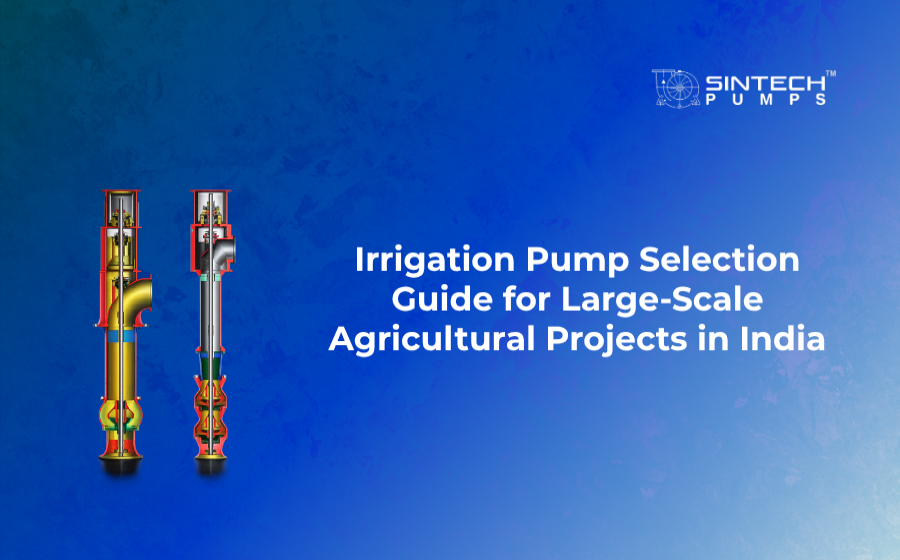
Not all irrigation pumps are built for the same job, and this is where most selection mistakes begin. Broadly, large agricultural projects in India rely on three categories of irrigation pumps, each suited to a distinct water source and terrain profile.

Vertical Turbine Irrigation Pumps for Deep Wells

When water sits deep underground or needs to be lifted from a canal at a lower elevation than the fields, vertical turbine pumps do the heavy lifting, quite literally. These pumps are built to operate at significant depths, often several hundred feet, making them the standard choice for deep tube wells serving large command areas. They’re compact at the surface, which matters when space around a wellhead is limited, and they’re engineered to run for long, unattended hours during peak irrigation season.

Axial Flow Pumps for High Volume Irrigation

Where the requirement is different, moving large volumes of water across relatively flat terrain, such as from a river or canal into a network of field channels, axial flow pumps are usually the better fit. They’re designed for high discharge at low head, which is exactly the profile of most surface irrigation and canal-lift schemes. A rice paddy system drawing from a nearby river, for instance, often needs volume far more than it needs pressure, and this is precisely where axial flow pumps outperform other configurations. Horizontal and vertical variants both exist, and the choice between them usually comes down to installation space and suction conditions at the site. In fact, most canal-lift schemes across the Indo-Gangetic plain rely on axial flow pumps precisely because they move so much water at such low energy cost per unit of discharge.

Centrifugal and Mixed Flow Irrigation Pumps

For projects that fall between these two extremes, needing moderate lift and moderate volume, centrifugal and mixed flow pumps offer a practical middle ground. They handle a wider band of head and flow combinations, which makes them common in mixed-cropping farms where water source and field elevation vary across the command area.

Getting this categorisation right before anything else is decided saves months of underperformance later. A farm that installs an irrigation motor pump suited for shallow, high-volume work on a deep borewell will find itself short on pressure no matter how powerful the motor rating looks on paper.

How to Choose the Right Water Pump for Irrigation

Once the pump category is narrowed down, the finer selection criteria come into play. Four factors consistently decide whether a water pump for irrigation performs as expected in the field.

The first is total dynamic head, the combined vertical lift and friction loss the pump has to overcome to deliver water from source to field. Underestimating this is the single most common design error in irrigation projects, and it shows up as weak flow at the far end of a distribution channel.

The second is discharge rate, measured against the actual water demand of the crop and the size of the command area, not against a generic catalogue figure. The third is the quality of the water source itself: silt content, temperature, and whether the source is a borewell, open well, canal, or river, because each of these affects impeller design and material selection differently. The fourth is power availability at the site, since rural feeders don’t always guarantee the voltage stability a pump motor needs to run efficiently.

None of these factors work in isolation. A farm that gets the head calculation right but ignores silt content in its canal water, for example, may still see premature wear on impellers within a couple of irrigation cycles.

Selecting an Agricultural Irrigation Water Pump Based on Farm Requirements

Large-scale agricultural projects rarely have uniform water needs across a season. Sugarcane and paddy demand sustained, high-volume irrigation for weeks at a stretch. Cotton and pulses need shorter, more calculated bursts timed to specific growth stages. This is why capacity planning for an agricultural irrigation water pump has to start with the crop calendar, not the pump catalogue.

A common mistake is oversizing the pump “to be safe.” In practice, an oversized agricultural irrigation water pump running below its best efficiency point wastes energy, wears out faster, and often floods field channels faster than the soil can absorb the water, which, ironically, can waterlog the very crop it’s meant to support. Right-sizing means calculating peak-day water demand across the largest crop block in rotation, adding a reasonable buffer for evaporation and conveyance loss, and selecting an irrigation motor pump that operates close to its optimum point across that range, not just at one flow rate.

For projects spanning multiple fields with different elevations or soil types, it’s often more efficient to install a combination of pump types feeding different zones, rather than expecting a single agricultural irrigation water pump to serve the entire command area equally well.

Improving Energy Efficiency with Irrigation Pumps

Every large irrigation project runs on a fine balance between water cost and power cost, and pumps sit right at that intersection. According to the Bureau of Energy Efficiency, agricultural pump sets in India often operate well below their design efficiency due to poor selection, ageing components, or mismatched motor sizing, a gap that translates directly into higher electricity or diesel bills across a season.

The efficiency conversation matters more for large-scale operations because the numbers compound. A pump running just 8-10% below its best efficiency point, multiplied across sixteen hours of daily operation during peak season, adds up to a meaningful chunk of a farm’s operating budget by the time the crop is harvested. This is one of the strongest arguments for treating pump selection as an engineering decision rather than a procurement afterthought: the cheapest water pump for irrigation at purchase is rarely the cheapest one to run.

Farms operating across states like Maharashtra, Karnataka, and Telangana, where power tariffs and feeder reliability vary significantly, have particular reason to prioritise pumps with proven efficiency curves over pumps chosen purely on upfront price.

Choosing the Right Irrigation Pump Manufacturer

It’s tempting to think of pump selection as purely a technical exercise: head, flow, horsepower, and stop there. But the manufacturer behind the pump shapes the experience just as much as the specification sheet does. Established irrigation pump manufacturers bring something a low-cost, unbranded unit usually can’t: engineering support at the design stage, consistent build quality across units, access to genuine spares when something wears out mid-season, and after-sales service that doesn’t disappear once the invoice is paid.

This matters enormously for large projects, where a single pump failure during a critical irrigation window can affect hundreds of acres, not just one field. Reliable irrigation pump manufacturers typically test units against recognised standards before they ever reach a farm, which reduces the guesswork around performance claims. It’s worth asking any prospective supplier for documented test data rather than relying on brochure numbers alone.

Working with a manufacturer that understands Indian field conditions specifically, including variable power supply, dusty or silty water sources, and extreme seasonal temperature swings, also tends to matter more in practice than working with one of the many irrigation pump manufacturers whose engineering was designed around very different operating environments.

Why Choose Sintech Pumps for Irrigation Applications

This is where a company like Sintech Pumps, headquartered in Ghaziabad, Uttar Pradesh, fits naturally into the conversation. Sintech has been engineering pumps for Indian industrial and agricultural applications since 1986, and its vertical turbine and axial flow pumps are built with exactly the kind of field realities described above in mind: deep tube wells, canal-lift schemes, and command areas where reliability over a long season matters more than a marginally lower price tag upfront.

What’s worth noting isn’t a sales pitch. It’s the design philosophy. Sintech’s engineering team works from the water source and field conditions backward, rather than pushing a fixed catalogue pump into every project. For a large-scale agricultural scheme still finalising its pump strategy, that kind of application-first approach, built on ISO 9001 certified manufacturing and decades of testing against Indian field conditions, is usually a better starting conversation than a price comparison sheet.

Conclusion

Choosing the right pump for a large agricultural project isn’t about finding the most powerful machine on the market. It’s about finding the one that fits your water source, your terrain, your crop cycle, and your budget for years of continuous operation. Whether the final choice is a vertical turbine unit or an axial flow system, a well-matched water pump for irrigation becomes almost invisible: it just runs, season after season, quietly doing its job. Get it wrong, and every other investment in the farm- the seed, the fertiliser, the labour- has to work harder to compensate.

If you’re in the process of planning or upgrading irrigation water pumps for a large farm or command area, it’s worth taking the time to get expert eyes on your site conditions before finalising a pump. Learn More about how the right selection process works, and don’t hesitate to bring in a manufacturer’s engineering team early. The earlier they’re involved, the fewer surprises show up once the pump is actually in the ground.

Frequently Asked Questions

1. What is the most important factor in selecting an irrigation pump? 

Total dynamic head and discharge rate together matter most. A pump chosen without accurately calculating the vertical lift and friction loss at the site will underperform, regardless of how strong its motor rating appears on paper.

2. Are axial flow pumps suitable for all irrigation projects? 

No. Axial flow pumps work best for high-volume, low-head applications like canal or river-fed field irrigation. For deep borewells requiring significant lift, vertical turbine pumps are generally the better choice.

3. How do I know if my irrigation pump is oversized? 

Signs include frequent cycling, waterlogging in fields faster than expected, and higher-than-normal power bills relative to the area irrigated. An oversized irrigation motor pump usually runs below its best efficiency point.

4. Does water quality affect pump selection? 

Yes, significantly. Silt content, temperature, and source type (borewell, canal, or river) influence impeller design and material choice. Ignoring this often leads to premature wear.

5. Why does the manufacturer matter if the specifications are similar? 

Specifications on paper don’t guarantee field performance. Established manufacturers provide tested build quality, genuine spares, and after-sales support, all of which matter more once a pump is running unattended for long hours.

6. How often should a large-scale irrigation pump be serviced? 

Most agricultural pumps benefit from a detailed inspection at least once before each major cropping season, with basic checks (bearings, seals, alignment) done more frequently during peak operating months.

Hey, like this? Why not share it with a buddy?

Leave a Reply

Top
Thanks!

Want us to call you back?

*Please share your details so that our representative can reach out to you. Please schedule a call between 9:30 AM to 5:30 PM (IST) Mon-Sat.

    SCS Pump Your phone number will not be used for marketing purposes.