Follow us

Follow us

Home » Blog » Horizontal vs Vertical Centrifugal pump: how to choose the right orientation

Horizontal vs Vertical Centrifugal pump: how to choose the right orientation

Posted: 31/07/2026
Category: Blog

Table of Contents

  1. What Is a Centrifugal Pump, and Why Does Orientation Matter?
  2. Horizontal Centrifugal Pumps Features Applications and Benefits
  3. Vertical Centrifugal Pumps Features Applications and Benefits
  4. Horizontal Pump vs Vertical Pump Key Differences Explained
  5. Horizontal vs Vertical Centrifugal Pumps Advantages and Limitations
  6. How to Choose the Right Centrifugal Pump
  7. Choosing the Right Industrial Centrifugal Pump Manufacturer
  8. Conclusion
  9. Frequently Asked Questions

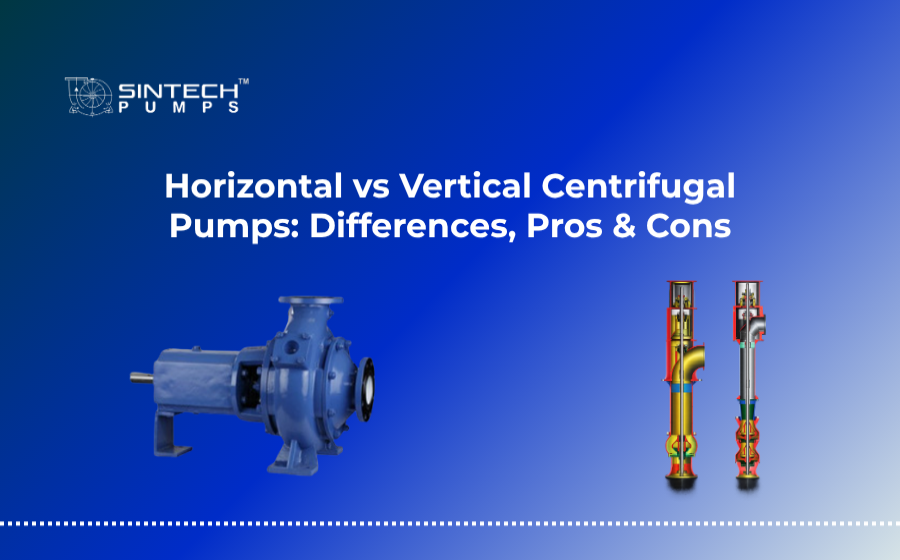
Horizontal centrifugal pumps mount the shaft parallel to the ground for easy maintenance access, while vertical centrifugal pumps mount it upright to save space and lift liquid from deep sources. Neither is universally better: the right choice depends on floor space, suction conditions, and servicing ease. This guide compares both and shows how to select between them.

What Is a Centrifugal Pump, and Why Does Orientation Matter?

A centrifugal pump moves liquid by converting rotational energy from an impeller into velocity, then into pressure, as the fluid passes through the casing. That basic operating principle stays the same whether the shaft sits flat or stands upright. What changes with orientation is everything around it: how the unit is supported, how it is primed, how much floor space it needs, and how easy it is to service five years down the line.

That’s really the heart of this comparison. Two machines can deliver similar flow and head numbers on paper, yet behave very differently once they’re bolted to a foundation and running three shifts a day. Engineers who’ve been burned by a wrong orientation call, usually because of a tight equipment room or an unexpected suction condition, tend to take this decision more seriously than the datasheet suggests they should.

Horizontal Centrifugal Pumps Features Applications and Benefits

In a horizontal centrifugal pump, the shaft runs parallel to the ground, with the motor and pump typically mounted side by side on a common baseplate. This is the configuration most engineers picture first when they hear the term, and for good reason: it’s the workhorse layout across chemical processing, water treatment, sugar mills, and general industrial service.

The biggest practical advantage of this layout is accessibility. Because the casing splits along a horizontal or axial plane, technicians can pull the rotating assembly for inspection without disturbing the piping in many designs, a real time-saver during a shutdown. Split casing double suction pumps, like Sintech’s SCS series, take this further with double suction impellers that balance axial thrust and reduce bearing wear, which matters a great deal in continuous-duty applications such as boiler feed and large water supply schemes.

Horizontal pumps also tend to be simpler to align, monitor, and troubleshoot because everything sits at a comfortable working height. The trade-off is footprint. This configuration needs more floor area than its vertical counterpart, which becomes a real constraint in retrofits or plants where space was never generous to begin with.

Vertical Centrifugal Pumps Features Applications and Benefits

A vertical pump orients the shaft perpendicular to the ground, often with the motor mounted above the pump casing or, in the case of turbine designs, well above the liquid source entirely. This configuration solves two problems that horizontal designs struggle with: limited floor space and the need to lift liquid from a deep source.

Vertical turbine pumps, such as Sintech’s SVT range, are a classic example. They’re built for deep well applications, canal irrigation, and cooling water intake, where the pump bowls sit submerged and the motor stays dry above deck. Because the footprint is essentially the pipe diameter, this design is the natural choice for sumps, tank pits, and congested plant layouts where a bulkier machine simply wouldn’t fit without expensive civil work.

Vertical sump pumps, like the STFV and CPSV series, follow the same logic for drainage and process sump applications. The pump hangs into the sump, eliminating the need for a separate suction pit and priming arrangement. The compromise is maintenance access. Pulling a tall unit for overhaul often means more crane work and more downtime planning than a horizontal split-casing pump, a factor maintenance teams should weigh honestly rather than discover mid-shutdown.

Horizontal Pump vs Vertical Pump Key Differences Explained

Beyond orientation, four things separate these two configurations in daily operation. Floor space is the first and most visible one; vertical pumps win decisively when real estate is limited or when the source liquid sits below grade. Priming is the second: many vertical machines, particularly submerged and turbine types, are effectively self-priming because the impeller stays wetted, while horizontal machines installed above the liquid level often need foot valves or priming systems.

Maintenance accessibility flips the advantage back to horizontal pump designs. A technician can usually inspect bearings, seals, and impellers on this configuration without a crane, whereas tall vertical assemblies, especially long-shaft turbine types, require more planning and specialised lifting equipment for a pull-and-inspect job. Finally, there’s a suction condition. Vertical designs handle low or negative suction head situations, such as drawing from a deep well or open channel, far better than horizontal units, which generally need a flooded or positive suction arrangement to avoid cavitation.

None of these differences make one configuration universally superior. They simply mean the right choice depends on what the site actually looks like, not on habit or what was specified last time.

Horizontal vs Vertical Centrifugal Pumps Advantages and Limitations

A horizontal pump earns its place through ease of maintenance, straightforward alignment, and a long track record in continuous process duty. Its limitations are footprint and, in most configurations, a dependency on flooded suction to perform reliably. A vertical centrifugal pump, by contrast, delivers a compact footprint and a genuine advantage in deep-suction or space-constrained installations, but asks for more careful planning around overhaul access and, in tall turbine assemblies, shaft alignment over long lengths.

Cost often narrows the gap more than people expect. A vertical machine avoiding civil work for a suction pit can be cheaper installed than a horizontal counterpart requiring a dedicated pump house, even if the pump itself carries a higher price tag. The honest answer, again, is that this comparison is really a site-specific engineering decision dressed up as a product comparison.

How to Choose the Right Centrifugal Pump

Good pump selection criteria start with the application, not the catalogue. Begin with the liquid source: is it a flooded suction tank, an open sump, or a deep bore well? That single question rules out one orientation for most projects before anything else gets considered. Next comes available space; a congested retrofit inside an existing building rarely has room for a horizontal baseplate and its service clearances, which pushes the decision toward a vertical or sump-mounted design.

Maintenance philosophy matters just as much as hydraulics. A plant running three shifts with a lean maintenance crew may prioritise the faster, simpler servicing that a horizontal centrifugal pump offers, even if it means a slightly larger equipment room. A municipal water utility drawing from a deep aquifer, on the other hand, doesn’t have that option worth considering; a vertical turbine pump is the only practical answer regardless of maintenance preference.

Finally, look at the numbers: flow rate, total dynamic head, NPSH (Net Positive Suction Head) available at the source, and duty cycle. Getting these figures right before choosing orientation saves the far more expensive mistake of correcting a foundation or piping layout after installation. Any credible set of pump selection criteria has to start with these operating conditions, not with a preference for one silhouette over another.

Choosing the Right Industrial Centrifugal Pump Manufacturer

This is exactly the kind of decision where working with experienced industrial centrifugal pump manufacturers pays off, because the right answer usually isn’t obvious from a flow-head chart alone. Sintech Pumps has spent close to four decades designing both configurations: horizontal split casing and process pumps built to ISO 2858 and ISO 5199, alongside vertical turbine, vertical mixed flow, and vertical sump pumps engineered for deep well, irrigation, and drainage duty.

That range matters less as a sales point and more as a practical one. A manufacturer that builds both orientations has no reason to push one over the other, only a reason to match the equipment to the site conditions in front of them. If you’re finalising a layout and genuinely unsure which configuration suits your process, sharing your suction conditions and site drawings with Sintech’s application engineers is usually a faster route to the right answer than debating it internally for another week.

Conclusion

Choosing between a horizontal and vertical centrifugal pump isn’t about picking the modern or traditional option; it’s about reading your site honestly and matching the machine to it. Horizontal designs reward you with easier maintenance and a proven track record in flooded-suction, continuous-duty service. Vertical designs solve the space and deep-suction problems that horizontal machines can’t. Get the suction conditions, footprint, and maintenance realities right first, and the orientation question tends to answer itself.

Working with industrial centrifugal pump manufacturers who genuinely build both configurations, rather than favouring one, is usually the fastest way to an unbiased recommendation. If you’d like a second opinion on your layout or want to explore Sintech’s horizontal and vertical pump range in more detail, our engineering team is happy to review your drawings and talk through the trade-offs, no pressure, just a straight conversation about what will actually work on your floor.

Frequently Asked Questions

1. Is a horizontal or vertical centrifugal pump more efficient? 

Efficiency depends on impeller design and duty point, not orientation. A well-matched pump of either configuration can hit strong hydraulic efficiency; the deciding factor is usually suction condition and installation, not the shaft position itself.

2. Which is cheaper to install, a horizontal pump or a vertical pump? 

It varies by site. Horizontal pumps often need a dedicated pump house, while vertical pumps can avoid civil work in sumps or wells, sometimes making the vertical option cheaper overall despite a higher unit cost.

3. Can a vertical pump handle high flow rates like a horizontal pump? 

Yes. Vertical mixed flow and turbine pumps handle high-volume duty comfortably, including irrigation and cooling water intake, provided the bowl assembly and motor are sized correctly for the head and flow required.

4. Do vertical pumps need priming like horizontal pumps do? 

Usually not. Most vertical pumps, especially submerged and turbine types, stay wetted at the impeller, making them effectively self-priming, whereas horizontal pumps often need a flooded suction or priming system.

5. Which orientation is easier to maintain? 

Horizontal pumps are generally easier to service because technicians can access bearings and seals at working height without a crane. Vertical pumps, particularly long-shaft turbine designs, need more planning for pull-and-inspect work.

6. What pump selection criteria should I prioritise first? 

Start with suction conditions and available space, then confirm flow rate, total dynamic head, and NPSH available. These factors narrow the orientation choice before comparing specific pump models or manufacturers.

Hey, like this? Why not share it with a buddy?

Leave a Reply

Top
Thanks!

Want us to call you back?

*Please share your details so that our representative can reach out to you. Please schedule a call between 9:30 AM to 5:30 PM (IST) Mon-Sat.

    SCS Pump Your phone number will not be used for marketing purposes.