Sintech Pumps No Comments

Signs that Indicate its Time to Replace Your Pump System

Whether you use your pump systems for irrigation, industrial piping or wastewater treatment systems, a consistent and high-performing pump system is essential. If you rely on outdated pumping systems, then you not only lose out on productivity and efficiency but also end up spending large sums of money as operational costs. To identify whether it’s time to upgrade your pumps, look out for the following signs:

Electrical Excess

ElectricalObsolete pumps use higher energy for the same outputs compared to modern pump systems. If you notice your electricity bills shooting higher and higher with the same amount of usage, then your pump systems may be to blame. Replacing your old pumps with modern ones not only help in improving efficiency but also help in reducing your overall electricity bills.

Frequent Repairs

pump repairsApart from wasting energy, old pumps tend to break down more often and require frequent services to keep them functioning. If you are spending more money and time on servicing your pump, then you can consider replacing it. Newer pumps like the latest range of pumps from Sintech are made of high-quality materials and incorporate state-of-the-art technology. They last for several decades without any issues. This reduces your overall pump maintenance costs.

Inadequate Pressure

PressureIf your pump struggles to displace the fluid at a constant pressure throughout the system, then it’s an indicator that you have to replace it. All latest pumps deliver and maintain consistent pressure throughout the system.

Visible Leaks

fluid LeaksIf you notice the displaced fluid escaping out from the pump system via leaks or if you notice the lubricant seeping out from the pump system, then it’s an indicator that it’s time to upgrade your existing pump system.

Drop in Performance

Drop in PerformanceFinding that the output delivered by your pump is lower and lower than before? Old pumps that have crossed their lifecycle see a drop in output performance.

You have no clue what’s Wrong with your Pump

Wrong with your PumpDo you find yourself calling in the pump service technician frequently? Not able to pinpoint accurately what’s wrong with your pump? Notice weird burning smells or loud noises from your pump, even after frequent services? These are sure signs that it’s time to upgrade your pump.

Getting Replacement Parts for Your Pump is Getting more and more Challenging

If you find that replacement parts are costing you an arm and a leg, it’s time to bite the bullet and replace your existing pump system. Worse still, you cannot find replacement parts even if you are ready to spend a fortune.

The only thing holding your pump system together is Rust

rust on pumpsYou can no longer find your pump system hidden underneath all the rust. You find that everything is leaking and disassembling and assembling your pump system is impossible without damaging a few parts. While trying to extend the lifecycle of your pump is appreciable, don’t overdo it. Maintaining an old pump is expensive and quickly dry up your working capital. So, make sure to replace your pump, cut down costs and increase outputs, if you notice one or more of the signs listed above. To purchase the best industrial pumps in India, reach out to one of our sales representatives here at Sintech.
Sintech Pumps No Comments

Battling Global Water Scarcity by Reusing Industrial Wastewater

Water is essential to all life on the planet. Sadly access to water is denied to millions of people. Find out, what you can do to battle global water scarcity. Access to water is linked not just to the health and safety of the world’s population, but also plays a crucial role in economic vitality and development. Yet, more than 4 billion people around the world don’t have access to clean drinking water. With increasing deforestation, soil erosion and pollution, climate changes and increased consumption – water quality and availability has deteriorated significantly all around the globe. We need to take collective action to improve water availability and to improve access to clean and safe water to all. Governments, private organizations, educational institutions, and civil society – everyone should work together to implement the right solutions to address water scarcity. Sustainable and innovative solutions are the best way to address water scarcity. Here, in today’s post, we shine the spotlight on how you can tackle water scarcity by reusing industrial wastewater generated at your plant. What is Industrial Water Reuse? Waste-WaterAs the term implies, industrial water reuse is the practice of using treated wastewater in other non-critical applications as a way to conserve water. From food production to automotive and aerospace technology, businesses across industries have integrated water reuse practices. Industrial wastewater generated can be treated in several ways like using an RO (Reverse Osmosis) system, or ZLD (Zero Liquid Discharge) system. Irrespective of the type of wastewater treatment system you use, the pumps are a critical component of the system. Environmentally Aware and Efficient – Sintech, Your Trusted Partner is Waste Water Engineering Pumps, valves, and systems from Sintech are a crucial component of wastewater handling in your industries. From transporting wastewater to treatment plants to disposal – Sintech’s range of pumps offer you complete reliability and efficiency. Our extensive experience and knowledge in wastewater engineering help you set up a smooth and efficiently operating the wastewater treatment plant. Here, at Sintech, our responsible and sustainable approach to the environment is as crucial as focusing on delivering maximum efficiency in our products and services. Reliable & Efficient – Presenting the Next Generation of Wastewater Pumps from Sintech With high-efficiency motors and non-clogging impellers, our range of wastewater pumps improves efficiency. The new gen wastewater pumps from Sintech include: Energy Efficient Wastewater Pumps and Motors for Optimum Efficiencies Whether you are looking to deal with industrial or municipal wastewater – the submersible motor pumps from Sintech are the perfect solution for all your wastewater transport requirements. Combined with high-efficiency motors, our pumps offer significant energy savings. Sintech Pumps is a leading industrial wastewater pump supplier in India. Reliable and Efficient: The New Non-Clogging Impellers New Non-Clogging ImpellersThe maximum-free flow impellers used in our new-gen range of wastewater pumps offer you maximum efficiency with minimum clogging risks. The asymmetric arrangement of the vanes offers a large uninhibited passage, which allows solids of different sizes to pass through the system without any difficulties. The slightly convex profile of the central hub in the middle of the impeller prevents the risk of clogging. Whether you are using submersible or centrifugal type of wastewater pumps, the new range of impellers offers you clogging-free operation. Energy-efficient Motors that Provide Optimum Efficiency Energy-efficient MotorsUsing our range of new-gen wastewater pumps that offer optimum efficiency provides you with considerable energy savings. The motors are highly economical to use and are suitable for all applications. You are assured of maximum energy savings due to low energy operational requirements, and reduced maintenance costs. With optimum operations, you are assured of constant performance. Customized Wastewater Pumps for all Requirements Irrespective of the type of wastewater treatment method you use, Sintech’s extensive range of specially-adapted impellers and energy-efficient motors offer you a wide range of wastewater pumps. Get in touch with our industrial pumps experts to find the right wastewater pump that suits your specific application – like improving operational efficiency and improving reliability.
Sintech Pumps No Comments

Save Water, Time and Money with Innovative Range of Wastewater Treatment Pumps from Sintech

Reduce the Discharge of Industrial Wastewater – by using highly efficient, innovative range of Sintech pumps. Continue reading to find out how you can “Save Water, Time and Money” with a Zero Liquid Discharge System, powered by Sintech’s latest range of industrial wastewater pumps. It’s Impossible to Reuse our Planet. But, we can indeed Reuse our Wastewater. All major industries today consume substantial amounts of freshwater while generating massive tons of industrial wastewater. The wastewater generated from these plants is usually discharged into nearby water bodies like a pond, or deep well injected. This not only poses a significant threat to our ecosystem but also causes major effects on public health. It also causes it causes severe groundwater contamination and other environmental problems. Additionally, discharging wastewater into the environment damages the reputation of businesses. Reduce and Reuse Industrial Wastewater – The Need of the Hour reuse-waste-waterZero Liquid Discharge (ZLD) systems present an innovative and sustainable solution and help to address the challenges industrial plants face in discharging wastewater sustainably. Also known as Minimal Liquid Discharge (MLD) treatment system, it helps to reuse and reduce industrial wastewater discharge. It’s an ambitious and innovative wastewater management strategy that helps to eliminate liquid waste while helping industries recover most of their wastewater discharge for reuse. ZLD is extremely beneficial to both the industry as well as the environment. However, the process is generally constrained by implementation limitations, extensive energy consumptions, and high costs. Industries that Benefit from Reducing Wastewater
  • Chemicals
  • Paper manufacturing
  • Sugar processing
  • Pharmaceuticals
  • Refineries
  • Textiles
  • Electronics
  • Power Plants
  • And, several others
Sintech presents Cost-Effective and Efficient Wastewater Treatment Pumps Salient Highlights of Sintech Pumps for ZLD Systems
  • Effortless scalability – Since the pump can run in parallel with other pumps and systems
  • Low leakage risk – Due to low housing pressure
  • Strong corrosion resistance – Since our range of pumps are made with high-grade steel
  • Low Pulsation – With a large number of pistons, our pumps have a positive impact on pulsation levels in the system
  • World-class Efficiency and Easy installation & maintenance – Backed by the Sintech mark of reliability
Here’s a quick introduction to the working of a ZLD system. What is a Zero Liquid Discharge System? As the name implies, the ZLD reduces the wastewater generated by an industrial plant. It can be broadly defined as a process that allows maximum recovery of water from a wastewater source. Without ZLD, the wastewater will be discharged into the environment or below ground. ZLD reduces the amount of wastewater discharged by reusing it beneficially. Zero Liquid Discharge can happen in many ways. There isn’t one solution that fits all. A ZLD system is highly site-specific. What works for one industrial plant may not be the best solution for another. Choosing the right ZLD system for your plant depends on several factors like wastewater composition, operating costs, the volume of the wastewater generated, the streams of wastewater to be treated, footprint availability and more. The size and complexity of the ZLD system depend on the nature and volume of the wastewater to be treated and other factors. It can include membrane processes, stand-alone thermal/evaporative processes and/or hybrid systems. How Does Zero Liquid Discharge Work? The ZLD is a wastewater treatment process that purifies and recycles wastewater. This system aims to leave zero discharges at the end of the water treatment cycle. It’s an advanced wastewater treatment method that uses several innovative processes like reverse osmosis, ultrafiltration, fractional electrode-ionization, and evaporation/crystallization. While the actual ZLD system varies from one application to another, a standard ZLD process generally consists of the following steps: Step 1: Pre-treatment and Conditioning Pre-treatment involves removing simple things from the wastewater stream by filtering or precipitation. It also conditions the water and reduces the number of suspended solids in it. Generally, the pre-treatment unit makes uses of a clarifier/reactor to precipitate hard metals, silica and other dissolved components in wastewater. Step 2: Coagulation Sometimes, caustic soda is added in this step for coagulation. This is a technique in which various chemicals are added to the reaction tank to remove contaminants, and other bulk suspended solids from the water. Step 3: Flocculation Once coagulation is over, the treated water is passed into a flocculation chamber. Here, the coagulated particles are stirred with long-chain polymers creating visible particles that look like snowflakes. Step 4: Sedimentation The treated water then enters the sedimentation stage. This consists of a gravity settler that is a large circular tank. The flocculated material and the water flow into this tank, to undergo a slow settling process. The water rises to the top and overflows the perimeter of the clarifier allowing solids to settle at the bottom of the clarifier. This forms a sludge blanket at the bottom. The solids are then passed into a tube, and the sludge is passed into a sludge handler. Step 5: Sludge Handler The sludge handler begins the dewatering process. Depending on the composition of the wastewater, additional chemicals may be added at this stage to reduce the quantity of silica and other materials in the water. Step 6: Ultra-Filtration Ultra-filters can be used in place of gravity sand filters. Fine membranes that filter contaminants from water replace the clarification stage completely. Step 7: Concentration The concentration of the wastewater can be done using any one of the following reverse osmosis membranes, electrodialysis, or brine concentrators. All three methods have varying requirements and the ideal method for concentration is dependent on the application type. Sometimes, two or more concentration methods can be used together to achieve the desired effect. At the end of the concentration stage, you can reclaim up to 60 to 80% of the water. Step 8: Evaporation/Crystallisation The next step involves generating a solid from the water using thermal processes like evaporation. In evaporation, the water is completely evaporated, leaving behind solid wastes. The evaporated water is then recollected and made available for reuse. Sometimes de-aeration is done at this stage to release dissolved carbon-di-oxide, oxygen, and other non-condensible gases. The leftover waste from the evaporator is then sent to a crystalliser. The solids are filtered out as crystals, and the water is made available for reuse. The treated water is then stored in a holding tank and is reused as required. The ZLD system makes water safe for reuse. The solids generated from the process are converted into a solid cake, which either can be reused or goes to a landfill. Join in the Fight against Water Scarcity with Sintech Pumps Here, at Sintech, we believe that as industrial pump manufacturers our responsibilities go far beyond producing and developing the latest pump systems. We believe that we have a role in caring for our environment. To support large-scale industries reduce their water consumption footprint – we are committed to developing sustainable solutions that will impact the world of tomorrow. We offer a wide range of high-pressure pumps for the wastewater industry. As one of the largest and leading industrial pump manufacturers, our range of pumps is engineered to provide you with world-class efficiency and reliability. We help you achieve your business objectives while helping you make a positive impact on the world. If you like to know more about our pump solutions, and how we can build customizable systems that work for your business, get in touch with our pump experts today. Check the range of water pumps which used in wastewater treatment.
Sintech Pumps No Comments

Are these 5 Innovative Solutions the Answer to Global Water Crisis?

                       Fact: Around 884 million people around the world don’t have access to clean water. What does it mean? 1 out of 9 people on the planet doesn’t have water that is safe for human consumption. This is the Water Crisis, we are facing today. Worldwide children, women,and men are affected by the water crisis, and every 90 seconds a child dies from a water-borne disease. Women and children are the most affected, as they spend over six hours a day collecting water. This is time lost on education, work,and family life. The Silver Lining Several innovative solutions are being discovered in developing and developed nations to meet the global water crisis. In this post, Sintech Pumps-centrifugal water pump manufacturers take a look at some of the revolutionary and creative technologies used to improve access to clean water.
  1. Drinkable Book
This was developed by the NGO; Water is Life along with researchers at CMU (Carnegie Mellon University). The words on each page of the book contain vital sanitation advice like keeping contaminants and feces away from drinking water. What’s unique about this book is that each page of the book is a filter paper, which purifies drinking water up to 99.9%. Each book has enough filter paper to provide drinking water to the reader for up to four years. Currently, this book is distributed in water scarce areas in Tanzania, India, Ethiopia, Haiti, Kenya,and Ghana.    2.  WaterSeer On first glance, this looks like a well. But, it isn’t. Unlike a well that extracts water from under the ground, the WaterSeer extracts water from the atmosphere. This device is planted at a depth of six feet below the ground. The lower chamber of the device is surrounded by the cool earth. Above the ground, it uses a turbine, which spins. The spinning of the turbine above the ground spins fan blades inside the buried chamber. These blades then push the air into an internal condensation chamber, where the warm air cools down into water vapour. This water vapour is then collected in the lower chamber and can be extracted using a simple pump and hose setup. The waterseer has the capability to collect 37 litres of water every day. The waterseer is developed by the US-based VICI labs and is currently being tested by the National Peace Corps Association.       3. Graphene Filters One of the biggest problems of desalination (the process of converting seawater into drinkable water) is that it’s too expensive and requires plenty of energy. Recently, a researcher Lockheed Martin has created, and patented graphene filters which he claims reduces the energy costs of conventional reverse osmosis by 20%. Additionally, this filter will be able to withstand high temperatures and pressures. The graphene filter is hyper-permeable and perforated and is one atom thick. This device claims that it increases water flow by 500% compared to conventional methods. This technology aims to reduce the wastewater generated by the oil and gas sector. Together, these two industries generate about 18 billion gallons of wastewater every year.      4. Fog Catchers These are vast mesh nets that capture moisture from fog. The moisture trapped from fog is dripped into collection trays, as a result of condensation. The biggest live example of this project is set up on the slopes of Mount Boutmezguida in Morocco. Here, around 6300 litres of freshwater is harvested daily using these mesh nets. The water is free, clean and gets collected quickly. The Non-profit responsible for this project, Dar Si Hmad was awarded the Momentum for Change award by the UN in 2016. You can find fog catchers in other countries like Ghana, Peru, Chile, South Africa, Eritrea,and even California.      5. Solar Pumps These pumps run on clean energy harnessed from the rays of the sun. The excess energy generated is then sent back to the grid, thereby conserving water and other precious resources like coal, fossil fuels, etc. In hot and dry climates like India, the majority of farmers depend on groundwater to irrigate crops. By harnessing the free energy of the sun, farmers reduce their expenses significantly. Also, the buy-back scheme lets them sell the excess power and thereby provides farmers with an additional source of income. In fact, the buy-back is seen as a triple win – farmers gain additional income, states add to their electricity reserves, and carbon emissions are cut down. Initially, this scheme was piloted in Gujarat and now has spread to the rest of the country. Water experts believe that solar pumps are the way forward, as this method is highly sustainable and reduces environmental impact significantly. Check out the different types of solar pumps available at Sintech. Wrapping it up Have you come across any other innovative solution that solves the global water crisis? Let us know in the comments below. And, if you’re interested in setting up a solar pump system, get in touch with our sales experts here at Sintech, India’s leading and innovative pump manufacturer.      
Sintech Pumps No Comments

How to Select the Right Pumps for your Wastewater Systems – A Comprehensive Guide

The Need for Wastewater Pumps Water is one of the most important elements for any industry. Be it paper manufacturing, sugar processing, chemical industries or more, water serves many purposes in the industrial plant. And, this essential element is becoming more and more scarce. This means, industries have to look for ways to reuse water, thereby reducing the burden on the environment. Once water has served its use, it needs to be collected and dispatched to the wastewater treatment plant. A wastewater treatment plant is one that treats used water and makes it suitable for other applications. In the treatment plant, wastewater flows through the system. Sometimes, wastewater has to be moved opposite to gravity. In such instances, you require a pumping station and pumps to create a stable and smooth flow of the wastewater throughout the treatment plant. The Unique Challenges faced by Wastewater Pumps Wastewater is trickier to transport. This is because it has plenty of rags, organic solids, debris and other waste water immersed in it. Also, it’s essential that the pumps you use for displacing wastewater are highly reliable, to prevent overflows and spills. In the unfortunate case that a spill occurs, it could lead to environmental pollution, thereby attracting huge fines from the local authorities. This is why; you need to spend considerable time picking the right state-of-the-art pumps and wastewater pumping stations for your industry. No worries, here at Sintech, we help you find the right wastewater pumps that meet your specific requirements. Let’s get started. What to look for in a Wastewater Pump? Here’s a quick look at the factors you have to consider while choosing a wastewater pump.
  • Minimum energy use
  • Maximum pumping reliability
  • Aesthetically pleasing design (it has to be invisible)
  • Features that deal with odour (mostly hydrogen sulphide)
  • Intelligent control systems
  • The pumps must suit even challenging pump station layouts
Types of Wastewater Pumps There are several kinds of wastewater pumps. The common ones are:
  • Single-stage dry well pumps. These are known as conventional wastewater pumps and are available in a vertical or horizontal configuration.
  • Single-stage, solids handling, wet-well submersible pumps. Some particular types of submersible pumps are suited for both dry and wet well installations.
  • Single-stage or two-staged solids handling pumps with vertical turbines.
When choosing the right type of wastewater pumps, you have to consider several factors like life-cycle economic costs, applicability, and more. Quick Description of the Different Types of Pumps
  • Conventional Wastewater Pumps
These are also known as non-clog, solids handling or dry-well pumps. Their main purpose is to pump liquids that contain soft solids and other stringy material. They don’t require frequent servicing and cleaning and operate without plugging. They can either be installed with horizontal or vertical mounting. Vertically mounted pumps use a motor on the pump frame or a life shaft.
  • Submersible Pumps
These are non-clog pumps that are immersed in the wastewater for operation. They come equipped with powerful motors. They are installed directly in wet well. This means wastewater pumping stations that use submersible pumps don’t require a dry well. The pumping system construction above the ground is minimal. All that’s visible above surface is a concrete slab and a small housing construction for the control centre. Conventional Vs Submersible Pumps – Which one to Choose? Both these types of wastewater pumps have pros and cons. here’s a look at the differences between them. Submersible pumps don’t require a dry well. This means the construction and installation costs of this type of pump is way lesser when compared to conventional pumps. On the flipside, submersible pumps are not readily available for service and inspection and don’t give much warning of any impending problems. This means the cost of service and maintenance are higherwhen compared to conventional pumps. Also, if any repair occurs it could lead to lengthy downtimes. When it comes to installing submersible pumps in wet-wells, it’s usually set up with a fixed discharging pipe that is supported by a tripod placed on the wet well floor. In such an installation, the wet well has to be drained during inspection, maintenance or service. Another alternative method of installing submersible pumps is the new pull-up design. Here, the discharge pipes are connected to a specially designed elbow that’s permanently fixed to the wet well floor. The pump discharge and the elbow come with a self-locking coupling. This set up, comes with a mounting bracket that moves up and down on rails. The pump can be raised or lowered into the wet well with the help of cables and cranes. The result, inspection personnel need not enter the wet-well and there’s no need to drain it during service. A few types of wastewater pumps that have submersible motors require continuous immersion in water during operation. They run only for short periods when exposed to air. Other advanced submersible pumps come with motors that provide internal cooling and can be operated continuously even at full loads, without immersion. You can also find internally cooled pumps for dry-well installations too. These pumps are highly resistant to damage even if the dry well gets accidentally flooded. The minor drawback with these types of pumps is that they come with higher initial costs. The latest pump in the non-clog pump world is the solids-handling, vertical turbine pumps. As the name implies, these pumps have the best of both vertical turbines and solids-handling. It’s installed directly on the top of the wet well and there’s no need for a dry well. It uses an angle gear or motor that is placed on top of the pump discharge head. This pump uses standard drivers and the drivers are easily accessible during maintenance or service. The discharge connections and the symmetrical bowl design can be mounted either below or above ground. Though this pump is a bit expensive, it reduces the need for a pumping station and dry well, thereby keeping the overall costs down. Choose the Right Wastewater Pumps that meet your Industry Requirements Now, that you’re aware of the working of the different types of wastewater pumps, we hope you can easily pick the best one that meets your specific requirements. And, if you need any further help, all you have to do is reach out to our team of pump experts, here at Sintech, India’s most trusted supplier of wastewater pumps.
Sintech Pumps No Comments

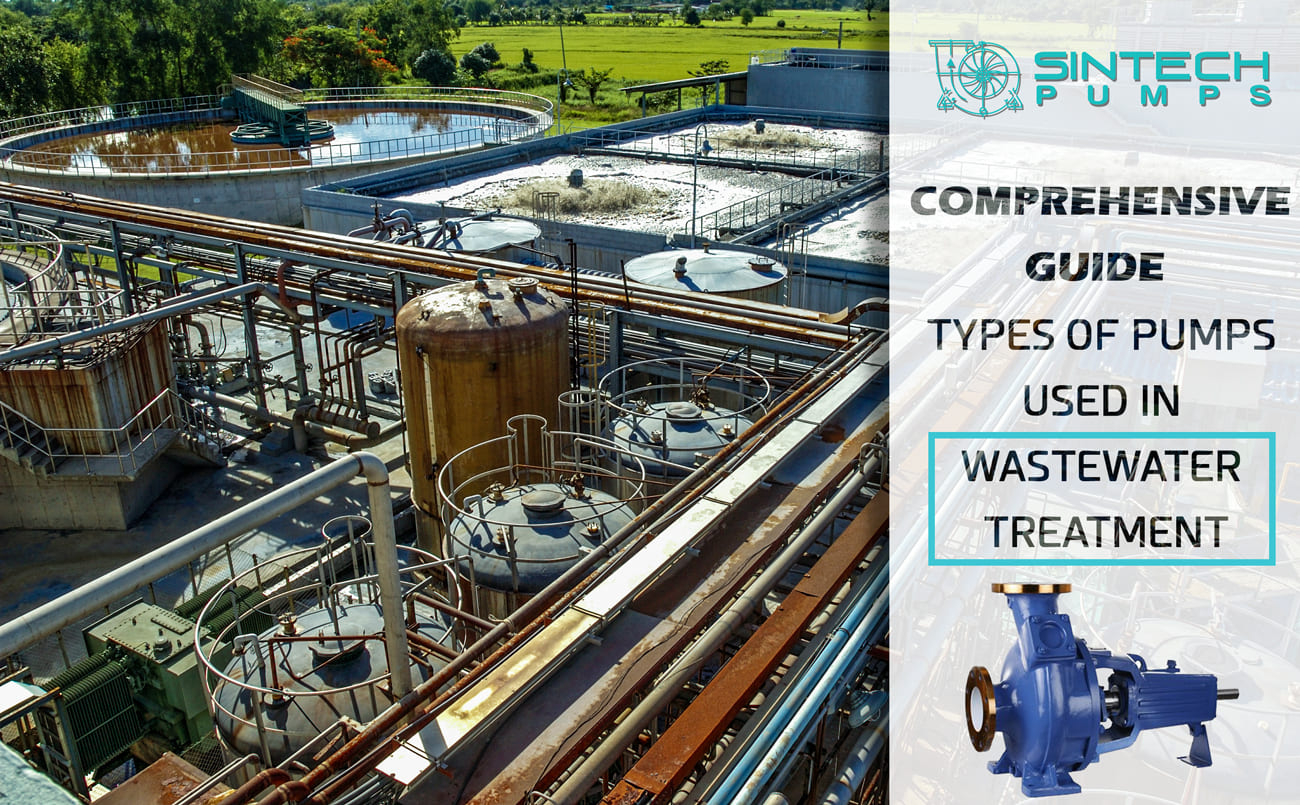
Types of Water Treatment Pump

A Comprehensive Guide to the Types of  Wastewater Pumps used in Wastewater Treatment Today, with drastic global climate changes and widespread droughts, Waste Water Management has become more crucial than ever before. Wastewater treatment is the need of the hour in commercial, residential complexes as well as in industrial zones. Wastewater Treatment Plants – The Pressing Need of the Hour Wastewater treatment plants play a vital role in places like industries where large volumes of wastewater are discharged every day. Wastewater treatment not only gives you the satisfaction of doing your bit to the Earth’s most precious resource but also could reduce your overall operational costs significantly. In industries like chemical, food processing, manufacturing, pharmaceutical and several others, wastewater treatment plants are a must to meet government regulations and rules. When it comes to treatment plants, there are three different treatment processes used like – primary, secondary and tertiary. The quality of treated water depends on the type of treatment process used. Different industries employ different types of treatment processes, based on the quantity of wastewater, contaminants in it and the level of purity required and other miscellaneous factors. However, what remain common among all wastewater and sewage treatment plants is that they all depend on wastewater pump(s) for the process. Role of Pumps in Wastewater Treatment These pumps are used to move wastewater from the collection pit to the treatment plant and back into the industry. There are plenty of wastewater pumps depending on the application and usage requirements. Here in this article, you can find all that you need to know about these pumps in one place. Let’s get started. Commonly used Types of Wastewater Pumps In any wastewater treatment plant, pumps play a vital role. They help in collecting the wastewater from different parts of the plant and transfer it to the treatment plant. Once the water is purified, pumps then assist in moving the treated water to places where it is required or to a storage tank. Based on the technique used for water treatment as well as the force required, there are several types of wastewater pumps in usage. Let’s take a look at the types of pumps based on their operation.

Centrifugal Pumps

As the name implies, these pumps make use of a centrifugal force to create sufficient velocity to displace the fluid through the system. Centrifugal pumps come with rotating impellers. These are parts that resemble a mechanical fan. It has a small intake and a large outlet. Highlights of a centrifugal pump that makes it ideal for wastewater treatments:
  • Simple and straightforward design that makes it practical to operate
  • The moving parts are highly durable, ensuring that your pumps last for long
  • Require minimal maintenance

Positive Displacement Pumps

These pumps make use of rollers, gears, impellers to displace fluid through the system. They are highly durable and are able to pump both liquids as well as slurries with lots of solid particles. The most popular type of positive displacement pumps are the diaphragm pumps. As the name states, these pumps have a chamber and a diaphragm membrane and are fitted with discharge valves. Other Popular Types of Wastewater Pumps There are plenty of wastewater pumps depending on the specific requirements of a particular application. Here are a few common ones:

Submersible Water Pumps

As the name suggests, these pumps are entirely submerged in the liquid they are displacing. They are mostly used to drain sewage or slurry. The pump is placed under the wastewater or sewage levels, and its operation is controlled with the help of level sensors. While some submersible pumps can handle only liquids and are used to drain water from trash pumps and sumps, others can handle solid sewage as well.

High-Pressure Pumps

These pumps employ axial piston principle and have a compact and light design. They can either be variable delivery pumps or fixed displacement pumps.

Water Pressure Booster Pumps

As the name indicates, these pumps are used in wastewater treatment plants to control and boost water pressure.

Agitator Pumps

This type of pumps supplies kinetic energy along the pump intake.

Circulation pumps

These pumps are used when you need to keep the slurry moving through the treatment plant.

Progressive Cavity Pumps

Here, in these pumps, storage tanks or pipelines are used to transfer fluids and slurry from the suction area to the discharge area. Apart from these, there are several other types of pumps used in wastewater treatment like mixed flow pumps, lift stations, and trash pumps. Final Thoughts Ultimately, the type of sewage pump you choose for your water treatment plant depends on several factors. The pump you choose must be able to withstand the abrasion and corrosion caused by the slurry or wastewater. Also, the pumps used in industrial plants are vastly different from those used in residential complexes. The former pumps must be highly durable and heavy-duty to handle large volumes effectively. Here, at Sintech, we provide you with different types of wastewater pumps, which are customized to suit your specific requirements and applications. Our pump experts analyze the volumes of wastewater your generate, the contaminants in the water and the level of purity required, to help you select the ideal pump that minimizes overall operational and maintenance costs while lasting long term. Give us a call at +91-120-4176000 or drop in your queries here, to find the best wastewater pump for your specific project at the most affordable prices.
Sintech Pumps No Comments

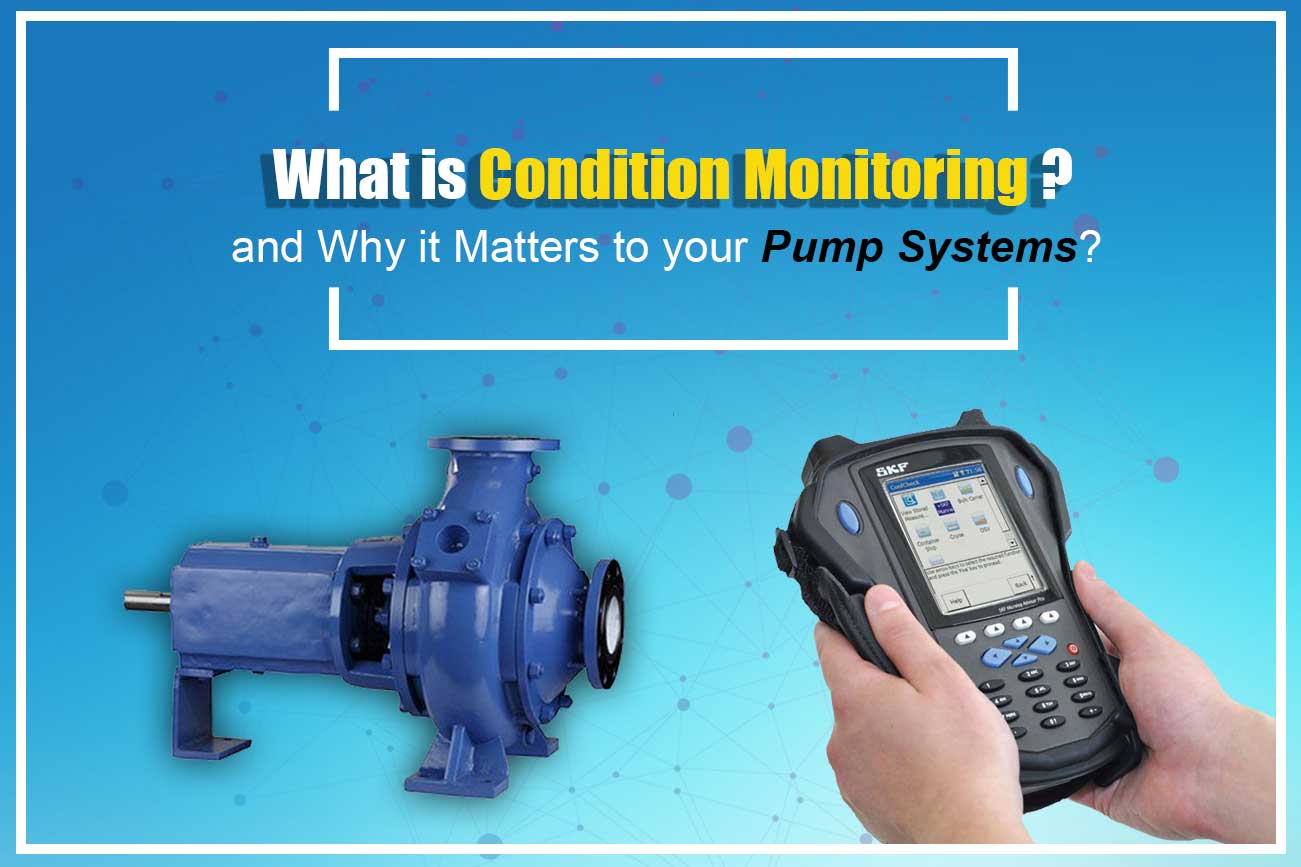
What is Condition Monitoring and Why it Matters to your Pump Systems?

Pumps are one of the most critical elements of an industrial process. Be it sugar processing, paper manufacturing, chemical processing, power plants or wastewater management systems, the quality of your pumps determines the efficiency of the overall operation. You need to keep your pumps in top-shape if you want your productivity levels to be optimum. Downtime and costly repairs not only disrupt your workflow but reduce your output significantly. This is where predictive maintenance based on conditional monitoring comes into the picture. What is Condition Monitoring? Condition Monitoring or CM, in short, is the process of determining the condition of your pumps, while they are in operation. This helps in monitoring the working situation of your water pumps using techniques like vibration monitoring. This eliminates equipment failure and reduces downtime significantly, as you can take remedial action before a particular problem takes a toll on productivity. Let’s take a look at the, Six Main Benefits of Condition Monitoring
  1. Reduce Repair Costs– In traditional maintenance, you usually have to replace the entire equipment in case of failure. However, in condition monitoring, you replace the critical piece of equipment before it fails. This helps in reducing the repair costs by a considerable margin. Instead of replacing the entire equipment or machinery, you can just replace the worn out part.
  2. Reduce Labour Costs– During repairs and maintenance, the time taken for repair is significantly reduced. This is because you have to replace only the worn out parts and not the entire pump system. Additionally, the number of “Critical Callouts” and the frequency of repair are reduced as the condition of the pumps is monitored continuously. This reduces overall labour costs.
  3. Eliminate Downtime– In traditional maintenance methods, a critical pump failure can lead to unscheduled downtime, which will end up costing you thousands of dollars. With condition monitoring, you take proactive maintenance, which means you can schedule repairs during non-productive times, thereby eliminating downtime.
  4. Improve overall safety– With condition monitoring, you can fix potential problems before they become a significant safety issue. This ensures that your pump always operates in a safe environment, thereby boosting the overall safety of customers and employees.
  5. Streamline Employee Operation Times– By identifying the precise repairs to be done beforehand, employees need not spend valuable time, trying to figure out what’s wrong.
  6. Above all, Increase your overall Revenue– With reduced repair costs, quick repair times, and no downtimes, you can increase your total revenue by a huge margin.
Popular Monitoring Methods: The internal wear of centrifugal pumps varies based on several factors like frequency of usage, characteristics of the pumped liquid, type of pump and so on. While some pumps last for years, others fail after a few months. You can avoid these uncertainties with the help of condition monitoring. Some of the common pump condition monitoring methods includes:
  1. Vibration Monitoring and Analysis– This is one of the most widely used ways of condition monitoring. It helps to detect problems like misalignment, unbalance and looseness of parts.
  2. Sampling and Analysis of Lubricants– As the name suggests, in this method you analyze the used lubricants to determine the rate of deterioration and wear and tear. This is mostly used for identifying lubrication system faults and bearing issues.
  3. Electrical Plant Tests– This technique is used to monitor the condition of the motor.
  4. Non-destructive Testing and Visual Inspection– This is used to identify wear and tear in the external pump casing.
  5. Performance Monitoring and Analysis– This is used to detect any faults with a pump’s internal conditions.
Experts recommend using more than one method of condition monitoring. This is because different methods detect different issues. So, when you use more than one process, you can find all the problems of your pump systems. Let’s take a look at a few of these Condition Monitoring Methods in Detail
  1. Vibration Monitoring
It’s one of the most effective methods of condition monitoring. It uses vibration sensor measurements to identify problems. This helps to identify future pump failures before they become a major issue. It makes use of an advanced dynamic model of the pump to detect errors. This model varies depending on the pump model/type.
  1. Oil/Wear Analysis 
The goal of this method is to detect any changes in the oil deterioration levels of water pumps, to signal any imminent distress before it occurs.  When used with vibration monitoring, this method is an efficient way to monitor the condition of water pump bearings. Two Popular Methods of Oil Analysis includes:
  1. Spectrometric Oil Analysis (SOA) – Identifies excessive wear
  2. Magnetic Plug Analysis – Ideal for small to medium water pumps
 
  1. Performance Monitoring 
It’s the easiest and simplest way to do condition monitoring. It involves comparing critical variables with a baseline to identify any variations. Some of the key variables measured in this method include:
  • Pressure Ratios
  • Vibration in the pump
  • Flow
  • Power consumed
  • Bearing temperatures
Performance analysis helps in monitoring key component performances and in revealing gradual pump degradation. Successful Condition Monitoring Just because you employ condition monitoring, it doesn’t mean that all your pump issues disappear magically. The success of this preventive maintenance technique depends on the following:
  1. Knowing what to look for
  2. Using the right tools to interpret the gathered data
  3. And, processing the information in the right way
Final Thoughts One of the biggest benefits of condition monitoring is that you can repair problematic components before failure. This prevents a full-scale breakdown. Condition monitoring not only reduces the chances of catastrophic failures but also helps you plan in advance. This way you can schedule manpower to handle repairs during scheduled downtimes. If you need any further info on condition monitoring and how to implement it in your system, get in touch with our pump care experts. All you have to do is give us a call at 0120-417-6000 or drop a mail to sales4@sintechpumps.com. Our experts get in touch with you and guide you through the entire process. Sintech is a leading pump manufacturer and maintenance expert in Asia. We provide customised pumps for a wide array of industries. Get in touch with us for all your pump requirements.
Sintech Pumps No Comments

Factors Impacting your Water Pumps as the Altitude Increases

Are you using your water pumps at a place higher than sea level? Wondering how altitude affects the working of your pump and what you should do to overcome it? If yes, then you’ve come to the right place. Here, in today’s article, we take an in-depth look at how altitude affects your pump systems. Relationship between Atmospheric Pressure and Altitude Before, we take a look at how altitude affects your water pumps; let’s understand the relationship between altitude and the prevailing atmospheric pressure. Definition of Atmospheric Pressure  It’s the pressure that’s exerted by the air weighing down on Earth at any particular point on the Earth’s surface. This depends on the amount of air at that particular point and varies from one location to another. Since, it depends on the amount of air at any point, as the altitude increases the pressure decreases. This is because the further, one moves from sea level, the air thins, causing a reduction in pressure. The atmospheric pressure depends on several factors like density, the surrounding temperature, the water content in the air and the altitude. This means with a decrease in air pressure, the volume of flow is significantly impacted. Now, let’s take a look at how the Altitude impacts your Pump’s Operations Altitude can either help in improving your pump’s performance or cause it to fall, depending on several factors like the atmospheric pressure, specific gravity and oxygen deprivation. The Relation between Specific Gravity, Atmospheric Pressure, and Altitude According to the rules of specific gravity, water can be pumped up from 26 feet or lesser, while operating a pump at sea level. This height at which the water moves up (26 feet) is reduced when the altitude increases, due to the decrease in atmospheric pressure. The rough rule of thumb to follow here is for every 1000 feet you move up, you have to reduce approximately 2 feet of water displacement height. So, make sure to locate your pump as close as possible to the source of water. Elevation & Suction Lift Take a look at this table to understand how elevation affects suction lift.

Altitude

Suction Lift (Feet)

Sea Level

10.0 15.0 20.0 25.0
2000 feet above sea level 8.8 13.2 17.6

22.0

4000 feet above sea level

7.8 11.7 15.6 19.5
6000 feet above sea level 6.9 10.4 13.8

17.3

8000 feet above sea level

6.2 9.3 12.4 15.5
10000 feet above sea level 5.7 8.6 11.4

14.3

From this table, one can understand that if a particular pump can provide a lift of 15.0 feet at sea level, the same pump can provide only a lift of 8.6 feet at the height of 10k feet above sea-level.
Altitude Discharge Flow Discharge Head
Sea level 100 % 100 %
2000 feet above sea level 97 % 95 %
4000 feet above sea level 95 % 91 %
6000 feet above sea level 93 % 87 %
8000 feet above sea level 91 % 83 %
10000 feet above sea level 88 % 78 %
  From this table, one can understand that if a pump has 100% discharge flow at sea-level, it performs only at 91% at 8000 feet above sea-level. How to overcome these issues of Pumping at Altitude? When you operate pumps at high altitudes, you have a different set of requirements than regular users. This is why here at Sintech, we offer modifications to suit your specific requirements. Our high altitude pumps alleviate issues faced like increased power consumption, increased emissions, spark plug fouling and hard starting. If you require customized pumps that are capable of operating at high altitudes, just get in touch Sintech, the leading pump manufacturers, and suppliers in India and overseas. Our pump care experts provide you with tailored solutions. Give us a call at +91-120-4176000 or drop a line at info@sintechpumps.com to get immediate help with all your inquiries.
Sintech Pumps No Comments

A Step-by-Step Guide to the Proper Boiler Feed Pump Selection for your System

What are Boiler Feed Pumps? As the name implies, Boiler feed pumps (also known as feed pumps) supply a boiler, a nuclear reactor or any other steam generator with feed water that is proportionate to the amount of steam generated. Majority of the boiler feed pumps in use today are centrifugal pumps. Earlier, they were made of unalloyed steels, but today boiler feed pumps are made with steel that has a chrome content of 13-14%. Today, boiler feed pumps have a rotational speed  even more than 6000 rpm, thanks to erosion and corrosion resistant materials like chrome steels that have anti-seizure properties and the advance in the technology of all pump components (including shaft seal, bearings and pump hydraulic system). Why the Boiler Feed Pump matters in an Industrial Steam Boiler? An industrial steam boiler is a highly pressurised tank. To avoid catastrophic failures, it’s essential that it always has the right amount of water. To ensure the correct water levels, the feed water pump must have a flow that is always higher than what’s required by the boiler for regular error-free operation. Additionally, other factors like the vented-receiver, temperature all have an impact on the mechanical design & seal of the boiler feed pumps. Steam boilers are used in various industries. They are available in a broad range of sizes, horsepower (100 to 1200) and design pressure (150 to 500 psig). ? Additionally, it’s common practice to use more than one boiler parallel to one another in several industries. Two Common Types of Feed-water pumping system designs are:
  • Direct Feed – This is the most commonly used system. It’s easy to maintain, and you can switch out a pump without impacting the rest of the system.
  • Booster Sets – In this type of system, there are no individual feed pumps. The boilers aren’t directly connected to supply Instead, there’s a booster set that provides water to a standard storage system. The water then moves from the common manifold to individual boilers with the help of a modulating feed water valve.
The Steps to determine the right boiler feed water pump for your System:
  1. Determine the control method. Check the specification of the system.
  2. Determine the base flow rate.
The formula to calculate base flow rate is: The maximum horsepower of the boiler * 0.069 * C You can find out the maximum horsepower of the boiler in the manufacturers manual. The value “C” depends on the mode of operation. C is 1.50 when the pump operates in an intermittent mode (on and off cycle), and C is 1.15 when the pump runs in continuous feed mode.
  1. Factor in the continuous boiler blow-down flow
This step is optional. It’s usually 10% of the pump’s best-efficiency flow rate; however, it can vary depending on the water treatment procedures. The continuous blow-down flow removes all the dissolved solids( silica content) from the water.
  1. Add bypass flow, if needed
Some systems use a feed valve and flow bypass recirculation line. The bypass flow ensures that the minimum amount of water passes through the pump at all times, thereby avoiding operation near to the shutoff head. This amount varies from one application to another but is generally 20 – 30% of the pump’s average flow rate.
  1. Determine the total flow rate
This is the sum of the base flow, continuous blow-down flow, and bypass flow.
  1. Calculate the base head for the feed pump
For the total dynamic head, make sure that you consider all the factors on both the suction side and discharge side. The formula is: Basehead in feet = 2.31 * 1.03 * maximum operating pressure of the boiler/liquid specific gravity
  1. Add all the suction-piping and discharge piping head components
Make sure you factor in all friction losses on both sides of the pump.
  1. Determine the total pumping head
This is the sum of the base head with the safety factor, discharge-side piping system head, and suction-side piping head.
  1. Calculate head at the boiler-safety-valve setting
Apart from reaching the correct head at the required flow rate, the pump must be able to achieve a shut-off head at the required flow rate.
  1. Find out the water temperature of the boiler’s feed-tank
  2. Calculate the net positive suction head
The formula for this is: Absolute pressure in the feed-water tank ± elevation of the minimum water level in the reservoir that lies above the feed pump – vapour pressure of the water – friction loss at the suction line
  1. Shortlist a few pumps
Make sure that all the pumps you choose meet the conditions listed above
  1. Check if the shutoff head is 3% or more than the safety-valve-setting
  2. Check if the net positive suction head is reached
  3. Ensure if the material of the pump is compatible
Check for both temperature and pressure compatibility. Once you have followed these fifteen steps, you can find the right boiler feed pump for your application. Not sure how to make the right choice? Worry not, just get in touch with our Pump Experts at Sintech to find the right boiler feed pumps that fit your system perfectly. Sintech Pumps are one of the leading industrial water pump manufacturers, and we supply pumps to several countries all over the globe. Get in touch with us by ringing us at +91-120-4176000 or drop in a line at info@sintechpumps.com.
Sintech Pumps No Comments

Difference between your Pump’s Performance and the Actual Published Curve?

One of the most asked questions by pump owners is, “Why is my pumps performance different from the actual published curve?” While the answer is often pretty simple, it’s often difficult to pinpoint the exact reason for the difference in performance. Here, in this article, we give you a few solutions that will help you in finding out the reasons behind the difference in your pumps performance. First, begin with the Basics. Start by checking the basics. Is your pump operating in the right direction? Is your suction line free of restrictions? Is it properly primed? Remember that it isn’t possible to vent a running pump, as the lighter air tends to stay in the middle of the casing, while the heavier dense liquid moves to the outside. Air entrainment, even if it’s as low as 2 to 4%, will restrict the operations of a standard pump. Hence, it’s vital that you maintain a sufficient NPSHA (Net Positive Suction Head). Are there air leaks? If you’re using a suction-based system, where the fluid is below the impeller’s centrepiece, then it’s essential to check for air leaks in the system. Remember that it isn’t the fluid leaking out of the system, but rather enters the system during an air leak. The ideal suction lift at sea-level is around 34 feet. But, in reality, due to vapour pressure and friction in the system, the level is often less, around 26 feet. If you’re looking to lift warmer liquids above 30 feet at higher altitudes vertically, then it’s natural to expect a drop in performance. How old is your pump? Age can take a toll on the performance of your pump. If the front cover of the impeller clearance is not set correctly or has opened due to wear and tear, then there is often a decrease in the efficiency of the pump and its performance will fall below the curve. Another component that wears down with age is the casing. The cutwater (the point in the housing that converts centrifugal force into pressure) is often washed out with extended usage, which in turn results in a performance drop. Have you installed the right impeller? Very often, most pumps are fitted with the wrong impeller, causing the performance to fall below the curve. Also, you may have used the right impeller but in the wrong diameter. Check out if this is the case. Accuracy is Key when Measuring Performance Another significant factor that contributes to the difference in performance is the method you’re using to check the pumps performance. Are you measuring it the right way? Are you using the correct calibrations? If the measurement data is skewed, then the results will be way off the mark. Ensure that all the flowmeters and gauges are calibrated correctly. Take the readings as close to the pump as possible. Remember that a single gauge on the discharge outlet measures just the discharge pressure and not the differential pressure. The discharge pressure depends heavily on the suction levels (the increasing or decreasing levels of the supply tank). Don’t forget to consider friction when measuring the performance of a pump. If you pump fluids of higher density than water, then the curve must be altered accordingly to allow for viscosity. Additionally, the power requirements of a pump also vary with different specific gravities. Also, when you operate the pump at either end of the curve, you can expect issues like separation, cavitation, and recirculation. It’s Time to Record the Performance of the Pump Now, that you have made the corrections suggested above, it’s time to put the pump to test by operating it at different points of the curve. You can do this by altering the discharge value. Field-test the pump at the maximum head (shutoff or zero flow) and make a note of the discharge pressure. Now, increase the flow bit by bit and track the discharge pressure at varying levels. If the performance doesn’t meet the curve at any point on the curve, then you can determine that there is a problem with the impeller size, opened clearance, incorrect speed or wear and tear. However, if the performance matches at Shut-off but differs as the flow increases, then you can conclude that there is an issue of insufficient NPHSA, starved suction, air binding or inadequate submergence. The Last Word While in an ideal world, the pumps performance should meet the actual curve, the reality is often different. Some differences can be tolerated. However, if you see a significant difference in performance, then it’s time to call in experts and fix the issue as early as possible. Need help figuring out what’s wrong with your pump or require assistance in improving its performance? Get in touch with our pump experts at +91-120-4176000 or drop in a line at sales@sintechpumps.com.