Sintech Pumps No Comments

5 Tips to Select the Best Pump Supplier in India for your Industrial Pump Requirements

Industrial pump solutions play a crucial role in determining the output of your industry. The wrong pump can break the entire process – halting operations, leading to significant downtime, costly repairs and replacement, and more. Here, in this guide, we help you locate the best industrial pump supplier in India. Tip #1: Ask Around or Check Online Reviews pump-manufacturing-company-review This is the starting point. Do you know other industrialists in your niche or similar areas? You can check with them to get a list of pump suppliers they rely on. Alternatively, you can use the internet to zero in on industrial pump solutions from the best pump dealers in India. Make sure to check Google reviews and other unbiased review sites to get a shortlist of pump suppliers. Tip #2: Check the Product Catalogue Product-Catalogue The next step is to check the product catalogue of the shortlisted pump suppliers. Check if they provide pumps that meet your requirements. Go through your list of requirements, and see if the supplier has pumps that fit these criteria. Tip #3: Consider Quality Certifications You need to find the right industrial pump supplier who offers you high-quality products that last for years to come, without any troubles. Look for quality certifications like ISO 2858, DIN 24255, HIS, IS – 1520, IS – 5120, and testing certifications like ISO – 2548, API – 610, and IS – 9137. Tip #4: Easily Accessible Your relationship with the supplier doesn’t end with the purchase. You may have to get in touch with the supplier for replacement parts, and other pump services down the line. Make sure to look for a supplier who is easily accessible via different communication channels like email, online chat, and telephone. Tip #5: Finally, Compare Costs While the budget plays a crucial role in the selection process, it shouldn’t be the sole deciding criterion. Make sure that you don’t compromise on the quality of purchase by choosing a pump supplier who offers you the lowest price. Now that you’re aware of the tips to select the best industrial pump suppliers in India let’s take a look at the reasons why Sintech is the No.1 choice for industrial pump solutions in the country. #1: Local Experience Combined with International Manufacturing Standards Headquartered in Noida, our extensive local knowledge, our decades of experience, and our growing global footprint set us apart. Whether you’re looking for industrial pumps for unique conditions or pumps that operate in extreme conditions, our team will help you find the best solutions that are cost-effective and long-lasting. With years of experience supplying pumps across industries, we help you find the best solutions that meet all your requirements. #2: Our commitment to Cost-Effective Solutions At Sintech, we ensure that our pumps are manufactured to global standards. We promise to deliver pumps that are cost-effective in the long run and work for years to come without any troubles. Our clients can enjoy peace of mind knowing that they have purchased pumps that are reliable and made in accordance with international standards. #3: Our wide Range of Products At Sintech, we offer pumps across a wide range of industries like – mining, food processing, paper manufacturing, chemical industries, steel industry, power plants, sugar industry, desalination, wastewater, and irrigation. Apart from standard pumps, we can also manufacture customized pumps to meet your specific industrial requirements. #4: Our Focus on Sustainability With a focus on sustainability, we ensure that our pumps are manufactured without damaging the environment. Also, when you purchase a Sintech pump, you can be assured that your pump will last for years to come, thereby avoiding frequent repairs and replacements, all of which harm the environment. #5: Our Added Value to Clients Not just sales, we also offer on-site expert training if required. We also help clients partner with us by becoming our distributors. Find out how Sintech meets your industrial needs by writing to us at sales@sintechpumps.com or give us a ring at +91 12- 417 6000.
Sintech Pumps No Comments

3 Ways to Buy Industrial Pumps in India

Are you looking to purchase an industrial water pump in India? Looking for the best water pump manufacturers in the country? Or do you already have an industrial water pump that’s showing its age, and you are looking to upgrade it? You’re in luck. You’ve come to the right place. Here, in this post, we help you find the best industrial water pump suppliers in the country. Let’s get started. Irrespective of the type of industrial application you use, a high-quality and durable pump is the cornerstone for the success of your project. Failing to find the right piece of pumping equipment will lead to maintenance troubles in the future. Unlike residential pumps, finding an industrial pump takes a bit more time. Here, we walk you through the process of finding the best industrial pumps that are a custom fit for your specific requirements. 3 Ways to Buy an Industrial Pump in India

#1: Buy a Used Industrial Pump

Buy-a-Used-Industrial-PumpIf you are looking to save some money, then you can choose a second-hand industrial water pump that is for sale. While this option may help you save some money at the outset, remember that all pumps have a certain lifespan. And, when choosing a used pump, you have no idea how long the pump you are buying has been used. Furthermore, remember that used pumps require frequent maintenance and repairs, which could end up costing you more in the long run. While this option may be the cheapest right now, it’s not the best option in the long run. Let’s take a look at the other options available to you.

#2: Buy it From a Representative of the Manufacturer

This is one of the best options to buy an industrial pump in India. When you choose a distributor or representative of the pump manufacturer, you don’t have to worry about long-distance transportation of the equipment. The representative sends pump experts directly to your premises, identifies and analyses your requirements, providing you with advice about the type of pump that suits your needs, and provides you with maintenance services on behalf of the manufacturer. Additionally, an authorized retailer is able to get pump models sourced from the manufacturer if it’s not available with them. You are assured of immediate local support if any problem arises in the future. Check out our worldwide dealer network, to locate a Sintech retailer near to you.

#3: Buy it Directly from the Manufacturer

Buy it Directly from the ManufacturerIf you cannot find a direct representative of the manufacturer, then you can order the pump directly from the manufacturer. Here, at Sintech leading pump exporters in India, we ship our industrial pumps all over the country and the rest of the world. Get in touch with us specifying your requirements, and we’ll help you find the best custom pump for you. At Sintech, we provide you access to a wide range of industrial pumps like centrifugal pumps, dynamic sealing pumps, torque flow pumps, sump pumps, turbine pumps, smart pumps, split casing pumps and more. We offer high-quality pumps that last for years to come. For more information on purchasing the right industrial pump, please download our free guide.
Sintech Pumps No Comments

All That You Need to Know about Your Industrial Centrifugal Pumps – Operation, Characteristics and More

The majority of industrial pump systems make use of a centrifugal pump. If you have ever contacted a pump supplier, then you would have probably heard the term, “centrifugal pump.” Ever wondered what exactly is the centrifugal pump and why is it so widely used in all applications? Here, in this post, we answer all your questions about centrifugal pumps – the parts, working principles, advantages and more.

What is a Centrifugal Pump?

Any pump – be it centrifugal, submersible or any other type – is used to transmit a liquid from a region of low pressure to a region of high pressure. A centrifugal pump is a hydraulic machine that converts mechanical energy into hydraulic energy. It does so with the help of centrifugal force acting on the displaced fluid.

The Different Parts of a Centrifugal Pump:

The main parts of a centrifugal pump are:
  • Shaft
  • Impellers
  • Casing
Shaft – This is the central part of the pump. It rotates the impeller connected to it. The shaft is attached to the prime mover to generate power. The shaft is fitted using a ball bearing. Impeller – It consists of several curved vanes. It is attached to the shaft of an electric motor. The impeller makes up the rotating part of the centrifugal pump. Generally, the impeller is enclosed within a watertight casing. Casing – This is a water-proof and air-tight passage outside the impeller. It is designed to convert the kinetic energy of the discharged water into pressure. The purpose of the casing is to act as protection.

Types of Casings Used in Centrifugal Pumps:

Volute Casing Also known as Spiral Casing, this surrounds the impeller. This casing is used to decrease the velocity of water, thereby increasing the water pressure. Vortex Casing This is a circular chamber between the impeller and the volute casing. The fluid first passes through the vortex casing and then through the volute casing. This helps in better conversion of the velocity energy into water pressure. Casing with Guide Blades These are casing blades that directly surround the impeller.

How does a Centrifugal Pump Work?

To better understand and troubleshoot your industrial pumps, you need to have a clear idea of the operating principles of centrifugal pumps. The basic principle of operation of centrifugal pumps is – force vortex flow. This means, when a body of liquid is acted upon by an external torque, it increases the pressure head of the rotating liquid. This increase in pressure is directly proportional to the velocity of the liquid. Thus, the rise in pressure is higher at the impeller outlet, causing the liquid to discharge at high pressure at the outlet. Because of this high-pressure head, the displaced liquid is lifted to high heights in a centrifugal pump system.

What is Centrifugal Pump Priming and why is it needed?

Priming refers to the principle of filling the suction pipe, casing and parts of the delivery valve with liquid from an external source. Priming is done to raise the liquid in the pump, before starting the operation. In a centrifugal pump, the pressure in the impeller is directly proportional to the density of the liquid in the impeller. If the impeller is running when filled with air, the pressure generated is negligible, which is not suitable for your operation. To avoid this scenario, you need to ensure that the pump is primed before beginning operation.

Differences between a Centrifugal Pump and a Reciprocating Pump

centrifugal-pumps-principle

Reasons to Use Centrifugal Pumps

  • The biggest benefit of using centrifugal pumps is that they are simple machines.
  • They work well for applications that require large discharge and small heads.
  • It doesn’t have any moving parts or valves. Hence maintenance is easy.
  • Centrifugal pumps can run at high speeds with minimal maintenance.
  • It produces a steady and consistent output.
  • They are highly flexible, and you can reposition them easily if needed.
That’s it. Now, you know all about centrifugal pumps. If you have any further queries or doubts or need help choosing the right centrifugal pumps for your application, don’t hesitate to get in touch with us. For further reading, check out our checklist for overhauling your old centrifugal pumps. Reach out to Sintech, India’s leading industrial centrifugal pump suppliers for all your pump queries.
Sintech Pumps No Comments

Effects of Corrosion and Erosion on Industrial Pumps and Ways to Overcome It

All industrial processes – be it food processing, wastewater treatment, energy, manufacturing, paper, oil refineries or more – require pumps to operate efficiently. All industrial processes and applications require liquids to be pumped at some point in the process. From deep sea oil and gas explorations to wastewater treatment plants, all industrial applications use pumps to perform a wide range of tasks. As an industrial plant owner, it’s essential that you minimize downtime and operational costs, by boosting the reliability and efficiency of all the pumps you use in your plant. One of the biggest drawbacks for industrial pumps is – erosion and corrosion. Industrial pumps, unlike domestic pumps, operate in harsh environmental conditions and face a continuous threat from erosion and corrosion. Here, in today’s post, we take a look at how modern industrial centrifugal pump manufacturers like Sintech use the latest pump designs and coating technologies to improve the long term performance of your industrial pumps, by combating erosion and corrosion.

How does Corrosion Occur in Industrial Pumps?

Corrosion Occur in Industrial PumpsCorrosion is a chemical reaction that occurs between the pump’s surface and the fluid that passes through it. It is of different types – uniform or general corrosion (that occurs all through the pump’s surface) and localized corrosion (that occurs in specific parts of the pump like crevice and pitting). Generally, metals that are prone to oxidation suffer from localized corrosion, whereas metals like stainless steel suffer from uniform corrosion. Another important type of corrosion in industrial pumps is FAC (Flow Accelerated Corrosion). This is the process of removal of the oxide layer from a metal’s surface. FAC depends on several factors like the flow velocity of the fluid, oxygen content and chloride levels. Generally, FAC occurs only in pumps that are made from cast iron and low carbon steels. You can easily eliminate FAC by using stainless steel or increasing the chromium content in the pump.

How does Erosion Occur in Industrial Pumps?

Erosion Occur in Industrial PumpsWhen the fluid being transferred contains abrasives like sand, dust and other fine particles, it can cause the pump to erode especially when the flow velocity is high. Erosion is a commonly occurring phenomenon in the injection pumps used in the oil and gas industry. In undersea oil and gas explorations, the pressure must be high to force the water back into the oil field. The entrapped sand particles at these high pressures erode the pump and affect its efficiency. You can reduce erosion in three ways:
  • Reduce the flow velocity in all parts of the pump
  • Design the pump, so that flow velocity doesn’t increase to high levels
  • Use erosion resistant coating materials for the pumps

Impacts of Erosion and Corrosion on Your Pumping System

Corrosion on Your Pumping SystemIn industrial applications, where both erosion and corrosion are present, it can cause degradation of the pump mechanism quickly. Corrosion may create oxide layers that are prone to erosion. On the other hand, erosion may bite into the passive underlying layers, which in turn, accelerates corrosion. When your pump undergoes erosion and/or corrosion, it affects the overall efficiency of your pump system. This, in turn, leads to increased downtime for repair and maintenance, which in turn, reduces your industrial output while increasing operational costs.

How to Prevent Erosion and Corrosion of Industrial Pumps?

Prevent ErosionYou can prevent the harmful effects of erosion and corrosion on your industrial pumps in two major ways.

1. Choose the Right Materials for your Pump

Choose the Right Materials for your PumpBy choosing the right materials for the construction of your pump, helps to mitigate the problems faced due to erosion and corrosion. For example, if you are looking to purchase cast iron or carbon steel pumps to reduce the overall costs, make sure to factor in the corrosion rate to the maintenance costs. If the maintenance cost calculated after including the corrosion rate is acceptable, you can choose pumps made of carbon steel or cast iron. If this maintenance cost is beyond your budget, it makes sense to pay extra and purchase pumps made from stainless steel and other materials that have a long shelf life. While some grades of stainless steel is more corrosion and erosion resistant, it can become susceptible to corrosion if the passive layer is damaged. When the passive layer (outer layer) is damaged, the base layer gets activated, which then starts to corrode. Another main reason for erosion and corrosion effects in stainless steel pumps is because of stagnant conditions. Similarly, if the chlorine level in the displaced fluid is high, it can have a corrosive impact on a stainless steel pump.

2. Protective Coatings

Protective CoatingsBy using advanced coating technologies, you can significantly improve the durability and performance of your industrial water pumps. Generally, coatings like Fusion Bonded Epoxy, a polymeric coating can be applied to pump components to reduce the effects of corrosion and erosion. Furthermore, polymeric coatings also improve the hydraulic performance of the pumping process. With that said, polymeric coatings don’t work well for applications that have high flow velocities. In such cases, you can opt for galvanic protection to reduce the effects of corrosion and erosion. Another popular coating is carbide coating. Tungsten along with nickel, cobalt, and chrome are used to provide corrosion resistance. With significant advances in coating technologies, you can now choose bespoke coatings that are tailor-made for your specific application requirements.

Overcome the Effects of Corrosion and Erosion to Improve Efficiency

As you can see, with the reduction of corrosion and erosion, you can eliminate maintenance costs by improving efficiency. Here, at Sintech, a leading industrial water pump manufacturer in the country, we employ state-of-the-art coating technologies and use new-age materials to ensure that your pumps are free from the harmful effects of corrosion and erosion. Get in touch with our Sintech industrial pump experts to help you find the right pumps that are a perfect fit for your specific applications and last long for years to come. Our core goal is to deliver flexible, cost-effective industrial pumps that optimize operational efficiency while minimizing downtime. For more information, check out the different types of industrial pumps we manufacture at Sintech Pumps.
Sintech Pumps No Comments

Signs that Indicate its Time to Replace Your Pump System

Whether you use your pump systems for irrigation, industrial piping or wastewater treatment systems, a consistent and high-performing pump system is essential. If you rely on outdated pumping systems, then you not only lose out on productivity and efficiency but also end up spending large sums of money as operational costs. To identify whether it’s time to upgrade your pumps, look out for the following signs:

Electrical Excess

ElectricalObsolete pumps use higher energy for the same outputs compared to modern pump systems. If you notice your electricity bills shooting higher and higher with the same amount of usage, then your pump systems may be to blame. Replacing your old pumps with modern ones not only help in improving efficiency but also help in reducing your overall electricity bills.

Frequent Repairs

pump repairsApart from wasting energy, old pumps tend to break down more often and require frequent services to keep them functioning. If you are spending more money and time on servicing your pump, then you can consider replacing it. Newer pumps like the latest range of pumps from Sintech are made of high-quality materials and incorporate state-of-the-art technology. They last for several decades without any issues. This reduces your overall pump maintenance costs.

Inadequate Pressure

PressureIf your pump struggles to displace the fluid at a constant pressure throughout the system, then it’s an indicator that you have to replace it. All latest pumps deliver and maintain consistent pressure throughout the system.

Visible Leaks

fluid LeaksIf you notice the displaced fluid escaping out from the pump system via leaks or if you notice the lubricant seeping out from the pump system, then it’s an indicator that it’s time to upgrade your existing pump system.

Drop in Performance

Drop in PerformanceFinding that the output delivered by your pump is lower and lower than before? Old pumps that have crossed their lifecycle see a drop in output performance.

You have no clue what’s Wrong with your Pump

Wrong with your PumpDo you find yourself calling in the pump service technician frequently? Not able to pinpoint accurately what’s wrong with your pump? Notice weird burning smells or loud noises from your pump, even after frequent services? These are sure signs that it’s time to upgrade your pump.

Getting Replacement Parts for Your Pump is Getting more and more Challenging

If you find that replacement parts are costing you an arm and a leg, it’s time to bite the bullet and replace your existing pump system. Worse still, you cannot find replacement parts even if you are ready to spend a fortune.

The only thing holding your pump system together is Rust

rust on pumpsYou can no longer find your pump system hidden underneath all the rust. You find that everything is leaking and disassembling and assembling your pump system is impossible without damaging a few parts. While trying to extend the lifecycle of your pump is appreciable, don’t overdo it. Maintaining an old pump is expensive and quickly dry up your working capital. So, make sure to replace your pump, cut down costs and increase outputs, if you notice one or more of the signs listed above. To purchase the best industrial pumps in India, reach out to one of our sales representatives here at Sintech.
Sintech Pumps No Comments

What is the Pump Suction Pipe & Why Does it Matter?

The suction pipe is one of the most underlooked components of a pump system. However, it plays a crucial role in ensuring that the overall pump system functions efficiently without any glitches. Here, in today’s post, we take a closer look at the role of the pump suction pipe. What is the Suction Pipe? As the name implies, the suction line of the pump system is a pipe that transports fluids from the source to the pump. The Role of Pump Suction Pipe Suction Pipe Length Though, it’s a small component in the overall pump system the suction pipe plays several crucial roles. They are:
  • It ensures that the displaced liquid/fluid is transported
  • It plays a role in the overall friction loss of the system.
As you can see, the suction pipe plays a crucial role in determining the overall efficiency of the system. A lengthy or an undersized suction pipe can cause negative or positive effects to the system. How does the Suction Pipe affect Friction Loss in the System? While installing the pump system, you have to consider the friction losses in the system. While calculating the power required for moving the liquid/fluid from point A to point B, you must also consider the resistance due to friction, apart from distance. To ensure that you calculate the overall power of the system accurately, you need to consider the friction loss of the suction line. Very often, this is forgotten. By not including the friction loss of the system into consideration, you are most likely to purchase the wrong equipment that is not up to the task. This is a costly mistake, as you end up overhauling the entire system in the near future. Make sure that you design the suction line before you purchase your pump system so that you choose the right equipment for the task. Why Short Suction Lines Work Better? Short Suction Lines Irrespective of the type of liquid you are pumping and the pumping system you use, your number one goal is the efficiency of the overall pumping system. The number one question you have to address while designing the pumping system is – how do you displace a particular volume of liquid/fluid from one point to another, within a particular time, using as little energy as possible? A short suction line is part of the solution. Here are the top advantages of having a short suction line:
  • Improvement in Overall Energy Efficiency
The lesser energy you consume, the lower is the strain caused on the pump components. Additionally, low energy reduces the cost of operating the pump. The longer is the suction line, the more energy you require to move the fluid/liquid from the source to the diaphragm/impeller and then onward to the discharge pipe. The general rule of thumb here is – more energy is required for moving the fluid across a longer distance. Additionally, the friction loss in the suction pipeline also increases the energy consumed. The shorter the suction pipeline, shorter is the distance travelled by the dispatched fluid and lesser is the friction loss, thereby reducing the overall energy consumption.
  • Elimination of Cavitation
Another major issued that impacts pump durability and maintenance is cavitation. Cavitation occurs when pockets of vapour or air are built up in the displaced fluid due to changes in pressure. These tiny air bubbles then explode, which causes shockwaves. The shockwaves cause damage to the surrounding parts of the pump system, which includes the impeller. With a short suction pipeline, it reduces the chances of cavitation. You can check out our blog post that details methods on how to avoid cavitation here. Altering Suction Pipe Length Impacts the Overall Efficiency Decreasing or increasing the length of the suction pipe, along with altering its design can have a huge impact on the overall efficiency of the pump, thereby increasing/decreasing its longevity. Looking for Expert Advice on Pump Design? Here, at Sintech, India’s most trusted industrial and suction pump manufacturers and distributor, we offer you complete guidance on how to achieve the best pump performance. Contact one of our friendly pump experts to help you design the most efficient pump system for your plant or factory.
Sintech Pumps No Comments

Expert Answers for 6 Common Centrifugal Pump Efficiency Questions

Are you a centrifugal pump user? Then, you need to know the answers to these six common pump efficiency questions. Understanding more about the working of your pump is essential to keep your pump operating reliably and efficiently. Without further delays, let’s dive right into the FAQ section.
  1. What is pump efficiency?
Simply put, the term “efficiency” refers to how well a particular machine can convert energy from one form to another. For instance, let’s assume that you supply 10 units of energy to a machine. If the output is 5 units of energy, then we can say that the efficiency of this machine is just 50% or one-half unit. When it comes to centrifugal pumps, the overall efficiency is the ratio of the output power to the input power. Here’s an equation that illustrates the efficiency of a centrifugal pump: Ef = Pw / Ps Here, Ef denotes the efficiency of the pump Pw Denotes the water power (output) Ps Denotes the shaft power (input)
  1. What is the speed of the pump and how does it affect the Pump Curve?
Specific speed is one of the most important factors in the design of a centrifugal pump. This value came into use in the late 1800s. The specific speed of a pump is independent of the size of the pump. This means you can use existing designs along with test data to design similar pumps with higher or lower flow rates. Very often, pump users find it a bit overwhelming to use specific speed in pump operations. To simplify it, you can think of it as an index number that helps you predict certain characteristics of the pump. The specific speed value can play a huge role in selecting the right pumps for particular applications and for predicting premature failure.
  1. What are the main factors that affect the Operation of a Pump?
Apart from the overall efficiency, several other individual efficiencies affect the functioning of a pump. They are:
  • Hydraulic Efficiency – This refers to the shape and spacing of the impeller vanes. Theoretically, an impeller can have an infinite number of vanes, but that isn’t possible due to real-world Generally, centrifugal pumps that handle clear liquids like water have five to seven vanes for every impeller. Pumps that handle solids and slush have lesser number of vanes.
  • Volumetric Efficiency – This is determined by the impeller and the volute. It refers to the power lost due to the leakage of the displaced liquid from the wearing rings, the balancing holes or the vane front clearances.
  • Mechanical Efficiency – This is another main contributor to the overall efficiency of the pump. Some of the mechanical losses in a centrifugal pump include shaft bearings, leakage from mechanical seals, packing and so on.
Combined efficiency or the overall efficiency of the pump is a combination of all the above-mentioned individual efficiencies.
  1. How to Preserve the Efficiency of a Centrifugal Pump?
An important part of the volute is the cut water. This purpose of the cut water (or tongue) is to maintain the flow of the pump into the throat. The optimum clearance between the periphery of the impeller and the tongue is the smallest distance, that doesn’t create pressure pulsations. A well-designed pump has the right sized impeller that meets these clearance criteria. When an impeller is trimmed down the distance increases, which in turn, allows more fluid to re-circulate back into the throat of the pump. When the re circulation increases, the efficiency of the pump decreases. So, in order to maintain high-efficiency rates, look to reduce the re-circulation.
  1. Does the shape of the Performance Curve predict Efficiency?
Yes. The performance curve and efficiency are highly interlinked. Generally, a typical performance curve is relatively flat at lower specific speeds and becomes more inclined as the specific speed increases. Pump efficiency is at its lowest at low specific speeds. If the value of your specific speed is less than 500, then you know that your pump is operating at low efficiency. The pump’s efficiency is at its peak when the specific speed values range from 2000 to 3000. Once again, when the specific speed value goes beyond 3000, the efficiency begins to drop. However, this drop is smaller compared to the drop at low specific speed values.
  1. Why does Pump Efficiency Matter?
Simply put, the power consumed by your pump during operation is directly proportional to the output flow and the head it produces. If you need to increase the flow/head, then you have to increase the power supplied to the centrifugal pump. On the other hand, the power consumed by the pump is inversely proportional to the efficiency of the pump. For the same flow/head output, by increasing efficiency, you can decrease the power requirement. As you can see, efficiency plays a crucial role in not only the day-to-day operation of the pump but also ensures that the pump lasts for long. Wrapping it up Determining the efficiency of a pump can play a vital role in the overall life and working of your pump. By ensuring that your pump operates at best efficiency, you not only extend the life of your pump but also reduce the operational and maintenance costs, associated with your centrifugal pumps. If you need further help figuring out the efficiency of your existing industrial centrifugal pumps, or need help choosing the right industrial pumps that operate at maximum efficiency, don’t hesitate to get in touch with our pump experts, here at Sintech, one of the top manufacturers and suppliers of quality industrial pumps in India and the rest of the world. Drop us a mail at sales4@sintechpumps.com or give us a ring at +91 120 4176000 to be connected with our friendly sales representatives, who will walk you through the entire process.
Sintech Pumps No Comments

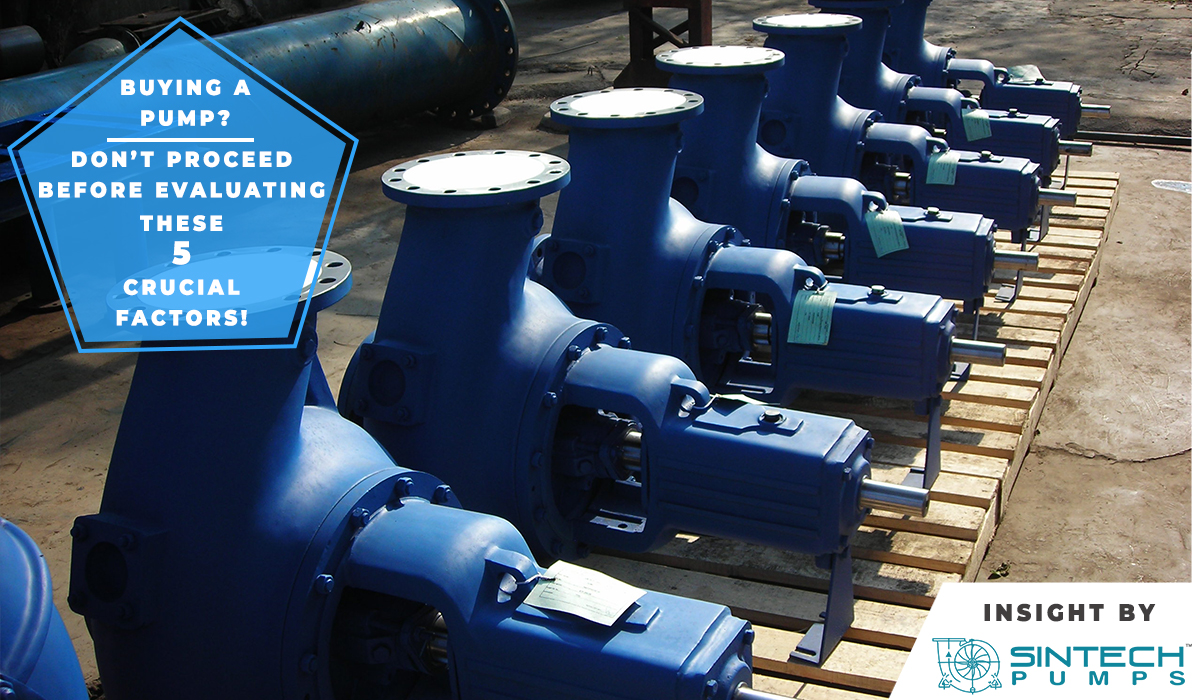
Top 5 Factors to Consider While Choosing the Perfect Pump for your Application

Here, at Sintech Pumps – water pump manufacturers, in our interactions with clients, we often find that they are overwhelmed. Even an experienced client, who has been in the industry for several years, finds it difficult to grasp new industry terminology. The result – they are baffled while selecting new or replacement pumps. Worry not, here our pump experts love nothing better than helping clients. They’ve compiled a quick list of factors that will help simplify your search for the perfect pump for your specific application. What is a Pump? Simply put, a pump is a hydraulic machine that helps to displace a liquid (or in some cases, a fluid) from one place to another. Pumps are used in plenty of applications from residential to commercial. Residential pumps are simple and small in size. On the other hand, industrial pumps are complicated machinery and can be huge. What are the Factors to Consider While Choosing a Water Pump? Just like all other gadgets, there are several factors to consider while choosing the right pump that suits your specific application. Here are the Top Factors to Consider:
  1. Flow Rate
This is one of the most important factors to consider while selecting a pump. The flow rate determines the effectiveness of the pump. It refers to the time taken by the pump to displace a specific amount of liquid. It’s usually measured in litres per minute. For most homes, a water pump with flow rates ranging from 100 – 200 litres is sufficient. On the other hand, for commercial applications, like industries and factories, you’ll need pumps with a flow capacity of over 2500 litres per minute.
  1. Size of the Inlet
Typically, most water pumps have an inlet size that ranges from 1 to 6 inches. However, it can also be more. Here’s a simple explanation of the working of pumps – pumps suck in water from the inlet and discharge it via the outlet valve. This means, bigger the size of the inlet valve, the higher is the amount of water that is dispatched from the pump. Simply put, bigger the inlet size, faster will be the pump able to do its job and higher is the amount of water dispatched.
  1. Maximum Head and Pressure
The maximum head of a pump indicates the maximum height (aka the longest distance) the pump will be able to pump the output liquid. Let’s explain this with an example. For instance, when you buy a water pump with a maximum head of 80 metres, then it means that if you try to pump water to heights higher than 80 metres, the pump’s flow rate will reduce to zero. The general rule of thumb is to choose water pumps with a maximum head that is higher than the height you want to displace the liquid. Say, you want to pump water to a height of 50 metres, then you should look for pumps with a maximum head of 60 metres or more.
  1. Quality of the Pump
This is another crucial factor that determines the life of your pump and other costs. Look for high-quality pumps from reputed manufacturers like Sintech. When you invest in a high-quality pump, it not only lasts for several years to come but also reduces your repair and maintenance costs down the line. Do your homework. Do your research on pump brands, read reviews or ask your peers. Spend some time investigating the quality of the pump, including the motor and engine. Remember the time you spend on evaluating the quality of the pump will save you tons of money, later on.
  1. Liquid to be Dispatched
This is the final factor that you’ll have to consider. Some pumps work only for water, while others can handle liquids with higher viscosities. If you’re looking for pumps for applications like paper manufacturing, food processing, sugar refining or chemical plants, then you’ll need to pump liquids with high viscosities. Make sure that the pump you choose is suited to the liquid you want to transfer. Final Thoughts If you need any further help in choosing the right pumps for your specific application, don’t hesitate to get in touch with our pump experts here at Sintech. Drop us a mail at sales4@sintechpumps.com or give us a ring at +91 120 4176000 to be connected with our friendly sales representatives, who will walk you through the entire process. Cheers and Good Luck on Finding the Right Pump for your Applications!
Sintech Pumps No Comments

Are these 5 Innovative Solutions the Answer to Global Water Crisis?

                       Fact: Around 884 million people around the world don’t have access to clean water. What does it mean? 1 out of 9 people on the planet doesn’t have water that is safe for human consumption. This is the Water Crisis, we are facing today. Worldwide children, women,and men are affected by the water crisis, and every 90 seconds a child dies from a water-borne disease. Women and children are the most affected, as they spend over six hours a day collecting water. This is time lost on education, work,and family life. The Silver Lining Several innovative solutions are being discovered in developing and developed nations to meet the global water crisis. In this post, Sintech Pumps-centrifugal water pump manufacturers take a look at some of the revolutionary and creative technologies used to improve access to clean water.
  1. Drinkable Book
This was developed by the NGO; Water is Life along with researchers at CMU (Carnegie Mellon University). The words on each page of the book contain vital sanitation advice like keeping contaminants and feces away from drinking water. What’s unique about this book is that each page of the book is a filter paper, which purifies drinking water up to 99.9%. Each book has enough filter paper to provide drinking water to the reader for up to four years. Currently, this book is distributed in water scarce areas in Tanzania, India, Ethiopia, Haiti, Kenya,and Ghana.    2.  WaterSeer On first glance, this looks like a well. But, it isn’t. Unlike a well that extracts water from under the ground, the WaterSeer extracts water from the atmosphere. This device is planted at a depth of six feet below the ground. The lower chamber of the device is surrounded by the cool earth. Above the ground, it uses a turbine, which spins. The spinning of the turbine above the ground spins fan blades inside the buried chamber. These blades then push the air into an internal condensation chamber, where the warm air cools down into water vapour. This water vapour is then collected in the lower chamber and can be extracted using a simple pump and hose setup. The waterseer has the capability to collect 37 litres of water every day. The waterseer is developed by the US-based VICI labs and is currently being tested by the National Peace Corps Association.       3. Graphene Filters One of the biggest problems of desalination (the process of converting seawater into drinkable water) is that it’s too expensive and requires plenty of energy. Recently, a researcher Lockheed Martin has created, and patented graphene filters which he claims reduces the energy costs of conventional reverse osmosis by 20%. Additionally, this filter will be able to withstand high temperatures and pressures. The graphene filter is hyper-permeable and perforated and is one atom thick. This device claims that it increases water flow by 500% compared to conventional methods. This technology aims to reduce the wastewater generated by the oil and gas sector. Together, these two industries generate about 18 billion gallons of wastewater every year.      4. Fog Catchers These are vast mesh nets that capture moisture from fog. The moisture trapped from fog is dripped into collection trays, as a result of condensation. The biggest live example of this project is set up on the slopes of Mount Boutmezguida in Morocco. Here, around 6300 litres of freshwater is harvested daily using these mesh nets. The water is free, clean and gets collected quickly. The Non-profit responsible for this project, Dar Si Hmad was awarded the Momentum for Change award by the UN in 2016. You can find fog catchers in other countries like Ghana, Peru, Chile, South Africa, Eritrea,and even California.      5. Solar Pumps These pumps run on clean energy harnessed from the rays of the sun. The excess energy generated is then sent back to the grid, thereby conserving water and other precious resources like coal, fossil fuels, etc. In hot and dry climates like India, the majority of farmers depend on groundwater to irrigate crops. By harnessing the free energy of the sun, farmers reduce their expenses significantly. Also, the buy-back scheme lets them sell the excess power and thereby provides farmers with an additional source of income. In fact, the buy-back is seen as a triple win – farmers gain additional income, states add to their electricity reserves, and carbon emissions are cut down. Initially, this scheme was piloted in Gujarat and now has spread to the rest of the country. Water experts believe that solar pumps are the way forward, as this method is highly sustainable and reduces environmental impact significantly. Check out the different types of solar pumps available at Sintech. Wrapping it up Have you come across any other innovative solution that solves the global water crisis? Let us know in the comments below. And, if you’re interested in setting up a solar pump system, get in touch with our sales experts here at Sintech, India’s leading and innovative pump manufacturer.      
Sintech Pumps No Comments

Sintech Pumps: How to Choose the Right Pump Motor Enclosure for Industrial Application

One of the most common questions that we receive here at Sintech Pumps – centrifugal water pump manufacturers is about Motor Enclosures. Both pump maintenance engineers and mechanics aren’t sure of the right type of enclosure to choose for their specific application. They know that motor enclosures are essential and the right one plays an important role in extending the life of their pumps. But, what they aren’t sure of is the right type of enclosure to choose for their industrial pump systems. Here, in this blog post, we take a closer look at motor enclosures. We hope by the time, you finish reading this article; you can find the right one for your pump. What is a Pump Motor Enclosure? All electric motors have an enclosure (or housing) that holds the working components. This enclosure is essential for the efficient functioning of the pump. It not only prevents dust, dirt, water and other foreign objects from entering the motor but also protects pump operators from accidents. The pump motor enclosure protects the vital internal components like bearings, windings and other mechanical parts from mechanical damage, chemical damage, moisture,and abrasion. Choosing the wrong motor enclosure can lead to potential failure of the entire pump system. Coming to the big question, Which motor enclosure is right for my pump system? There are plenty of options when it comes to motor enclosures. And, to add to the confusion, motor enclosures are often identified using confusing acronyms like TEWD, TENV, ODP and more. Worry not, here we describe the common types of motor enclosures and help you pick the right one. 7 Commonly Used Pump Motor Enclosures:
  1. Open Drip Proof (ODP)
This enclosure allows air to circulatearoundthe motor. Pros:
  • Prevents drop of liquid from entering the motor
  • Circulates air through the windings, that lets the motor cool down
Drawback:
  • Works only for liquids falling from a 15◦ vertical angle.
Applications:
  • Generally used for indoor pumps that operate in a relatively dry and clean location.
 
  1. Totally Enclosed Fan Cooled (TEFC)
This enclosure prevents air from entering inside the frame. However, it does not make the frame entirely airtight. Pros:
  • A fan attached to the shaft pushes air above the frame, thereby helping to cool the motor.
  • It’s the most versatile enclosure.
Applications:
  • Used on all types of fans, pumps, compressors, industrial belt drives,and other connected equipment.
 
  1. Totally Enclosed Non-Ventilated (TENV)
As the name implies, this enclosure is completely closed and doesn’t offer any ventilation. Rather, it uses convention to cool down. Pros:
  • No vents, but the tightly enclosed space prevents the free exchange of air.
Drawback:
  • Not airtight.
Applications:
  • Used for pumps that are exposed to dampness and dirt. But not suitable for extremely moist locations.
 
  1. Totally Enclosed Air Over (TEAO)
Here, the motor is mounted within the airflow range of the fan to enable cooling. Applications:
  • Used for blower duty motors, belt driven fans or shaft mounted fans.
 
  1. Totally Enclosed Wash Down (TEWD)
  Pros:
  • Can be used in extremely moist and chemical environments.
  • Can withstand high-pressure wash-downs in wet and high humidity environments.
Drawback:
  • Not suited for hazardous or explosive locations.
Applications: Suitable for applications where the motors are exposed to wash downs at high pressure. Generally used in industries like pharmaceuticals, food processing,and packaging.
  1. Explosion Proof Enclosures (EXPL)
This is a totally enclosed enclosure that can withstand explosions. They are specifically designed for use in hazardous environments that contains gases and dust. Pros:
  • It’s designed to withstand accidental explosions.
Drawback:
  • For safe operation, the maximum operating temperature of the motor must be maintained below the ignition point of the surrounding vapors and explosive gases.
Applications: Suitable for hazardous environments like the oil industry, chemical plants, wood and plastic processing and even for agriculture.
  1. Weather Protected Enclosures – Type I and Type II
As the name implies, this enclosure protects the motor from debris, rain, dust and other environmental factors. Applications:
  • Suitable for outdoor use.
Sintech Pumps is here to Help If you aren’t sure which motor enclosure to pick for your pump, then don’t hesitate to get in touch with our pump experts here at Sintech, India’s leading industrial pump manufacturer and exporter. Our team will help you choose the right enclosure to protect your motor while improving performance and reliability.