Sintech Pumps No Comments

Expert Answers for 6 Common Centrifugal Pump Efficiency Questions

Are you a centrifugal pump user? Then, you need to know the answers to these six common pump efficiency questions. Understanding more about the working of your pump is essential to keep your pump operating reliably and efficiently. Without further delays, let’s dive right into the FAQ section.
  1. What is pump efficiency?
Simply put, the term “efficiency” refers to how well a particular machine can convert energy from one form to another. For instance, let’s assume that you supply 10 units of energy to a machine. If the output is 5 units of energy, then we can say that the efficiency of this machine is just 50% or one-half unit. When it comes to centrifugal pumps, the overall efficiency is the ratio of the output power to the input power. Here’s an equation that illustrates the efficiency of a centrifugal pump: Ef = Pw / Ps Here, Ef denotes the efficiency of the pump Pw Denotes the water power (output) Ps Denotes the shaft power (input)
  1. What is the speed of the pump and how does it affect the Pump Curve?
Specific speed is one of the most important factors in the design of a centrifugal pump. This value came into use in the late 1800s. The specific speed of a pump is independent of the size of the pump. This means you can use existing designs along with test data to design similar pumps with higher or lower flow rates. Very often, pump users find it a bit overwhelming to use specific speed in pump operations. To simplify it, you can think of it as an index number that helps you predict certain characteristics of the pump. The specific speed value can play a huge role in selecting the right pumps for particular applications and for predicting premature failure.
  1. What are the main factors that affect the Operation of a Pump?
Apart from the overall efficiency, several other individual efficiencies affect the functioning of a pump. They are:
  • Hydraulic Efficiency – This refers to the shape and spacing of the impeller vanes. Theoretically, an impeller can have an infinite number of vanes, but that isn’t possible due to real-world Generally, centrifugal pumps that handle clear liquids like water have five to seven vanes for every impeller. Pumps that handle solids and slush have lesser number of vanes.
  • Volumetric Efficiency – This is determined by the impeller and the volute. It refers to the power lost due to the leakage of the displaced liquid from the wearing rings, the balancing holes or the vane front clearances.
  • Mechanical Efficiency – This is another main contributor to the overall efficiency of the pump. Some of the mechanical losses in a centrifugal pump include shaft bearings, leakage from mechanical seals, packing and so on.
Combined efficiency or the overall efficiency of the pump is a combination of all the above-mentioned individual efficiencies.
  1. How to Preserve the Efficiency of a Centrifugal Pump?
An important part of the volute is the cut water. This purpose of the cut water (or tongue) is to maintain the flow of the pump into the throat. The optimum clearance between the periphery of the impeller and the tongue is the smallest distance, that doesn’t create pressure pulsations. A well-designed pump has the right sized impeller that meets these clearance criteria. When an impeller is trimmed down the distance increases, which in turn, allows more fluid to re-circulate back into the throat of the pump. When the re circulation increases, the efficiency of the pump decreases. So, in order to maintain high-efficiency rates, look to reduce the re-circulation.
  1. Does the shape of the Performance Curve predict Efficiency?
Yes. The performance curve and efficiency are highly interlinked. Generally, a typical performance curve is relatively flat at lower specific speeds and becomes more inclined as the specific speed increases. Pump efficiency is at its lowest at low specific speeds. If the value of your specific speed is less than 500, then you know that your pump is operating at low efficiency. The pump’s efficiency is at its peak when the specific speed values range from 2000 to 3000. Once again, when the specific speed value goes beyond 3000, the efficiency begins to drop. However, this drop is smaller compared to the drop at low specific speed values.
  1. Why does Pump Efficiency Matter?
Simply put, the power consumed by your pump during operation is directly proportional to the output flow and the head it produces. If you need to increase the flow/head, then you have to increase the power supplied to the centrifugal pump. On the other hand, the power consumed by the pump is inversely proportional to the efficiency of the pump. For the same flow/head output, by increasing efficiency, you can decrease the power requirement. As you can see, efficiency plays a crucial role in not only the day-to-day operation of the pump but also ensures that the pump lasts for long. Wrapping it up Determining the efficiency of a pump can play a vital role in the overall life and working of your pump. By ensuring that your pump operates at best efficiency, you not only extend the life of your pump but also reduce the operational and maintenance costs, associated with your centrifugal pumps. If you need further help figuring out the efficiency of your existing industrial centrifugal pumps, or need help choosing the right industrial pumps that operate at maximum efficiency, don’t hesitate to get in touch with our pump experts, here at Sintech, one of the top manufacturers and suppliers of quality industrial pumps in India and the rest of the world. Drop us a mail at sales4@sintechpumps.com or give us a ring at +91 120 4176000 to be connected with our friendly sales representatives, who will walk you through the entire process.
Sintech Pumps No Comments

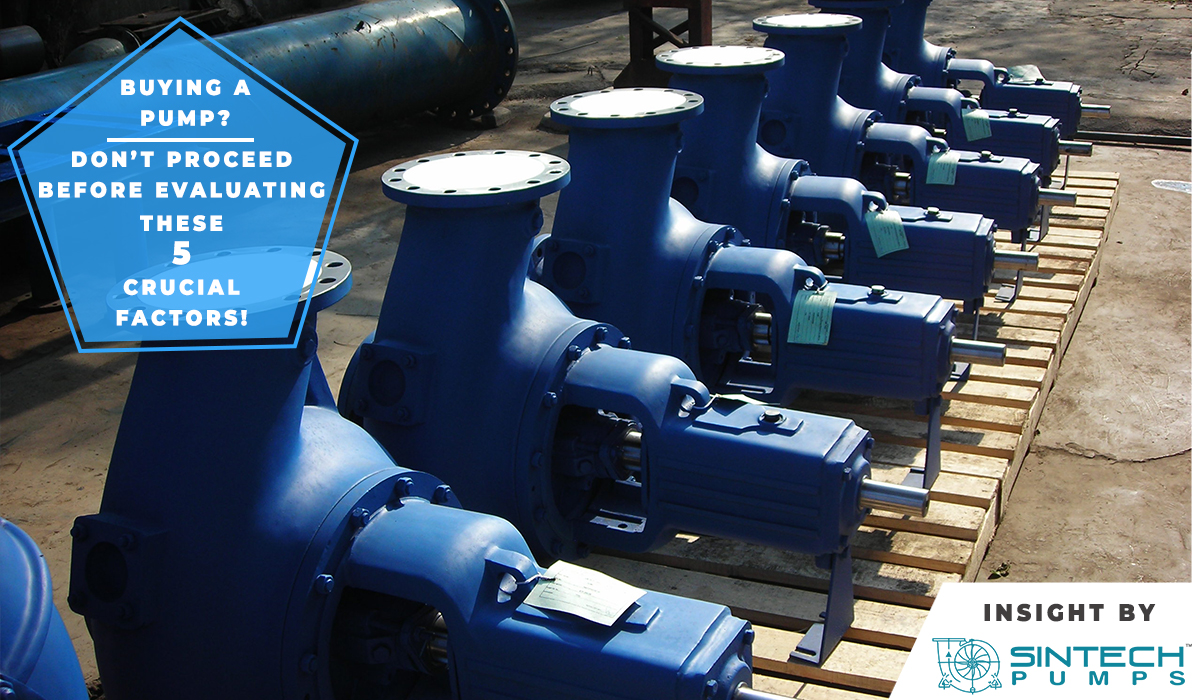
Top 5 Factors to Consider While Choosing the Perfect Pump for your Application

Here, at Sintech Pumps – water pump manufacturers, in our interactions with clients, we often find that they are overwhelmed. Even an experienced client, who has been in the industry for several years, finds it difficult to grasp new industry terminology. The result – they are baffled while selecting new or replacement pumps. Worry not, here our pump experts love nothing better than helping clients. They’ve compiled a quick list of factors that will help simplify your search for the perfect pump for your specific application. What is a Pump? Simply put, a pump is a hydraulic machine that helps to displace a liquid (or in some cases, a fluid) from one place to another. Pumps are used in plenty of applications from residential to commercial. Residential pumps are simple and small in size. On the other hand, industrial pumps are complicated machinery and can be huge. What are the Factors to Consider While Choosing a Water Pump? Just like all other gadgets, there are several factors to consider while choosing the right pump that suits your specific application. Here are the Top Factors to Consider:
  1. Flow Rate
This is one of the most important factors to consider while selecting a pump. The flow rate determines the effectiveness of the pump. It refers to the time taken by the pump to displace a specific amount of liquid. It’s usually measured in litres per minute. For most homes, a water pump with flow rates ranging from 100 – 200 litres is sufficient. On the other hand, for commercial applications, like industries and factories, you’ll need pumps with a flow capacity of over 2500 litres per minute.
  1. Size of the Inlet
Typically, most water pumps have an inlet size that ranges from 1 to 6 inches. However, it can also be more. Here’s a simple explanation of the working of pumps – pumps suck in water from the inlet and discharge it via the outlet valve. This means, bigger the size of the inlet valve, the higher is the amount of water that is dispatched from the pump. Simply put, bigger the inlet size, faster will be the pump able to do its job and higher is the amount of water dispatched.
  1. Maximum Head and Pressure
The maximum head of a pump indicates the maximum height (aka the longest distance) the pump will be able to pump the output liquid. Let’s explain this with an example. For instance, when you buy a water pump with a maximum head of 80 metres, then it means that if you try to pump water to heights higher than 80 metres, the pump’s flow rate will reduce to zero. The general rule of thumb is to choose water pumps with a maximum head that is higher than the height you want to displace the liquid. Say, you want to pump water to a height of 50 metres, then you should look for pumps with a maximum head of 60 metres or more.
  1. Quality of the Pump
This is another crucial factor that determines the life of your pump and other costs. Look for high-quality pumps from reputed manufacturers like Sintech. When you invest in a high-quality pump, it not only lasts for several years to come but also reduces your repair and maintenance costs down the line. Do your homework. Do your research on pump brands, read reviews or ask your peers. Spend some time investigating the quality of the pump, including the motor and engine. Remember the time you spend on evaluating the quality of the pump will save you tons of money, later on.
  1. Liquid to be Dispatched
This is the final factor that you’ll have to consider. Some pumps work only for water, while others can handle liquids with higher viscosities. If you’re looking for pumps for applications like paper manufacturing, food processing, sugar refining or chemical plants, then you’ll need to pump liquids with high viscosities. Make sure that the pump you choose is suited to the liquid you want to transfer. Final Thoughts If you need any further help in choosing the right pumps for your specific application, don’t hesitate to get in touch with our pump experts here at Sintech. Drop us a mail at sales4@sintechpumps.com or give us a ring at +91 120 4176000 to be connected with our friendly sales representatives, who will walk you through the entire process. Cheers and Good Luck on Finding the Right Pump for your Applications!
Sintech Pumps No Comments

Sintech Pumps: How to Choose the Right Pump Motor Enclosure for Industrial Application

One of the most common questions that we receive here at Sintech Pumps – centrifugal water pump manufacturers is about Motor Enclosures. Both pump maintenance engineers and mechanics aren’t sure of the right type of enclosure to choose for their specific application. They know that motor enclosures are essential and the right one plays an important role in extending the life of their pumps. But, what they aren’t sure of is the right type of enclosure to choose for their industrial pump systems. Here, in this blog post, we take a closer look at motor enclosures. We hope by the time, you finish reading this article; you can find the right one for your pump. What is a Pump Motor Enclosure? All electric motors have an enclosure (or housing) that holds the working components. This enclosure is essential for the efficient functioning of the pump. It not only prevents dust, dirt, water and other foreign objects from entering the motor but also protects pump operators from accidents. The pump motor enclosure protects the vital internal components like bearings, windings and other mechanical parts from mechanical damage, chemical damage, moisture,and abrasion. Choosing the wrong motor enclosure can lead to potential failure of the entire pump system. Coming to the big question, Which motor enclosure is right for my pump system? There are plenty of options when it comes to motor enclosures. And, to add to the confusion, motor enclosures are often identified using confusing acronyms like TEWD, TENV, ODP and more. Worry not, here we describe the common types of motor enclosures and help you pick the right one. 7 Commonly Used Pump Motor Enclosures:
  1. Open Drip Proof (ODP)
This enclosure allows air to circulatearoundthe motor. Pros:
  • Prevents drop of liquid from entering the motor
  • Circulates air through the windings, that lets the motor cool down
Drawback:
  • Works only for liquids falling from a 15◦ vertical angle.
Applications:
  • Generally used for indoor pumps that operate in a relatively dry and clean location.
 
  1. Totally Enclosed Fan Cooled (TEFC)
This enclosure prevents air from entering inside the frame. However, it does not make the frame entirely airtight. Pros:
  • A fan attached to the shaft pushes air above the frame, thereby helping to cool the motor.
  • It’s the most versatile enclosure.
Applications:
  • Used on all types of fans, pumps, compressors, industrial belt drives,and other connected equipment.
 
  1. Totally Enclosed Non-Ventilated (TENV)
As the name implies, this enclosure is completely closed and doesn’t offer any ventilation. Rather, it uses convention to cool down. Pros:
  • No vents, but the tightly enclosed space prevents the free exchange of air.
Drawback:
  • Not airtight.
Applications:
  • Used for pumps that are exposed to dampness and dirt. But not suitable for extremely moist locations.
 
  1. Totally Enclosed Air Over (TEAO)
Here, the motor is mounted within the airflow range of the fan to enable cooling. Applications:
  • Used for blower duty motors, belt driven fans or shaft mounted fans.
 
  1. Totally Enclosed Wash Down (TEWD)
  Pros:
  • Can be used in extremely moist and chemical environments.
  • Can withstand high-pressure wash-downs in wet and high humidity environments.
Drawback:
  • Not suited for hazardous or explosive locations.
Applications: Suitable for applications where the motors are exposed to wash downs at high pressure. Generally used in industries like pharmaceuticals, food processing,and packaging.
  1. Explosion Proof Enclosures (EXPL)
This is a totally enclosed enclosure that can withstand explosions. They are specifically designed for use in hazardous environments that contains gases and dust. Pros:
  • It’s designed to withstand accidental explosions.
Drawback:
  • For safe operation, the maximum operating temperature of the motor must be maintained below the ignition point of the surrounding vapors and explosive gases.
Applications: Suitable for hazardous environments like the oil industry, chemical plants, wood and plastic processing and even for agriculture.
  1. Weather Protected Enclosures – Type I and Type II
As the name implies, this enclosure protects the motor from debris, rain, dust and other environmental factors. Applications:
  • Suitable for outdoor use.
Sintech Pumps is here to Help If you aren’t sure which motor enclosure to pick for your pump, then don’t hesitate to get in touch with our pump experts here at Sintech, India’s leading industrial pump manufacturer and exporter. Our team will help you choose the right enclosure to protect your motor while improving performance and reliability.
Sintech Pumps No Comments

Causes for Pump Coupling Failures and Ways to Avoid Them

Shaft couplings are one of the most inexpensive parts of your pump system. Yet, they are one of the most critical elements. Very often, pump owners and operators don’t pay much attention to coupling selection. The result – frequent coupling failures, which in turn reduce pump operation efficiency and increase downtime. Here, in this post, Sintech Pumps – best pump manufacturers provides the Causes of Coupling Failures and the Ways to Avoid Them. What is a Coupling? It’s a device that is used to connect two rotating shafts in your pump system. If you’re experiencing frequent coupling burns and breakages, then it means that there’s a bigger issue with your pump. Coupling failures impact the reliability of your pump dramatically. If you’re experiencing coupling failures and replace couplings often, then continue reading to identify the underlying causes. Symptoms of Coupling Failures A coupling failure presents you with a few warning signs. Being aware of these signs will help you identify and spot coupling failure as soon as it occurs. If your pump demonstrates these symptoms, then it could indicate coupling failure:
  • Excessive vibration and/or noise
  • Increased power consumption
  • Bearing failure
  • Premature failure of the mechanical seals
Causes of Coupling Failure and Ways to Avoid It Let’s take a look at the reasons for frequent coupling failures
  1. Misalignment
This is one of the most common causes of a coupling failure. Misaligned pump or motor shafts lead to damage or breakage of the couplings. In fact, several studies state that misalignment is the reason for nearly 70 – 80% of pumps failing. Generally, couplings are flexible and can handle minor misalignments with no issues. However, like all other mechanical parts, couplings too come with limitations. If the misalignment goes beyond a particular degree, even a flexible coupling will fail. Make sure to check whether the shaft alignments are within limits specified by the manufacturer. If the shaft alignment goes beyond the manufacturer recommended levels, then make sure to do a laser alignment, before installing a new coupling. Some of the common types of misalignment of pump motor shafts include:
  1. Axial misalignment
  2. Radial misalignment
  3. Angular misalignmentMisalignment Types
 
  1. Torque Capacity
Just like alignments, all couplings have a torque limit. Torque failures account for 10-15% of all coupling failures. By miscalculating torque, you not only burn through couplings but could also end up damaging your pump systems. Too much torque at low-speed damages couplings. Make sure to consider both the steady state torque and instantaneous torque, while selecting couplings.
  1. Incorrect coupling selection
Unfortunately, most pump operators fail to prioritize shaft coupling selection while assembling a pump. In fact, it’s one of the most underappreciated and overlooked features of a pump. Incorrect coupling happens when you choose the wrong type of couplings or choosing couplings late in the application design process. A simple way to overcome this issue is by integrating coupling selection during the early stages of the pump assembly. If done, this could help you choose the right type of coupling based on requirement as well as aspect. This way, you can choose the right coupling size that suits the specific application requirements. If in the case, the application changes in the future, you have to revise coupling specifications.
  1. Environmental Causes
This is a rare cause of coupling failure. Exposure to harmful chemicals, excessively cold or warm temperatures, thermal expansion may negatively affect the life of your coupling. While these cases aren’t common, there are chances of them occurring.
  1. Improper Lubrication
Couplings made out of plastic, flexible rubber or magnetic metals don’t require lubrication. On the other hand, other types of couplings like grid and gear require lubrication. The lubrication levels of couplings must be checked at least once or twice every year. Make sure to flush out any contaminants from the lubricants to avoid premature failure of couplings. Final Thoughts – Coupling Failures can Impact Safety Make sure that your couplings are in perfect condition to avoid safety issues. When it comes to pump systems, proactive maintenance is vital. Ensure that you monitor your couplings regularly. If it requires lubrication or flushing, make sure to do it according to the schedule. Also, ensure that you select the right couplings for your pumps. This not only helps to increase the efficiency of your pumps but also improves reliability and uptime. Want to increase the reliability of your pump systems? Check out our diverse range of industrial pumps to find the best one that suits your needs. Talk to our pump specialists here at Sintech, to help you choose the right pumps that suit your specific application. We are one of the leading manufacturers and suppliers of industrial pumps in India and overseas.
Sintech Pumps No Comments

Looking to Reduce the Life Cycle Cost of your Pump Systems – Don’t forget to Consider these Factors

What is the Life Cycle Cost of a Pump? Simply put, it’s the total cost of ownership of the pump. It involves all the expenditures, right from the initial investment costs to ongoing maintenance and repair costs. All industrial users must do a Life Cycle Cost Analysis before purchasing a pump for their factory or plant. With that said, sometimes industry owners make the mistake of choosing a pump that comes with the lowest acquisition price, forgetting to consider the total life cycle cost. This can be a pretty expensive mistake, as ongoing and periodic life cycle costs are a major component of the buying equation. And, ignoring these, is a fatal mistake. The Three Main Components of Pump Life Cycle Costs Pump life cycle costs can be divided into three components:
  • Acquisition (Initial Costs)
  • Annual Expenditures (Maintenance)
  • Periodic (Repair and Replacement)
All these three components play a major role in determining the overall pump life cycle cost. While the acquisition cost is straightforward, the other two are a bit complicated and takes time to determine. Nevertheless, while purchasing a pump, you have to factor in all these three elements. Here, in this week’s post, we give you the best ways to reduce the overall lifecycle costs of your pump systems. Cost Saving Strategies to cut Operational Costs There are several strategies that you can employ to reduce the operational costs of your centrifugal pumps and rotary pumps. Here are a few of the top methods:
  • Always choose the right pump manufacturer
This is crucial because the right pump manufacturers would be able to provide you with the right pumping sizes that suits your requirements over a long term. Also, with the right pumps manufacturers you can be assured of getting repair assistance throughout your pump’s life cycle, not having to worry about replacing it. While choosing a pump manufacturer make sure to consider all the following factors – ease of use, reliability, part availability and consistent pricing. Additionally, try getting reviews from previous customers as to the trustworthiness of the supplier. Other factors to consider include warranties, pump operator training, repairs and more.
  • Look for pumps that come with a VFD (Variable Frequency Drive)
This helps you to alter the speed output based on the load requirement, instead of using parts that wear out prematurely.
  • Look for Pump Designs with Money Saving Features
Features like cartridge seals with reusable holders, reversible wear plates, and adjustable housing segments help in reducing the overall costs of a pump. While choosing pumps, spend a few minutes understanding all the features so that you pick the right ones that aren’t just suitable for your application, but also come with other advanced features that cut down operational costs.
  • Provide the Right Training for Pump Operators
Another main reason why you spend a fortune on expensive pump repairs is that the pumps were operated under the wrong conditions. To avoid such situations, make sure to provide the right training to pump operators. They must be able to decide whether parts need changing and if yes, do it on their own, or call in the right personnel for the job. Also, pump operators must know how to change oil and respect operational tolerances.
  • Invest in a few Sensors
You can install sensors that let you know of abnormal pump operating conditions. If possible, try to reduce the number of pump models in your plant so that you can cut down on inventory costs. Final Thoughts While low acquisition costs may appear advantageous in the outset, if your pump is going to need frequent repairs, it isn’t worth it in the long run. So, make sure to consider the total cost of ownership (which includes acquisition, ongoing and periodic costs) rather than the initial price. If you need any further help on choosing the right pump for your application, don’t hesitate to get in touch with us, here at Sintech, India’s leading manufacturer and distributor of a wide range of industrial pumps.  
Sintech Pumps No Comments

Reconditioning to your Rescue – Improve your Pump Efficiency & Make it Last Long

Though industrial pumps don’t undergo immense wear and tear, their performance takes a dip after a few years of usage. Worry not, Sintech Pumps provides reconditioning solutions to your rescue. Why Reconditioning? It can help your pumps last longer than their average life cycle. Also, reconditioning is highly environmentally friendly, as you don’t replace pumps but instead give them a new lease of life. Furthermore, the costs of reconditioning are significantly lower than the cost of a new pump. With reconditioning, you can restore the reduced capacity of your pump to its original level. Here’s a Bullet-point List of the Benefits of Reconditioning:
  • Your pump is restored to its original efficiency and capacity
  • All types of pumps can be reconditioned
  • No further modifications required to the foundations and piping
  • Lower cost
  • Eco-friendly
Is it time for a Pump Recondition? Here are the factors you have to consider before you decide to recondition your pump.
  1. System Requirements
Has your pump’s performance deteriorated to the point that it no longer meets the head and flow requirements? If yes, then your pump must either be replaced or reconditioned.
  1. Pump Deterioration Levels
Once you have determined that the pump’s performance has deteriorated, the next step is to find out by how much? In order to find this, you have to conduct a detailed pump system analysis, to help you find out the true performance degradation.
  1. What causes the pump’s performance deterioration?
Is the pump deterioration caused by the following elements?
  • Wearing ring clearance
  • Roughening of the pump’s waterways
  • The speed of the pump’s operation. Higher the speed, the greater is the impact or friction caused. (with higher speed, the flow is increased, while the head is reduced)
  • The magnitude of the water passages. Larger pumps can allow greater amount of roughness, while smaller pumps see a reduction in efficiency, with higher roughness.
  • Or other reasons
Answering the big question, Should the Pump be Reconditioned? Once you have determined the levels of pump performance degradation, the energy saving potential, the impact of the losses incurred due to internal leakage and increased friction, the cost of reconditioning, and the payback as a result of reconditioning – have to be charted to decide whether you should go in for a recondition or replacement of the pump. What are the Common Methods Employed for Reconditioning Pumps:
  1. Waterways
There are several aftermarket ways to recondition pump casings, impellers, and internal passages. Some of the most common techniques used are sand/grit blasting, wire brushing and coating.
  1. Wear Ring Clearances
Another easy way to recondition pumps is to replace wearing rings. This helps to not only improve the head and efficiency of the pump, but also reduces NPSH, since the turbulence and flow through the eye of the impeller is reduced. The lower the pump’s speed, higher is the impact of the wearing ring clearance on the pump’s overall performance. Where to Recondition Existing Pumps? If your pump is in need of reconditioning, make sure to approach your pump’s manufacturer who can accurately determine whether your pump’s efficiency can be improved with reconditioning or whether you have to replace the entire unit to improve the efficiency of the system. For any further queries, get in touch with our pump care experts, here at Sintech, the top industrial pump manufacturer and supplier in India. We customize pumps of all capacities to suit your requirements specifically. Give us a ring at 0120 417 6000 or drop in a mail at sales4@sintechpumps.com to know more.
Sintech Pumps No Comments

IoT& Its Huge Impact on the Pump Industry – A Brief Look at what to Expect in the Next Few Years

IoT or the “Internet of Things” is the latest buzzword and is becoming a growing topic of conversation, not only in tech circles but even outside of it. Before we head into today’s article of how IoT impacts the Pump Industry, let’s start with understanding a few key aspects. What’s IoT? The broad idea of IoT is that a whole lot of traditional appliances are increasingly built with wireless internet connectivity. This means you can now monitor and control these devices over the internet with the help of a mobile app. Why is IoT popular all of a sudden? The reason for this depends on a lot of factors – increased broadband coverage, decreasing costs of building devices with Wi-Fi capability, Smartphone penetration and so on. Ok, what does it have to do with Pumps? As more and more devices are turning smart, from coffee makers to cars, the pump industry is no exception. Digital transformation and internet are changing the face of the pump industry completely. More and more manufacturers are experimenting with adding sensors and Wi-Fi devices to pumps. This helps in predictive analysis and equipment monitoring, thereby reducing high, unpredictable maintenance costs and expensive downtime. Let’s take a look at the factors that are driving the move towards IoT  enabled pumps.
  1. Convergence of Industries
Long gone are the days when industries were considered as stand-alone. In the era of globalization and rapid digitization, the lines between industries are blurring. The proliferation of smart devices and emergence of new business models are disrupting traditional industrial practices. Additionally, with increased access to the cloud and reduced prices of sensors, more and more pump manufacturers are looking to implement these new technologies in their products. 2. Emergence of Digital Technology Three trends play a crucial role in the increasing move to IIoT (Industrial Internet of Things):
  • Aging workforce coupled with aging systems. There is a severe shortage of skilled labour all over the world.
  • Global volatility and increasing competition mean that manufacturers have to adopt new technologies to stand apart from competitors.
  • Exponential dependence on data. More and more organizations are looking to collate data and use it to enhance operations further.
3. Increase in the number of connected devices From Smartphones to smart cars, all the devices that we use and interact with, are increasingly becoming smart. These technologies are no longer the domain of Hollywood science fiction. They are a reality and are frequently used by us. From lights that you can switch off/on even when you aren’t at home to fridges that alert you to purchase milk on your way home, more and more devices are becoming smart. All thanks to the rapidly decreasing costs of IC chips and sensors. Additionally, with the rapid proliferation of wireless technology, companies can now quickly transform conventional devices into smart ones by utilizing the power of the Cloud. Consumers are expecting more from their devices. They don’t want an appliance that performs just the primary function, but they are looking for extra features. This means, more and more pump manufacturers are looking to provide smart solutions to enhance the overall experience of the end-users. 4. Evolution of Service Models Traditionally, most businesses followed a preventive maintenance service model. However, one major drawback of this model is OPEX (unnecessary Operational Expense). This has forced more organizations to move to a proactive maintenance model. When combined with the lack of a skilled workforce and the efficiency of predictive analytical solutions using data points means that more and more pump manufacturers are looking to adopt these new technologies to offer enhanced solutions to their users. So, how will a Smart Pump of the Future look like? Here, we give you an example of what pumps will do shortly. Your system pump will be outfitted with several sensors that measure everything from flow rate, pressure, vibration, temperature, current and voltage. All the data from these sensors will be passed to an IIoT gateway. There can be several such gateways depending on the complexity of your application. The gateway (or gateways) then aggregates the data from the sensors and decides whether to trigger any pre-set event alarms. When you move from a manual maintenance routine to an online monitoring system, like the one illustrated above, you get plenty of benefits.
  1. Your workforce need not spend their working time, moving around, checking existing systems and measuring data. Instead, they can use the accumulated data managing and diagnosing assets.
  2. Real-time data analysis is possible. This means you get the chance to spot any malfunctioning as and when it occurs, instead of further damaging the system.
  3. Additionally, sensors send data to the cloud only when something is out of the normal range. This means you don’t require a huge bandwidth to operate your pumps. After all, there’s no point streaming terabytes of data from a healthy pump all the way to the official cloud.
You can increase pump uptime and reduce overall operating cost with the help of these self-diagnosing sensors. Simply put, the sensors continuously monitor both, “What’s going to break?” and “When it’s going to break?” This is highly helpful to maintenance engineers in a power plant, water treatment plant or any other industry. They get a clear idea of what’s wrong and how long it will take for them to fix it. Additionally, the pumps of the future will be able to tell you explicitly what’s wrong with them, so you can fix them quickly and get the system up and running in no time. Are you ready for the pumps of the future? Get in touch with Sintech, the leading industrial pumps manufacturer, and distributor in India, for customized solutions across industries. Ring us at +91-120-4176000 or drop in a line at sales4@sintechpumps.com for more info.