Sintech Pumps No Comments

All That You Need to Know about Your Industrial Centrifugal Pumps – Operation, Characteristics and More

The majority of industrial pump systems make use of a centrifugal pump. If you have ever contacted a pump supplier, then you would have probably heard the term, “centrifugal pump.” Ever wondered what exactly is the centrifugal pump and why is it so widely used in all applications? Here, in this post, we answer all your questions about centrifugal pumps – the parts, working principles, advantages and more.

What is a Centrifugal Pump?

Any pump – be it centrifugal, submersible or any other type – is used to transmit a liquid from a region of low pressure to a region of high pressure. A centrifugal pump is a hydraulic machine that converts mechanical energy into hydraulic energy. It does so with the help of centrifugal force acting on the displaced fluid.

The Different Parts of a Centrifugal Pump:

The main parts of a centrifugal pump are:
  • Shaft
  • Impellers
  • Casing
Shaft – This is the central part of the pump. It rotates the impeller connected to it. The shaft is attached to the prime mover to generate power. The shaft is fitted using a ball bearing. Impeller – It consists of several curved vanes. It is attached to the shaft of an electric motor. The impeller makes up the rotating part of the centrifugal pump. Generally, the impeller is enclosed within a watertight casing. Casing – This is a water-proof and air-tight passage outside the impeller. It is designed to convert the kinetic energy of the discharged water into pressure. The purpose of the casing is to act as protection.

Types of Casings Used in Centrifugal Pumps:

Volute Casing Also known as Spiral Casing, this surrounds the impeller. This casing is used to decrease the velocity of water, thereby increasing the water pressure. Vortex Casing This is a circular chamber between the impeller and the volute casing. The fluid first passes through the vortex casing and then through the volute casing. This helps in better conversion of the velocity energy into water pressure. Casing with Guide Blades These are casing blades that directly surround the impeller.

How does a Centrifugal Pump Work?

To better understand and troubleshoot your industrial pumps, you need to have a clear idea of the operating principles of centrifugal pumps. The basic principle of operation of centrifugal pumps is – force vortex flow. This means, when a body of liquid is acted upon by an external torque, it increases the pressure head of the rotating liquid. This increase in pressure is directly proportional to the velocity of the liquid. Thus, the rise in pressure is higher at the impeller outlet, causing the liquid to discharge at high pressure at the outlet. Because of this high-pressure head, the displaced liquid is lifted to high heights in a centrifugal pump system.

What is Centrifugal Pump Priming and why is it needed?

Priming refers to the principle of filling the suction pipe, casing and parts of the delivery valve with liquid from an external source. Priming is done to raise the liquid in the pump, before starting the operation. In a centrifugal pump, the pressure in the impeller is directly proportional to the density of the liquid in the impeller. If the impeller is running when filled with air, the pressure generated is negligible, which is not suitable for your operation. To avoid this scenario, you need to ensure that the pump is primed before beginning operation.

Differences between a Centrifugal Pump and a Reciprocating Pump

centrifugal-pumps-principle

Reasons to Use Centrifugal Pumps

  • The biggest benefit of using centrifugal pumps is that they are simple machines.
  • They work well for applications that require large discharge and small heads.
  • It doesn’t have any moving parts or valves. Hence maintenance is easy.
  • Centrifugal pumps can run at high speeds with minimal maintenance.
  • It produces a steady and consistent output.
  • They are highly flexible, and you can reposition them easily if needed.
That’s it. Now, you know all about centrifugal pumps. If you have any further queries or doubts or need help choosing the right centrifugal pumps for your application, don’t hesitate to get in touch with us. For further reading, check out our checklist for overhauling your old centrifugal pumps. Reach out to Sintech, India’s leading industrial centrifugal pump suppliers for all your pump queries.
Sintech Pumps No Comments

What is the Pump Suction Pipe & Why Does it Matter?

The suction pipe is one of the most underlooked components of a pump system. However, it plays a crucial role in ensuring that the overall pump system functions efficiently without any glitches. Here, in today’s post, we take a closer look at the role of the pump suction pipe. What is the Suction Pipe? As the name implies, the suction line of the pump system is a pipe that transports fluids from the source to the pump. The Role of Pump Suction Pipe Suction Pipe Length Though, it’s a small component in the overall pump system the suction pipe plays several crucial roles. They are:
  • It ensures that the displaced liquid/fluid is transported
  • It plays a role in the overall friction loss of the system.
As you can see, the suction pipe plays a crucial role in determining the overall efficiency of the system. A lengthy or an undersized suction pipe can cause negative or positive effects to the system. How does the Suction Pipe affect Friction Loss in the System? While installing the pump system, you have to consider the friction losses in the system. While calculating the power required for moving the liquid/fluid from point A to point B, you must also consider the resistance due to friction, apart from distance. To ensure that you calculate the overall power of the system accurately, you need to consider the friction loss of the suction line. Very often, this is forgotten. By not including the friction loss of the system into consideration, you are most likely to purchase the wrong equipment that is not up to the task. This is a costly mistake, as you end up overhauling the entire system in the near future. Make sure that you design the suction line before you purchase your pump system so that you choose the right equipment for the task. Why Short Suction Lines Work Better? Short Suction Lines Irrespective of the type of liquid you are pumping and the pumping system you use, your number one goal is the efficiency of the overall pumping system. The number one question you have to address while designing the pumping system is – how do you displace a particular volume of liquid/fluid from one point to another, within a particular time, using as little energy as possible? A short suction line is part of the solution. Here are the top advantages of having a short suction line:
  • Improvement in Overall Energy Efficiency
The lesser energy you consume, the lower is the strain caused on the pump components. Additionally, low energy reduces the cost of operating the pump. The longer is the suction line, the more energy you require to move the fluid/liquid from the source to the diaphragm/impeller and then onward to the discharge pipe. The general rule of thumb here is – more energy is required for moving the fluid across a longer distance. Additionally, the friction loss in the suction pipeline also increases the energy consumed. The shorter the suction pipeline, shorter is the distance travelled by the dispatched fluid and lesser is the friction loss, thereby reducing the overall energy consumption.
  • Elimination of Cavitation
Another major issued that impacts pump durability and maintenance is cavitation. Cavitation occurs when pockets of vapour or air are built up in the displaced fluid due to changes in pressure. These tiny air bubbles then explode, which causes shockwaves. The shockwaves cause damage to the surrounding parts of the pump system, which includes the impeller. With a short suction pipeline, it reduces the chances of cavitation. You can check out our blog post that details methods on how to avoid cavitation here. Altering Suction Pipe Length Impacts the Overall Efficiency Decreasing or increasing the length of the suction pipe, along with altering its design can have a huge impact on the overall efficiency of the pump, thereby increasing/decreasing its longevity. Looking for Expert Advice on Pump Design? Here, at Sintech, India’s most trusted industrial and suction pump manufacturers and distributor, we offer you complete guidance on how to achieve the best pump performance. Contact one of our friendly pump experts to help you design the most efficient pump system for your plant or factory.
Sintech Pumps No Comments

Expert Answers for 6 Common Centrifugal Pump Efficiency Questions

Are you a centrifugal pump user? Then, you need to know the answers to these six common pump efficiency questions. Understanding more about the working of your pump is essential to keep your pump operating reliably and efficiently. Without further delays, let’s dive right into the FAQ section.
  1. What is pump efficiency?
Simply put, the term “efficiency” refers to how well a particular machine can convert energy from one form to another. For instance, let’s assume that you supply 10 units of energy to a machine. If the output is 5 units of energy, then we can say that the efficiency of this machine is just 50% or one-half unit. When it comes to centrifugal pumps, the overall efficiency is the ratio of the output power to the input power. Here’s an equation that illustrates the efficiency of a centrifugal pump: Ef = Pw / Ps Here, Ef denotes the efficiency of the pump Pw Denotes the water power (output) Ps Denotes the shaft power (input)
  1. What is the speed of the pump and how does it affect the Pump Curve?
Specific speed is one of the most important factors in the design of a centrifugal pump. This value came into use in the late 1800s. The specific speed of a pump is independent of the size of the pump. This means you can use existing designs along with test data to design similar pumps with higher or lower flow rates. Very often, pump users find it a bit overwhelming to use specific speed in pump operations. To simplify it, you can think of it as an index number that helps you predict certain characteristics of the pump. The specific speed value can play a huge role in selecting the right pumps for particular applications and for predicting premature failure.
  1. What are the main factors that affect the Operation of a Pump?
Apart from the overall efficiency, several other individual efficiencies affect the functioning of a pump. They are:
  • Hydraulic Efficiency – This refers to the shape and spacing of the impeller vanes. Theoretically, an impeller can have an infinite number of vanes, but that isn’t possible due to real-world Generally, centrifugal pumps that handle clear liquids like water have five to seven vanes for every impeller. Pumps that handle solids and slush have lesser number of vanes.
  • Volumetric Efficiency – This is determined by the impeller and the volute. It refers to the power lost due to the leakage of the displaced liquid from the wearing rings, the balancing holes or the vane front clearances.
  • Mechanical Efficiency – This is another main contributor to the overall efficiency of the pump. Some of the mechanical losses in a centrifugal pump include shaft bearings, leakage from mechanical seals, packing and so on.
Combined efficiency or the overall efficiency of the pump is a combination of all the above-mentioned individual efficiencies.
  1. How to Preserve the Efficiency of a Centrifugal Pump?
An important part of the volute is the cut water. This purpose of the cut water (or tongue) is to maintain the flow of the pump into the throat. The optimum clearance between the periphery of the impeller and the tongue is the smallest distance, that doesn’t create pressure pulsations. A well-designed pump has the right sized impeller that meets these clearance criteria. When an impeller is trimmed down the distance increases, which in turn, allows more fluid to re-circulate back into the throat of the pump. When the re circulation increases, the efficiency of the pump decreases. So, in order to maintain high-efficiency rates, look to reduce the re-circulation.
  1. Does the shape of the Performance Curve predict Efficiency?
Yes. The performance curve and efficiency are highly interlinked. Generally, a typical performance curve is relatively flat at lower specific speeds and becomes more inclined as the specific speed increases. Pump efficiency is at its lowest at low specific speeds. If the value of your specific speed is less than 500, then you know that your pump is operating at low efficiency. The pump’s efficiency is at its peak when the specific speed values range from 2000 to 3000. Once again, when the specific speed value goes beyond 3000, the efficiency begins to drop. However, this drop is smaller compared to the drop at low specific speed values.
  1. Why does Pump Efficiency Matter?
Simply put, the power consumed by your pump during operation is directly proportional to the output flow and the head it produces. If you need to increase the flow/head, then you have to increase the power supplied to the centrifugal pump. On the other hand, the power consumed by the pump is inversely proportional to the efficiency of the pump. For the same flow/head output, by increasing efficiency, you can decrease the power requirement. As you can see, efficiency plays a crucial role in not only the day-to-day operation of the pump but also ensures that the pump lasts for long. Wrapping it up Determining the efficiency of a pump can play a vital role in the overall life and working of your pump. By ensuring that your pump operates at best efficiency, you not only extend the life of your pump but also reduce the operational and maintenance costs, associated with your centrifugal pumps. If you need further help figuring out the efficiency of your existing industrial centrifugal pumps, or need help choosing the right industrial pumps that operate at maximum efficiency, don’t hesitate to get in touch with our pump experts, here at Sintech, one of the top manufacturers and suppliers of quality industrial pumps in India and the rest of the world. Drop us a mail at sales4@sintechpumps.com or give us a ring at +91 120 4176000 to be connected with our friendly sales representatives, who will walk you through the entire process.
Sintech Pumps No Comments

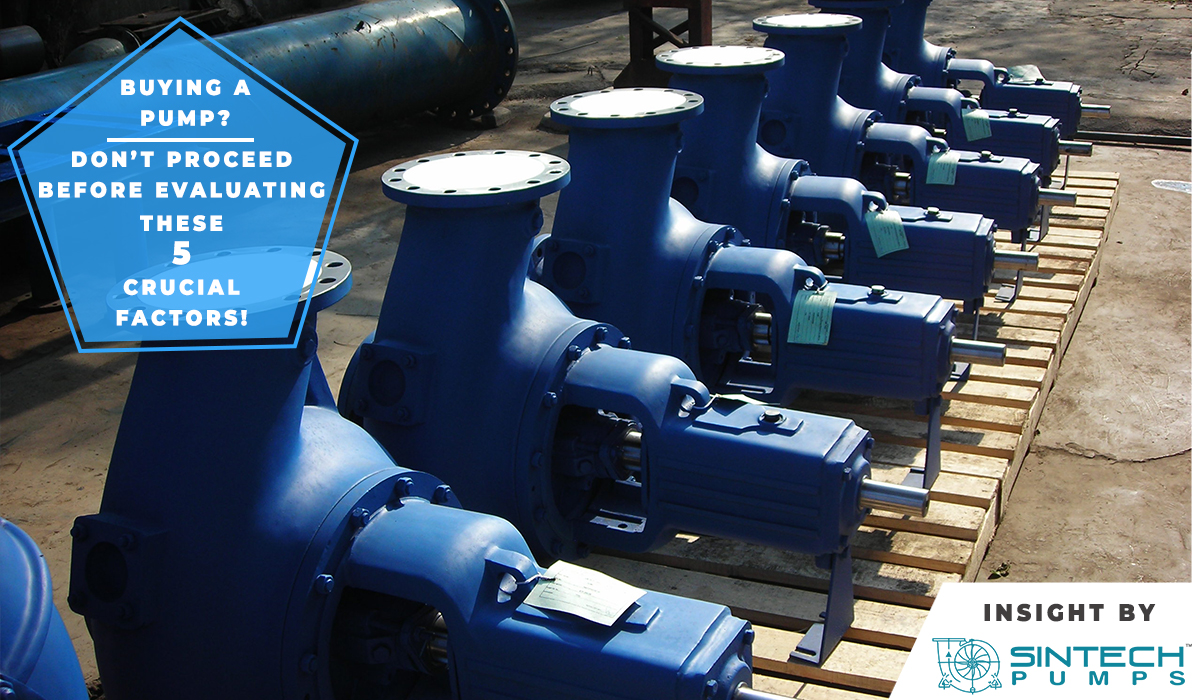
Top 5 Factors to Consider While Choosing the Perfect Pump for your Application

Here, at Sintech Pumps – water pump manufacturers, in our interactions with clients, we often find that they are overwhelmed. Even an experienced client, who has been in the industry for several years, finds it difficult to grasp new industry terminology. The result – they are baffled while selecting new or replacement pumps. Worry not, here our pump experts love nothing better than helping clients. They’ve compiled a quick list of factors that will help simplify your search for the perfect pump for your specific application. What is a Pump? Simply put, a pump is a hydraulic machine that helps to displace a liquid (or in some cases, a fluid) from one place to another. Pumps are used in plenty of applications from residential to commercial. Residential pumps are simple and small in size. On the other hand, industrial pumps are complicated machinery and can be huge. What are the Factors to Consider While Choosing a Water Pump? Just like all other gadgets, there are several factors to consider while choosing the right pump that suits your specific application. Here are the Top Factors to Consider:
  1. Flow Rate
This is one of the most important factors to consider while selecting a pump. The flow rate determines the effectiveness of the pump. It refers to the time taken by the pump to displace a specific amount of liquid. It’s usually measured in litres per minute. For most homes, a water pump with flow rates ranging from 100 – 200 litres is sufficient. On the other hand, for commercial applications, like industries and factories, you’ll need pumps with a flow capacity of over 2500 litres per minute.
  1. Size of the Inlet
Typically, most water pumps have an inlet size that ranges from 1 to 6 inches. However, it can also be more. Here’s a simple explanation of the working of pumps – pumps suck in water from the inlet and discharge it via the outlet valve. This means, bigger the size of the inlet valve, the higher is the amount of water that is dispatched from the pump. Simply put, bigger the inlet size, faster will be the pump able to do its job and higher is the amount of water dispatched.
  1. Maximum Head and Pressure
The maximum head of a pump indicates the maximum height (aka the longest distance) the pump will be able to pump the output liquid. Let’s explain this with an example. For instance, when you buy a water pump with a maximum head of 80 metres, then it means that if you try to pump water to heights higher than 80 metres, the pump’s flow rate will reduce to zero. The general rule of thumb is to choose water pumps with a maximum head that is higher than the height you want to displace the liquid. Say, you want to pump water to a height of 50 metres, then you should look for pumps with a maximum head of 60 metres or more.
  1. Quality of the Pump
This is another crucial factor that determines the life of your pump and other costs. Look for high-quality pumps from reputed manufacturers like Sintech. When you invest in a high-quality pump, it not only lasts for several years to come but also reduces your repair and maintenance costs down the line. Do your homework. Do your research on pump brands, read reviews or ask your peers. Spend some time investigating the quality of the pump, including the motor and engine. Remember the time you spend on evaluating the quality of the pump will save you tons of money, later on.
  1. Liquid to be Dispatched
This is the final factor that you’ll have to consider. Some pumps work only for water, while others can handle liquids with higher viscosities. If you’re looking for pumps for applications like paper manufacturing, food processing, sugar refining or chemical plants, then you’ll need to pump liquids with high viscosities. Make sure that the pump you choose is suited to the liquid you want to transfer. Final Thoughts If you need any further help in choosing the right pumps for your specific application, don’t hesitate to get in touch with our pump experts here at Sintech. Drop us a mail at sales4@sintechpumps.com or give us a ring at +91 120 4176000 to be connected with our friendly sales representatives, who will walk you through the entire process. Cheers and Good Luck on Finding the Right Pump for your Applications!
Sintech Pumps No Comments

Find Out Which Pump is Best Suited for Wastewater Sludge Transfer?

The Crucial Role of Waste Water Treatment Plants Today, several industries across verticals are committed to sustainable practices that don’t have a negative impact on the environment. Companies that produce or use fluids in their industrial processes are looking for innovative ways to dispose of the byproducts without damaging the environment and disturbing the ecological balance. For instance, food and beverage processors, textile industries, chemical manufacturers, metal finishers and more generate fluids that have to be treated in accordance with local government regulations, before it could be discharged into the sewers or drains. Today, everyone involved in the process – customers, shareholders, government bodies and manufacturers and industrialists are all concerned about adopting sustainable practices. There’s an increased awareness on minimizing resources and impacts on the environment. Also, with water scarcity on the rise, more and more industries are looking for ways to recycle and reuse water. This is where, waste water treatment plants come into the picture. And, industrial pumps are at the core of all wastewater treatment systems. Positive displacement pumps are used to transfer waste liquids (along with solid sludge) from one tank to another, throughout the process. You need high-quality industrial pumps that can handle a range of wide fluids along with submerged solid particles. The Role of Positive Displacement Pumps in Wastewater Treatment Processes:
  • To transfer fluids from the sump to the reactor
  • To draw slurry from the clarifier tank and feed it into the filter press
  • For dosing chemicals into neutralizer tanks and the reactor
Here’s a Quick Working of Wastewater Treatment Plants The process begins in the sump tank. Waste fluids (remnants of industrial processes) accumulate here. A positive displacement pump is then used to transfer the fluid to a second tank, where the water flow is equalized and then pushed into the reactor tank. In the reactor tank, concentrated chemicals are added to the fluid to neutralize the pH levels. Here, a diaphragm pump or a metering pump is used to monitor dosage of chemicals. Finally, the neutralized liquid then flows into the flocculator, where special chemicals are added to particulates to make them coagulate at the bottom of the clarifier tank. While choosing positive displacement pumps for wastewater treatment systems, you have to consider both the composition and the temperature of the fluid, which passes through the system. Generally, there are four major pump options that industries use for sludge displacement. Each type has its own benefits and disadvantages. Let’s take a closer look at each of these four major categories of positive displacement pumps, from the perspective of sludge transfer.
  1. Centrifugal Pumps
They are good choices for transferring sludges with low viscosity and very little immersed solids. Centrifugal pumps generate significantly lesser pulsation, compared to the other positive displacement pumps on this list. Unfortunately, centrifugal pumps come with a higher shear rate. As you would be aware, shear on sludge is hampers the treatment process. During sludge treatment, wastewater treatment plants aim for high sludge concentration. If shearing happens, more sludge surface area is generated, which in turn disperses the solid substances, making it difficult to dewater.
  1. AOD (Air-operated Diaphragm) Pumps
AOD pumps are one of the most popular options for transferring sludge. The reason for this is that the operation of AOD pumps is quite simple and straightforward. The AOD pump has a single diaphragm which is operated using compressed air. Controlling the pump’s speed is really simple, and the fluid displacement outcome is also easily predictable. It’s ideal for producing a uniform and consistent sludge blanket, which in turn, produces consistent solid sludge. However, just like centrifugal pumps, AOD pumps too have high pulsation rates. As mentioned above, it uses compressed air for operation. If you don’t have an existing air compressor at the wastewater treatment plant, then operating this pump could become expensive, as you have to invest in an air compressor. On the other hand, if you have access to compressed air, then using this pump is relatively easy and inexpensive.
  1. Progressive Cavity Pump
This type of pumps handles sludge efficiently. They generate low pulsation rates and create zero to minimal shear on the sludge. While progressive cavity pumps come with high efficiency, repair and maintenance become highly difficult. However, of late, many pump manufacturers including Sintech are coming up with new progressive cavity pump designs that are easy maintenance. However, progressive cavity pumps have a bigger operational footprint. If you’re replacing an existing pump with progressive cavity pumps, then you’ll have to retrofit existing pipes to suit the new pump.
  1. Rotary Lobe Pumps
These pumps can handle fluids of high viscosity with ease. Just like progressive cavity pumps, rotary lobe pumps also have low pulsation and low shear. They come with a tiny operational footprint and accessing the interior parts is easy, via the front cover plate. While rotary lobe pumps may feel expensive initially, they are worth it. This is because the amount you spend on maintenance, repair and replacement parts for rotary lobe pumps is far lesser compared to progressive cavity pumps. The Last Word by Sintech Pumps Indeed there are plenty of options available to you for pumping wastewater sludge. Ultimately, it depends on several factors like – the position of the sludge in the treatment process, the budget available, type of sludge, air availability at the wastewater treatment plant and more. If you need further help with selecting the best positive displacement pump for sludge treatment, don’t hesitate to ask us about it. Our pump experts, here at Sintech, India’s most reputed sludge pump manufacturers, will help you find the right solution that meets your specific requirements.
Sintech Pumps No Comments

Impact of the Boom of Megacities on the Pump Industry

“Megacities” is one buzzword that has been doing the rounds for quite some time, not just among industry experts but even the general public. 

Before, we take a look at what are megacities and how they are all set to change the global economy in unprecedented ways, let’s take a quick look at how urbanization has evolved over the years.

The Era of Huge Cities and Rapid Urbanisation

In the 1800s, less than 5% of the world’s population resided in urban areas. The rest were spread out among villages, country houses, and towns. Today, 55% of the world’s population lives in metropolitan regions aka cities. This is a dramatic transformation. As humanity experiences massive improvements in lifestyles, rapid urbanization is the norm rather than the exception. This has led to the growth of “Megacities.”

Not just Cities, but Megacities

It’s not that most of us live in urban areas, but a colossal population lives in huge urban pockets. At the very beginning of the 19th century, Beijing was the only city on the planet to have a population of more than 1million. Today, there are more than 450 cities spread all across the planet, that house more than 1million people each. This accounts for nearly 22.7% of the world’s entire population.

Just four decades ago, only New York and Tokyo were categorized as “Megacities” owing to their population and area. Today, there are nearly 30+ megacities that are home to a staggering population of more than 10million people each. The largest of all megacities is Tokyo (37.6million). The others include famous cities like Delhi, Mumbai, Jakarta, Seoul, Manila, and lesser known ones like Nagoya, Guangzhou Foshan, and several others.

Challenges Faced by Megacities & Its Impact on the Pump Industry

While there’s no denying the fact that megacities have made a significant contribution in improving the economic and social aspects of life, they come with their unique set of challenges. Let’s take a look at these challenges and how it impacts the Future of the Pump Industry.

One of the major problems of megacities is that the rapid rate of expansion and urbanization of these cities are not in hand with the capacity of the national and local planning civic bodies. Meaning, it becomes tough for the government to monitor the growth and transition efficiently, sustainably and equitably. 

This has led to an urgent need for water management solutions in megacities. Besides water supply, megacities have to deal with sanitation, wastewater management, storm water and rainwater drainage and other issues. All of these are impacting the water pump industry big time.

The Need for New Age Pumps

In Construction:

With the growth of megacities, the demand for pumps in the construction sector is huge. Right from building infrastructure to repairing existing systems and updating them with new technologies, pumps in the construction industry like Split Casing, Multistage and mixed flow pumps are all set to increase. 

In Process Industry:

The emergence of megacities means that there’s a huge growth of various Process industries like paper, food, electronics, consumer goods and other processing factories. This has led to the demand for new centrifugal industrial pumps that can meet the growing requirements of these huge new-age factories.

Energy-efficient Pumps:

With the growth of megacities, more and more people are looking for eco-friendly and green alternatives. This means that pumps have to move from conventional sources of energy and look to alternatives. This has led to the demand for energy-efficient pumps. 

The Last Word

This presents both challenges and opportunities for the pump industry. You can no longer use existing pump systems to meet the high demands of these megacities. There arises the need for pumps that are explicitly designed to cater to these huge urban pockets. 

This is where pump suppliers like Sintech play a huge role. With a long history of innovation and research, Sintech is always focusing on new pumps to address the latest demands of the market. 

Whether you’re looking for mega water pumps to supply huge residential areas or industrial pumps, Sintech is here for you. Our pump experts analyze your specific needs and build you custom solutions that meet all your particular requirements. Our expertise spans various verticals like water and wastewater management, power, sugar, steel, paper and other processing industries. 

To begin building your custom solution, all you have to do is give us a call at +91-120-4176000 or drop a line at info@sintechpumps.com. Our design experts get in touch with you and walk you through the entire process right from design to installation.

Let’s work hand in hand, building the cities of the future! Let’s get started!

Sintech Pumps No Comments

Checklist for Overhauling Centrifugal Pumps

After all, Prevention is the Best Cure and it Applies to your Centrifugal Pumps too To ensure that your centrifugal pump works with utmost efficiency and minimal repairs, it’s essential to set up a sound maintenance program. And, this checklist will help you do precisely that. Whether your centrifugal pump operates in mild, external conditions or harsh environments, the surroundings can place a great deal of stress on your pump equipment. Pumps generally have to run 365 days a year, with downtime being extremely costly. Hence, it’s essential that your centrifugal pumps run at optimum performance. Why is it crucial that a Pump operates near and left of BEP? You get the most out of the system, when your pumps operate at BEP (Best Efficiency Point) – the point at which the unbalanced load is at a minimum. If your pump runs at a point different from the actual BEP, then it leads to an overall increase in the unbalanced load. This affects the pump’s performance, drastically reducing the efficiency and reliability. This is where the role of a routine maintenance program is vital. It helps in extending the life of your pump by reducing repair frequency and cost. In this article, we outline a basic checklist that will help you in preventive maintenance of centrifugal pumps. Steps involved in the Removal of Centrifugal Pumps for Maintenance and Inspection
  1. Switch off the power supply to the pump from the control room. Isolate the breaker with masking tape and put up a safety board that says, “Do not operate machinery. Men at Work.”
  2. The next step is to cut off the supply from the local panel. Once done, isolate it with masking tape and place a similar safety board on top of the panel.
  3. Close the inlet (suction) and outlet (discharge) valves and tie them with rope.
  4. The next step is to drain the water remaining in the suction pipe. Make sure that water is not entering the system. Then, loosen up the joints and make sure that the pump is safe for opening.
  5. Fix a chain block. Make sure the length of the cable is adequate, and it has sufficient strength.
  6. Mark on the point of casings and couplings with a temporary marker and then remove the bolts.
  7. Next, make a note of the motor input wiring and disconnect it as per the circuit drawing.
  8. Lift the motor with the help of the chain block.
  9. Disconnect all the external casings and fittings including the pressure gauge, cooling pipe, and purging cock.
  10. Remove the top cover.
  11. Jack, it to ease removal.
  12. Lift up the pump shaft along with the impeller.
  13. Dismantle the impeller and liner.
  14. Remove the wear ring.
  15. Finally, remove the gland packing.
Now, you have successfully disassembled the pump and made it ready for inspection and maintenance. Inspection Procedure for Routine Maintenance of Centrifugal Pumps Let’s take a closer look at the centrifugal pump inspection procedure.
  1. Check the pump shaft, impeller and casing for any signs of erosion, wear downs, or pitting.
  2. If you spot any troublesome signs, rectify the defects with the help of brass putty.
  3. If some parts are worn down beyond repair, then replace them with new ones.
  4. The next step is to inspect the wear levels of the ring clearance. The general procedure is that the rings are replaced with new rings during every inspection.
  5. Next, check the shaft trueness. If needed, remove the sleeve from the shaft and replace the ‘O’ ring.
  6. Ensure that the key, key slots, nuts, and threads are all in perfect condition.
  7. Once you have inspected all these components, you can begin assembling the parts of the centrifugal pump.
How to Restart the Pump?
  1. Open up all the inlet and outlet valves.
  2. Remove air from the suction line and prime it up.
  3. Ensure that the pump shafts are free to rotate and turn the shaft couplings in the right position.
  4. Connect the motor wires R, Y and B.
  5. The final step is to turn on the motor. Check the current drawn by the pump while starting and during running. Note down the values and feel the casing for any unusual vibrations, noise or rise in temperature.
Troubleshooting Centrifugal Pump Operation One of the biggest problems with centrifugal pumps is in figuring out what has gone wrong exactly. For instance, your pump may run, but the output may falter. The reason for this is many. Here, in this section of the article, we give you some common errors with centrifugal pumps and the reasons behind it.
  • Error 1: Does not Pump out any Liquid
Possible Causes:
  • Inadequate pumping speed
  • Insufficient priming liquid
  • Excessive pressure in the discharge due to a partially closed valve or any other block on the discharge outlet
  • Rotation in the wrong direction
  • Loss of suction pressure
  • Clogged impellers or suction screen
  • Torn/broken suction line
  • Excessive suction lift
  • Error 2: A crackling noise from the casing and/or lowered pump capacity
Possible Causes:
  • Leakage of air in the suction line
  • Inadequate pump speed
  • Clogged impellers
  • Excessive suction lift and discharge pressure
  • Mechanical defects like worn down rings, sleeves, impellers and stuffing box packing
  • Error 3: Not enough discharge pressure
Possible Causes:
  • Inadequate pump speed
  • Air or gas mixed with the displaced liquid
  • Mechanical causes like worn impellers, wearing rings, and leaking sleeves and seals
  • Error 4: Pump works for a short while after which it fails to pump the liquid
Possible Causes:
  • Air entry into the suction line
  • Air leakage from the stuffing boxes
  • Blocked water seals
  • Inadequate liquid on the inlets (suction side)
  • Excessive temperature of the pumped liquid
  • Error 5: Overheating of the motor due to too much power
Possible Causes:
  • Pump is continuously operated at excess capacity
  • Misalignment of the shafts or bent shafts
  • Worn down wearing rings and other mechanical defects
  • Excess tight stuffing in the packing
  • Inadequate discharge pressure
  • Error 6: Vibration of the Pump Casing
Possible Causes:
  • Misalignment of the shafts or bent shafts
  • Foundation is not rigid
  • Inadequate suction pressure
  • Fluctuations in the discharge pressure
  • Inadequate venting
The Last Word Regular overhauling of your centrifugal pump is essential to prolong the life and to avoid costly downtime, repairs, and replacement. Make use of this handy checklist to overhaul and inspect the working of your pump periodically and ensure that it’s in perfect condition. If you have any further queries on how to handle pump overhauling or if you’re looking for the right centrifugal pumps for your industry, then get in touch with our Sintech pumps care experts who provide you with expert guidance. Just give us a call at +91-120-4176000 or drop in a line at sales@sintechpumps.com.