
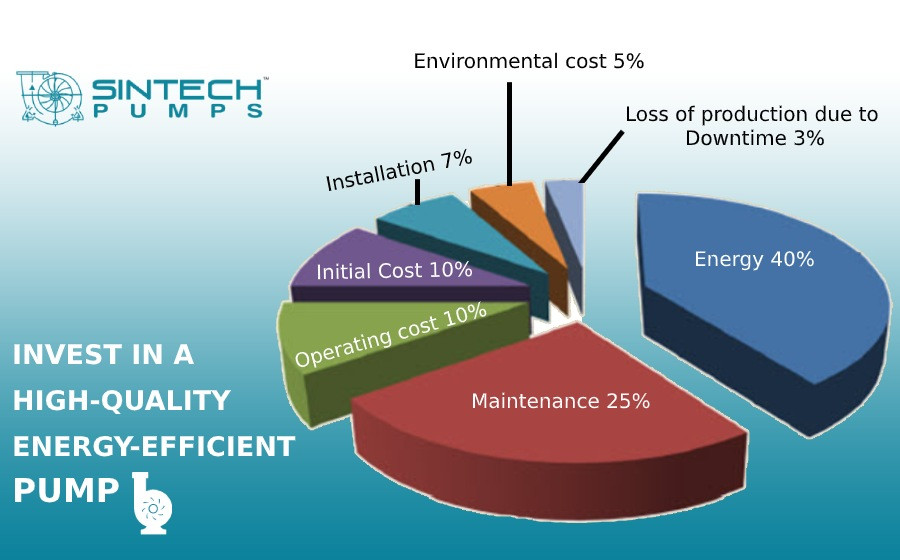
At Sintech, we have always believed that it’s worth to pay more initially to purchase a high-quality pump than to save a few bucks on a cheap pump and suffer the consequences later on. A high-efficiency pump may cost more initially. However, the overall lifecycle cost of a high-quality pump is way lesser than that of a cheap pump.Focussing on the initial cost of the pump alone makes you miss the bigger picture. Take a look at the various components of the lifecycle cost of an industrial pump. As you can see from the chart, the significant expenses incurred by a pump during its lifetime are energy expenses and maintenance costs with account for 40% and 25% appropriately. Investing in an energy-efficient pump will help you reduce your overall pump expenditures significantly. Similarly, a high-quality pump runs for years to come without requiring extensive maintenance and frequent repairs. This reduces the overall maintenance cost as well.Let’s explain our hypothesis with an example. Let’s compare two pumps A and B. Pump A is of high-quality and comes with an initial purchase and installation cost of Rs. 1 lakh. Pump B, on the other hand, comes with a cheaper price tag of Rs. 50,000.But, Pump A is energy-efficient. The annual electricity charges for it are around Rs. 50,000, and the maintenance bill is just Rs. 10,000 annually. Pump B, on the other hand, is not energy-efficient and runs up an electricity bill worth Rs. 80,000 annually. Additionally, Pump B requires frequent repairs, and the annual maintenance bill comes to Rs. 30,000.
Now, let’s compare the overall costs of both these pumps:
Investing in an energy-efficient pump will help you reduce your overall pump expenditures significantly. Similarly, a high-quality pump runs for years to come without requiring extensive maintenance and frequent repairs. This reduces the overall maintenance cost as well.Let’s explain our hypothesis with an example. Let’s compare two pumps A and B. Pump A is of high-quality and comes with an initial purchase and installation cost of Rs. 1 lakh. Pump B, on the other hand, comes with a cheaper price tag of Rs. 50,000.But, Pump A is energy-efficient. The annual electricity charges for it are around Rs. 50,000, and the maintenance bill is just Rs. 10,000 annually. Pump B, on the other hand, is not energy-efficient and runs up an electricity bill worth Rs. 80,000 annually. Additionally, Pump B requires frequent repairs, and the annual maintenance bill comes to Rs. 30,000.
Now, let’s compare the overall costs of both these pumps:
| Pump Expenditure | Pump A | Pump B |
|---|---|---|
| Initial Purchase | Rs. 1,00,000 | Rs. 50,000 |
| Year 1 – Operational Costs | Rs. 60,000 | Rs. 1,10,000 |
| Year 2 – Operational Costs | Rs. 65,000 | Rs. 1,20,000 |
| Year 3 – Operational Costs | Rs. 70,000 | Rs. 1,30,000 |
| Overall Expenditure | Rs. 2,95,000 | Rs. 4,10,000 |